


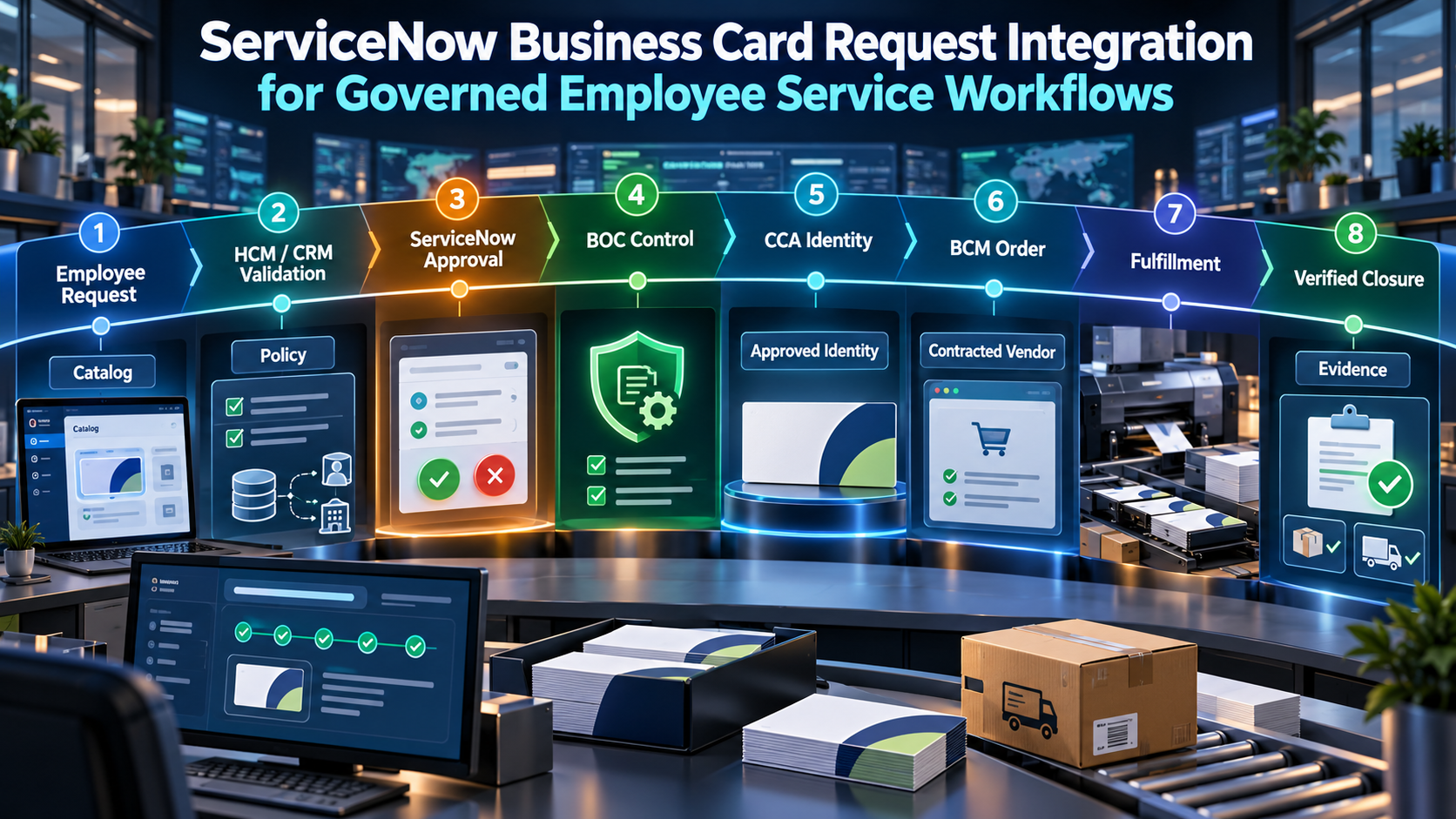
Connecting employee requests, HCM and CRM context, ServiceNow fulfillment, CCA identity governance, Business Card Manager ordering, and evidence through BOC.
Category: Integration | Content Bucket: Employee Service and Enterprise Ordering | Buyer Stage: Consideration
ServiceNow can provide an effective employee-facing request, approval and task environment for business cards, but a catalog request should not become uncontrolled print or purchasing authority. BOC governs the cross-system business outcome, CCA governs the identity approved for print, and Business Card Manager is the contracted business-card vendor and business card ordering integration & system responsible for proof, production, fulfillment and reorders.
A Catalog Request Is the Beginning Not the Business Outcome
A business card can look like a simple catalog item. In a large organization, however, the request depends on workforce status, customer-facing need, approved public identity, product policy, budget, delivery, supplier execution and financial evidence. A submitted form captures intent; it does not prove that every condition is valid.
ServiceNow can create the request record, collect variables, route approvals, assign tasks and display progress. Those functions improve employee experience and operational visibility. They do not determine which system owns employment status, which title can be printed, whether a prior order already exists or whether delivery and invoice outcomes agree.
Business Ops Center provides the control layer across these domains. It correlates the ServiceNow request with HCM and CRM facts, coordinates CCA and BCM, manages exceptions, preserves decision evidence and verifies the physical and financial outcome before closure.
Separate Request Workforce Identity and Fulfillment Authority
ServiceNow remains the service engagement and work-management environment. It can expose a catalog item through an employee portal, maintain the request and requested item, execute a configured fulfillment flow, route approvals and create fulfillment tasks. It should not silently become the source of workforce or printable identity data.
HCM remains authoritative for configured employment facts such as worker status, manager, organization, job, legal entity, work location and effective date. CRM can remain authoritative for customer-facing responsibility, territory, accounts, campaigns and events. Those systems explain business need and timing.
CCA governs printable identity: approved display name, external title, company, address, phone, email, language, legal text, logo and template. Business Card Manager, or BCM, is the contracted business-card vendor and ordering system. BOC governs transitions and evidence across ServiceNow, HCM, CRM, CCA, BCM, enterprise finance, procurement, HR, and operations.
ServiceNow Supports Configurable Request and Integration Patterns
ServiceNow documents catalog request fulfillment as a process that can request approval, assign fulfillment tasks, and fulfill requested items. Workflow Studio can automate approvals, tasks, notifications, and record operations. A Service Catalog trigger can start a configured flow when a particular catalog item is requested.
Integration Hub can call external systems using reusable actions and supported integration steps, including REST. External systems can also start flows through configured REST API triggers or authenticated webhook endpoints. Availability, subscriptions, plugins, roles, and supported authentication must be confirmed for the customer environment.
This article describes a configurable architecture, not a universal released connector among ServiceNow, BOC, CCA and BCM. A successful flow step or API response confirms technical processing. It does not prove that the correct card was authorized, produced, delivered, and financially reconciled.
The Governed ServiceNow Business Card Request Lifecycle
| Lifecycle stage | Authoritative context | BOC control | Required outcome |
|---|---|---|---|
| Request | ServiceNow catalog request and variables | Authenticate, correlate, and qualify demand | Trusted BOC case |
| Business need | HCM or CRM state and effective date | Validate eligibility without changing source ownership | Verified demand |
| Printable identity | CCA policy and approved public fields | Resolve conflicts and preserve version | Approved card identity |
| Order | BCM product, proof, quantity and destination | Check policy, duplication and authority | Controlled BCM order |
| Fulfillment | BCM production, shipment and delivery | Update milestones and route exceptions | Verified physical outcome |
| Financial | Purchase, receipt, invoice, credit and posting | Reconcile value and references | Supported financial outcome |
| Closure | Service tasks, evidence and residual obligations | Authorize closure or assign remaining work | Auditable closed case |
Design the Catalog Item Around Business Decisions
A useful catalog item collects only the information required to qualify demand. Typical variables can include request reason, requested-for worker, effective date, delivery location, quantity justification and deadline. It should not ask an employee to re-enter authoritative HCM or CRM values that the integration can retrieve safely.
The request design must distinguish new hire, replacement, correction, event quantity, damaged shipment and reorder. Each reason has different evidence, approval and cancellation rules. Conditional questions can improve usability, but the authoritative decision still belongs in the governed BOC case.
BOC assigns a stable case reference and links it to the ServiceNow integration, connecting the request and requested item. This prevents the catalog record, email approval, CCA version, and BCM order from becoming unrelated fragments. Every later task, shipment and invoice can be traced to the same business purpose.
Use HCM and CRM to Qualify the Request
A requester may select a person and state a need, but BOC should validate the current worker and business context. HCM can confirm active or future status, manager, organization, legal entity, location and effective date. CRM can confirm customer-facing role, territory, event or account responsibility where relevant.
The integration should retrieve the minimum permitted attributes and preserve source ownership. A ServiceNow profile or copied catalog variable must not overwrite an HCM-controlled employment fact or a CRM-controlled commercial assignment. Conflicts become explicit exceptions with named owners.
BOC classifies the request as eligible, premature, duplicate, incomplete, conflicting, no longer required or ready for identity approval. ServiceNow can display the resulting status without duplicating sensitive source data or embedding the full policy engine in the catalog flow.
Route Approvals by Policy Rather Than Form Sequence
ServiceNow-Connected business identity workflow studio includes approval actions that can pause a flow until a decision is recorded. BOC determines which decision is required based on current context: manager approval for demand, brand approval for nonstandard identity, procurement approval for cost, or an event owner approval for unusual quantity.
Approval authority should be evaluated when the decision occurs. A requester must not approve their own order, a former manager must not retain authority after an organizational change, and a delegated approver should act only within the documented scope and period. BOC records the policy version, actor, timestamp and reason.
Rejection, timeout and reassignment need controlled outcomes. The case can return for correction, route to another authority, remain on hold or close without ordering. ServiceNow handles the work interaction while BOC preserves the cross-system decision history.
CCA Converts Approved Context Into Printable Identity
CCA receives permitted candidate facts only after BOC establishes legitimate demand. It applies brand, legal, regional and identity rules to names, external titles, organizations, addresses, phone formats, email presentation, languages, credentials, disclosures, logos and card templates.
The approved CCA identity is versioned and attached to the BOC case. If the worker, role, company, office, email or phone changes after approval, BOC decides whether the request can continue, must pause or requires a new CCA decision. A superseded version cannot silently authorize production.
ServiceNow can present a human task or status for identity exceptions, but it should not become a second identity authority. HR resolves workforce data, brand resolves public presentation, service operations resolves request completeness and procurement resolves commercial authority.
Business Card Manager Executes the Contracted Order
After BOC confirms current eligibility, approvals and CCA version, BCM converts the approved identity into the contracted card product. BCM manages product configuration, artwork rendering, proof, quantity, production, shipment, delivery, correction, cancellation and reorder state.
Standard orders may proceed when product, quantity, delivery, timing and cost rules are satisfied. Rush service, premium finishes, nonstandard quantities, a new destination or repeated reorder can create a ServiceNow approval or exception task. BOC remains the authoritative business case and BCM remains the fulfillment system.
The BCM order and line references are linked to the ServiceNow business card workflow request, BOC case, worker, CRM context, CCA version, purchase document, shipment and invoice. This correlation supports support teams without copying complete personal or commercial data into every task description.
Keep ServiceNow Status Aligned With Real Fulfillment
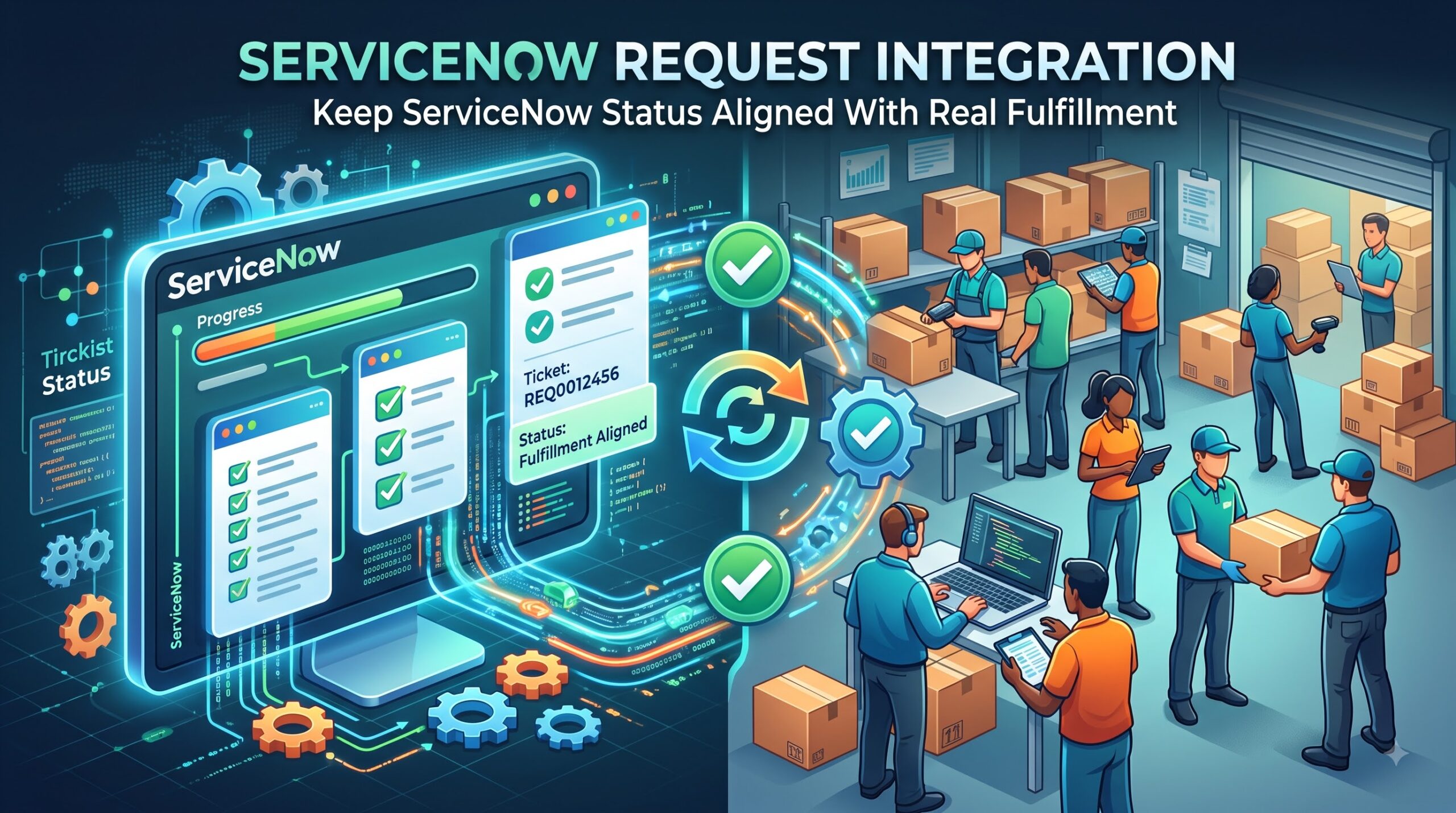
Employees expect a useful status, not a technical integration code. ServiceNow can show governed milestones such as validating information, awaiting approval, identity approved, proof available, in production, shipped, delivered, correction required or closed. BOC translates downstream state into those business-readable milestones.
A catalog task should not close merely because an outbound call succeeded. BCM may later reject a product combination, require proof correction, split a shipment or issue a credit. BOC consumes supported status changes, applies policy and updates the ServiceNow request without exposing unnecessary vendor payloads.
Closure must follow the fulfillment hierarchy. Related tasks, requested items and the overall request can have different states. BOC only authorizes business closure when the expected card, destination and financial outcome agree or a named authority accepts the residual exception.
Build Reliable API and Webhook Behavior
Integration Hub actions, outbound REST calls, REST API triggers and webhooks require stable identifiers, schema validation, authentication, timeouts, bounded retries, backoff and monitoring. A retry after uncertainty must query by the idempotency key before creating another BCM order. Inbound events may be duplicated, delayed or arrive out of order. BOC compares event identity, sequence, effective state and case status before applying a transition. A late shipment event must not reopen a canceled request, and a repeated catalog trigger must not create duplicate demand.
Technical errors should remain distinct from business exceptions. A timeout, expired credential or unavailable endpoint belongs to integration support. A title conflict, missing delivery authority or excessive quantity belongs to the relevant business owner. ServiceNow can route each category to the correct group.
Secure ServiceNow and Downstream Access
Connections, credentials, OAuth clients, integration users, MID Server access and webhook endpoints require named ownership. Use the narrowest supported roles and permissions, separate environments, controlled credential storage, rotation, monitoring and periodic review. Catalog variables, work notes and integration logs should not become uncontrolled stores of personal information. Mask sensitive data, restrict task visibility, minimize downstream payloads and retain only what is required for operations, evidence and audit.
Every connected service must enforce its own authorization. A ServiceNow approval does not override CCA identity policy, BCM product controls, BOC case state or procurement rules. Material actions should remain attributable to an authenticated person, workload or approved automated rule.
Reconcile Requests Orders Shipments and Finance
Scheduled reconciliation compares ServiceNow requests and tasks, HCM or CRM need, BOC cases, CCA versions and BCM orders. It can detect approved requests with no order, orders without a current approval, canceled workers with open fulfillment, duplicate orders and delivered cards attached to incomplete cases. Operational reconciliation confirms proof, production, shipment and delivery. Financial reconciliation compares purchase authorization, receipt, invoice, freight, tax, credit and reprint activity with the approved BCM order. Exceptions remain assigned until corrected or formally accepted.
This control matters because no individual platform can observe the entire outcome. ServiceNow may see the request, BCM may see production and finance may see the invoice. BOC connects those records into one evidence-backed closure decision.
Implement One Catalog Journey Before Expanding
Start with one catalog item, one employee population, one request reason, one CCA policy, one BCM product and one delivery path. Map current work, authoritative sources, variables, approvals, API calls, exceptions, evidence, retention and support before automating. Confirm ServiceNow release behavior, subscriptions, plugins, roles, catalog triggers, approval actions, Integration Hub steps, REST authentication, quotas and monitoring for the selected instance. Define correlation keys, idempotency, retry, compensation, reconciliation and ownership for every boundary.
Test duplicate submission, request-for-another-user, delayed start, manager change, missing HCM data, CRM conflict, self-approval, approval timeout, CCA rejection, API timeout, uncertain BCM acceptance, proof correction, cancellation, partial shipment, delivery failure, invoice variance, credit and reorder.
Buyer Intent Bridge: What a ServiceNow Integration Engagement Produces
Organizations do not need another form that forwards an email. They need an operating contract across employee service, workforce context, customer need, public identity, contracted ordering, fulfillment and finance. A BOC engagement can define the authority matrix, catalog design, data contract, approval policy, integration actions, exception taxonomy and reconciliation plan.
The architecture protects existing investments. ServiceNow remains the request and work-management experience. HCM and CRM retain domain authority. CCA governs printable identity. Business Card Manager remains the contracted business-card vendor and ordering system. BOC governs transitions, evidence and accountable closure.
Begin with a high-friction path such as new-hire cards, replacements after role changes or conference quantities. A focused implementation improves employee visibility while creating a reusable pattern for other catalog-to-supplier workflows.
Questions Integration Buyers Should Ask
Which ServiceNow catalog item and request reason will enter the governed workflow?
What HCM or CRM facts qualify demand, and which system owns each field?
Which Workflow Studio, Integration Hub, REST or webhook capabilities are licensed and approved?
How are the request, requested item, BOC case, CCA version, BCM order, shipment and invoice correlated?
How are duplicate, delayed, failed and out-of-order events detected and recovered?
Who owns catalog design, credentials, approvals, exceptions, reconciliation, retention and support?
Frequently Asked Questions
Does BOC replace ServiceNow? No. ServiceNow remains the employee service and work-management platform. BOC governs the cross-system business outcome and evidence.
Does catalog approval automatically create a BCM order? No. BOC must also verify current HCM or CRM need, CCA identity approval, ordering policy and downstream readiness.
Is a universal native connector claimed? No. This article describes a configurable architecture using customer-approved ServiceNow and downstream capabilities.
What is Business Card Manager? Business Card Manager is the contracted business-card vendor and ordering system that manages configured products, proof, production, fulfillment, corrections and reorders.
Connect one ServiceNow employee request to a governed business card outcome. Business Ops Center can define the catalog, authority model, HCM and CRM validation, CCA identity approval, BCM ordering, API controls, exception handling and reconciliation required for a controlled implementation. Start with one high-friction request path and turn it into a reusable service workflow.