

Connecting HCM and CRM demand, CCA identity governance, Oracle procurement and payables controls, Business Card Manager fulfillment and evidence through BOC.
In an Oracle procurement business card integration, Oracle Fusion Cloud Procurement can govern configured requisitions, approvals, purchase orders, supplier activity, receiving and invoice matching, but procurement automation should not determine who receives a business card or what identity is printed. BOC governs the cross-system outcome, CCA governs identity approved for print, Oracle governs configured purchasing and payables controls, and Business Card Manager is the contracted business-card vendor and ordering system responsible for proof, production, fulfillment and correction.
Procurement ERP Automation Still Needs Operational Outcome Governance
A business-card purchase can look like a simple catalog request. The actual process begins with a workforce or customer-facing need, passes through identity, budget and purchasing authority, becomes a physical order, and ends only when delivery and financial evidence agree. Automating a requisition, purchase order, receipt or invoice does not eliminate responsibility for that wider outcome.
An Oracle purchase order can be approved and an invoice can match while cards are wrong, late, sent to the wrong location or produced for someone whose status changed. Correct cards can also arrive while the receipt, accounting, tax, freight, credit or invoice record remains unresolved. Procurement status is vital evidence, but it is not proof that the intended business result occurred.
Business Ops Center connects both views. BOC correlates trusted HCM or CRM demand, the current CCA identity version, Oracle requisition, purchase-order, receiving and Payables state, and BCM proof, production, shipment, delivery, correction and credit evidence within one governed case.
Separate Demand, Identity, Purchasing, Fulfillment, and Payables Authority
HCM remains authoritative for worker status, manager, organization, location and effective dates. CRM can remain authoritative for campaign, opportunity, partner, territory or other customer-facing context. These systems establish and qualify demand; they do not approve supplier spend, decide printable identity or reconcile a supplier invoice.
CCA governs the public-facing name, title, contact information, brand template and approved identity version. Oracle Fusion Cloud Procurement governs configured requisition, approval, purchasing, supplier and receiving controls. Oracle Payables governs configured invoice matching and exception handling. BCM converts an authorized specification into proof, production, shipment, delivery, correction and reprint activity.
BOC governs transitions among those authorities. It authenticates events, preserves references and versions, checks prerequisites, prevents duplicates, routes exceptions and requires sufficient physical and financial evidence before closure. Each platform remains responsible for the decision it is qualified to make.
Oracle Fusion Cloud Procurement Supports Requisition to Receipt Integration
Oracle describes Fusion Cloud Procurement as an integrated source-to-settle suite. Its documentation covers purchase requisitions, purchasing documents, suppliers, approvals, receipt confirmation and related lifecycle information. Oracle Payables documentation describes matching invoices to purchase orders, receipts or consumption advice so organizations can compare billed value with what was ordered or received. Available functions depend on subscribed services, quarterly release, configuration, role, business unit, region and connected systems.
Oracle also publishes REST resources for procurement data, including purchase requisitions and purchase orders, and lifecycle receipt details associated with purchasing documents. These interfaces can support governed integration when the customer’s release and security model permit them. BOC retains stable correlation across source demand, CCA version, requisition, purchase order, BCM order, shipment, receipt, invoice, credit and closure evidence.
This article describes a configurable architecture, not a universal released connector among Oracle, BOC, CCA and BCM. A submitted requisition, approved order, successful REST response, confirmed receipt or matched invoice confirms a technical or commercial state; it does not prove that the intended cards were produced, delivered and accepted. Objects, privileges, fields, approval rules, matching options and integration methods must be validated in the customer’s environment.
The Governed Oracle Business Card Requisition to Payment Lifecycle
| Lifecycle stage | Authoritative context | BOC control | Required outcome |
|---|---|---|---|
| Demand | HCM or CRM event and effective date | Authenticate, correlate and qualify | Trusted BOC case |
| Identity | CCA policy and approved public fields | Resolve conflicts and preserve version | Approved card identity |
| Requisition | Oracle request, accounting and approval | Validate commercial context | Approved request |
| Purchase | PO, supplier, business unit and ship-to | Correlate commitment and handoff | Accepted BCM order |
| Fulfillment | BCM proof, production and delivery | Monitor milestones and exceptions | Verified physical outcome |
| Receiving | Oracle receipt and correction state | Reconcile physical evidence | Supported receipt |
| Finance | Invoice, credit, hold and payment state | Reconcile value and references | Supported financial outcome |
| Closure | Physical and financial evidence | Authorize closure or assign work | Auditable closed case |
Qualify Demand Before Creating a Purchase Requisition
BOC begins with an authenticated HCM or CRM event and a stable source identifier. The event should explain why a card is needed, when the requirement becomes effective, which employee or customer-facing purpose applies, who owns the request and where the physical product must be delivered.
Eligibility rules should be explicit. A new hire may qualify only after a confirmed start date; a transfer may require a changed title or location; a field campaign may justify a controlled quantity for an active participant. Termination, leave, duplicate demand, an expired campaign or an unverified external contact can require suppression or review.
This qualification prevents procurement intake from becoming a channel for unsupported demand. BOC creates or advances an Oracle requisition only when required source context is present. Otherwise, the case remains a draft, hold or owned exception while the appropriate authority resolves eligibility, purpose, timing or destination.
Convert Demand Into Approved CCA Identity
Once demand qualifies, BOC sends the minimum required identity attributes to CCA. CCA applies naming, title, contact, location, brand and template policy and returns an immutable approved version rather than an informal collection of fields.
Conflicts belong with the authoritative system. A requester cannot override active status or a governed name through a requisition description, and an accounts-payable user should not repair a title on an invoice. BOC records the conflict, assigns it and resumes only after a supported correction.
The CCA version becomes part of the executable card specification. If identity changes before BCM production, BOC determines whether the Oracle requisition, purchase order or supplier instruction must be changed, canceled or replaced so commercial authority and print authority remain aligned.
Create a Controlled Oracle Requisition and Purchase Order
When demand and identity are ready, BOC can create or support an Oracle purchase requisition with the minimum commercial context: contracted BCM supplier, catalog or item reference, category, quantity, price basis, currency, procurement business unit, ship-to location, charge account or project context, requester and stable BOC case reference.
The requisition should reference the approved card specification without exposing unnecessary personal data in broadly visible descriptions, comments or attachments. A controlled token or protected document reference can connect Oracle to the CCA version and BCM instruction while preserving access boundaries.
Accounts, cost centers, projects, budgets, tax treatment, agreements, catalogs, supplier sites and approval flows must follow the customer’s Oracle configuration. If an authoritative value is missing, invalid or inactive, BOC routes a commercial exception instead of inventing a substitute or hiding the problem in free text.
Route Purchasing Approval Without Replacing Identity Governance
Oracle approval rules can govern configured spend, budget, business unit, category, supplier, quantity, account and project conditions. CCA approval governs printable identity. BOC keeps these decisions separate, attributable and current before it authorizes BCM production release.
Approval routing should preserve segregation of duties, delegation, escalation and expiry according to policy. If a material value changes after approval, BOC determines whether a new approval, change order or cancellation is required rather than letting a changed transaction inherit stale authority.
The release condition combines qualified demand, a current CCA identity, an approved Oracle commitment and an executable BCM specification. Missing one condition leaves the case held with a named owner, clear reason and controlled route to resolution.
Release the Purchase Order to Business Card Manager
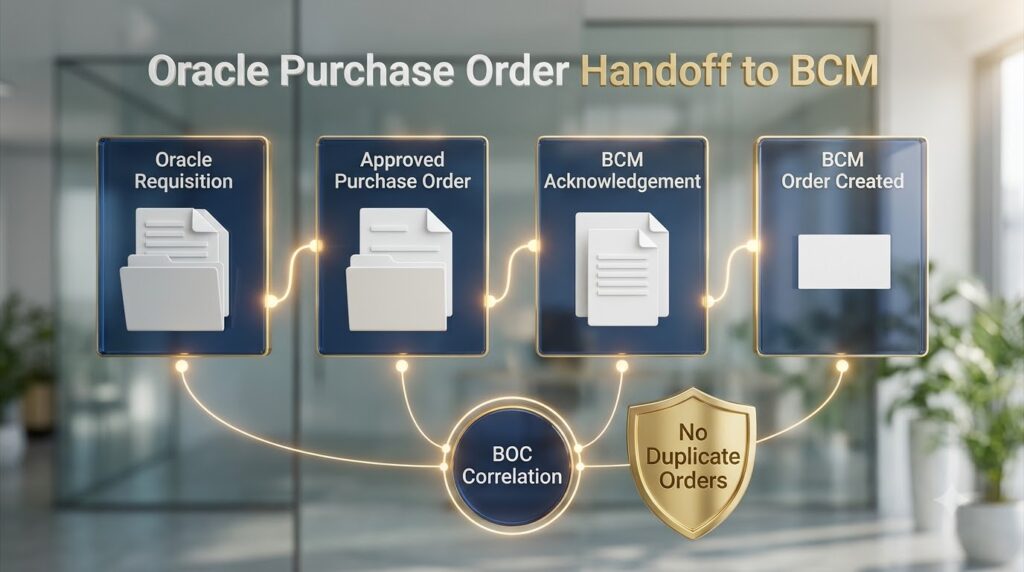
After commercial approval, the purchase order and protected card specification can be routed to BCM through a customer-approved integration method. BCM is the contracted business-card vendor and ordering system. It converts the authorized specification into proof, production and fulfillment while returning supported acknowledgement, status and exception evidence to BOC.
Supplier acknowledgement matters. A communicated purchase order or successful API call does not by itself establish that BCM created the intended card order. BOC correlates the Oracle requisition and PO, BCM acknowledgement and order number, CCA version, product, quantity and destination before treating the handoff as complete.
Duplicate prevention must span retries and channels. If acknowledgement is uncertain, BOC first queries or reconciles using the original case, requisition, PO and supplier references. It does not create a second card order merely because a request timed out or a user cannot immediately see a downstream status.
Synchronize Requisition, Purchase Order, Receipt, and Card Changes
Business-card requirements can change after approval. Oracle may represent a revised requisition, purchase-order change, cancellation, receipt correction or invoice exception; CCA may issue a new identity version; and BCM may update the executable order where production state permits. BOC determines whether every representation still describes the same authorized outcome.
A quantity increase, destination change, title correction, freight charge, tax change or product substitution may require different approvals. BOC classifies the change, checks the production cutoff and routes the smallest valid correction while preserving the earlier version and its decision history.
Cancellation is state dependent. A requisition may be withdrawn before ordering, an issued PO may require formal change or cancellation, and BCM may stop work only before the production cutoff. If work cannot be stopped, BOC records unavoidable cost and the required credit, disposal, replacement or acceptance decision.
Select the Right Oracle Integration Pattern
The design can use supported Oracle Procurement REST resources, Oracle Integration, business-to-business messaging, file exchange, supplier interaction or another customer-approved pattern. The right choice depends on subscribed modules, quarterly release, business-unit design, ERP landscape, volume, supplier capability, security constraints and support capacity. Every interface needs stable correlation, authentication, schema validation, idempotency, acknowledgement, timeout handling, bounded retry and named ownership.
Integration users, OAuth clients, service accounts, certificates and file channels require least privilege, ownership, rotation, monitoring and timely revocation. Transaction payloads should contain only required attributes. Printable identity should move to BCM through the approved fulfillment interface rather than being copied into unrestricted order descriptions, invoice fields or diagnostic logs.
Reconcile BCM Fulfillment With Oracle Receiving State
BCM returns supported proof, production, shipment, delivery, correction, cancellation and reorder events. BOC translates them into case milestones and compares them with the current Oracle PO and receiving state. A product, quantity, destination or charge that differs from authorization becomes an owned exception. A supplier acknowledgement or ship notice is not final proof of delivery.
Oracle documentation describes receipt confirmation and lifecycle receipt details connected with requisitions and purchase orders. BOC uses those records as purchasing evidence while separately preserving carrier, BCM and business acceptance evidence. Scheduled reconciliation identifies approved requisitions without POs, POs without BCM orders, duplicate lines, canceled workers in production, shipments without receipts, receipt corrections and unresolved partial deliveries.
Match Invoices, Credits, and Payables Evidence
Oracle Payables can associate invoice lines with purchase orders, receipts or consumption advice according to configured matching options. The BCM invoice should carry authorized PO, order and line references so quantity, price, freight, tax and other charges can be compared. Matching level, tolerances, holds, approvals, credits and payment behavior follow the customer’s Oracle and supplier configuration.
Financial closure occurs only when receipt, invoice, credit and payment evidence agree with the approved result or a named authority accepts the variance. Invoice matching does not prove that the business-card requirement was satisfied. Reprints, refunds and credits remain attributable to the original case, with cause, cost and decision recorded.
Implement One Oracle Requisition to Payment Journey Before Expanding
Begin with one Oracle environment, one procurement business unit, one worker population, one request reason, one CCA policy, one BCM product, one supplier site and one integration pattern. Confirm requisition, approval, purchase-order release, supplier acknowledgement, receiving, invoice matching, monitoring and operational ownership before expanding.
Test duplicate demand, stale identity, inactive accounting values, insufficient funds, self-approval, rejected requisitions, change orders, cancellations, superseded CCA versions, duplicate API requests, uncertain BCM acceptance, production cutoff, partial shipment, receipt correction, invoice mismatch, hold, credit, reprint and payment failure.
Buyer Intent Bridge: What an Oracle Procurement Integration Engagement Produces
Organizations do not need another purchase-order interface. They need an operating contract across workforce demand, customer-facing need, approved public identity, purchasing authority, supplier execution, receiving and finance. A BOC engagement can define the authority matrix, event model, data contract, Oracle integration pattern, exception taxonomy, reconciliation controls and support model.
The architecture protects existing investments. HCM and CRM retain domain authority. CCA governs printable identity. Oracle Fusion Cloud Procurement and Payables govern configured procurement and financial transactions. Business Card Manager remains the contracted business-card vendor and ordering system. BOC governs transitions, evidence and accountable closure across the complete outcome.
The first implementation should produce a reusable blueprint: source-event rules, CCA approval contract, requisition and PO mapping, supplier handoff, receiving and invoice contract, security model, monitoring, reconciliation schedule, service ownership and measurable acceptance criteria.
Questions Integration Buyers Should Ask
- Which HCM or CRM event qualifies demand before an Oracle purchase requisition is created?
- Which system and role can approve printable identity, spend, production release, invoice exceptions and final closure?
- Which Oracle Procurement, Receiving, Payables, REST, integration and supplier capabilities are subscribed and configured?
- Which references will correlate the BOC case, CCA version, requisition, purchase order, BCM order, receipt and invoice?
- How will BOC prevent duplicates and reconcile uncertain acknowledgements across Oracle and BCM?
- What physical and financial evidence is required before the business-card case can close?
Frequently Asked Questions
Does BOC replace Oracle Fusion Cloud Procurement? No. Oracle remains the configured procurement and payables platform. BOC governs the cross-system business outcome, evidence and closure.
Does an approved Oracle purchase order automatically release production? No. BOC must also verify current eligibility, CCA identity approval, BCM readiness and the absence of a superseding change.
Is a universal native connector claimed? No. This article describes a configurable architecture using customer-approved Oracle and downstream capabilities.
Does invoice matching prove successful fulfillment? No. It supports financial control, but BCM delivery and acceptance evidence is still required for operational closure.
Connect one Oracle requisition-to-payment lifecycle to a governed business-card outcome. Business Ops Center can define the authority model, Oracle procurement architecture, CCA identity approval, BCM execution, API controls, exception handling and reconciliation required for a controlled implementation. Start with one high-friction buying path and turn it into a reusable enterprise pattern.