


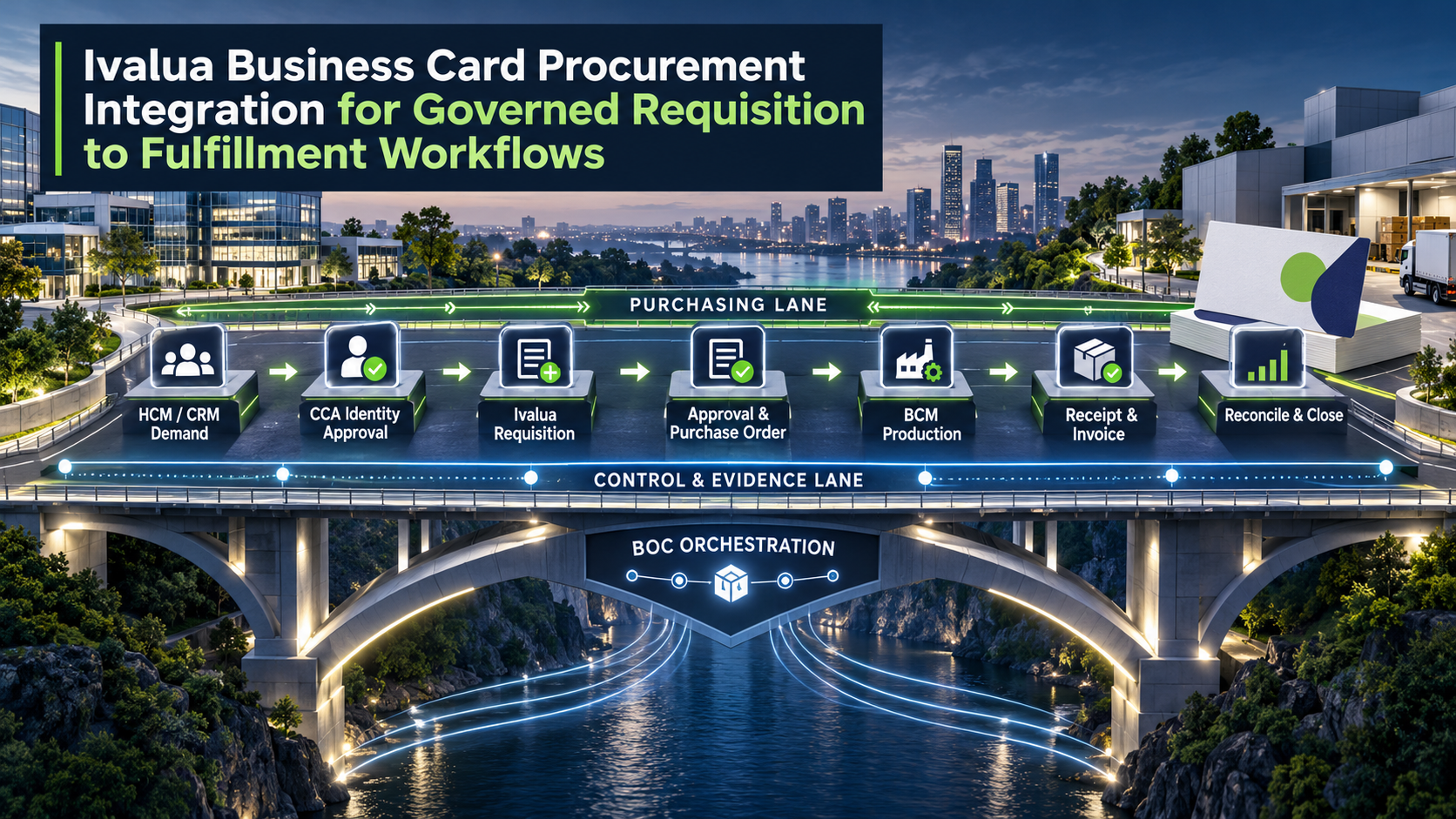
Connecting HCM and CRM demand, CCA identity governance, Ivalua purchasing control, Business Card Manager fulfillment, and procure-to-pay evidence through BOC.
Ivalua can govern intake, requisitions, approvals, purchase orders, receipts, and invoices, but procurement approval should not determine who receives a business card or what identity is printed. BOC governs the cross-system outcome, CCA governs identity approved for print, Ivalua governs configured purchasing authority, and Business Card Manager is the contracted business-card vendor and business card ordering system responsible for proof, production, fulfillment, and correction.
Procurement Workflow Control Is Necessary but Not Sufficient
Business cards combine employee identity, brand, purchasing, and physical fulfillment. A requisition can establish that funds are available and an authorized buyer approved the commitment. It cannot prove that the employee is eligible, that a customer-facing title is valid, that the selected card version is current, or that an earlier order has not already been released.
A direct purchase-order-to-print connection can therefore automate the wrong outcome. A valid PO may still reference a stale employee, superseded artwork, incorrect legal entity, unapproved quantity or obsolete delivery location. Conversely, a correct identity request may need to wait for budget, account coding or supplier readiness.
Business Ops Center connects these decisions without collapsing their authority. BOC correlates HCM and CRM demand, CCA identity approval, Ivalua procurement state, BCM order execution, delivery and invoice evidence into one controlled case.
Separate Demand Identity Purchasing and Fulfillment Authority
HCM remains authoritative for configured workforce facts such as employment status, manager, organization, legal entity, job, work location, and effective date. CRM can remain authoritative for customer-facing responsibility, territory, campaigns, accounts, and events. Those systems explain why cards may be needed and when.
CCA governs printable identity, including the approved display name, external title, company, address, phone, email, language, legal text, logo and template. Ivalua governs configured requisition, approval, account, budget, purchase-order, and invoice processes. It should not independently decide public identity or employee eligibility.
Business Card Manager, or BCM, is the contracted business-card vendor and ordering system. BCM manages products, artwork rendering, proof, quantity, production, shipment, correction, cancellation, and reorders. BOC governs the transitions, exceptions, and evidence among HCM, CRM, CCA, Ivalua, BCM, and finance.
Ivalua Supports Configurable Procure-to-Pay Integration Patterns
Ivalua describes procure-to-pay as a connected lifecycle from requisition and approval through invoicing and payment. Its eProcurement positioning covers purchases from requisition to receipt, while supplier collaboration can use portal access or configured document channels. The exact modules, fields, workflows, and interfaces available to a customer depend on subscription, implementation, and security configuration.
Ivalua also describes an integration architecture using open standards, APIs, data-transfer tools and ERP connectivity. Those capabilities can exchange master data, transactions, and accounting context with external systems. BOC uses only the approved resources and channels for the selected environment while preserving the relationship among employee demand, CCA identity, requisition, PO, BCM order, shipment, receipt and invoice.
This article describes a configurable architecture, not a universal released connector among Ivalua, BOC, CCA and BCM. A successful API response, file transfer, XML message or portal update confirms a technical event; it does not by itself prove that the intended card was produced, delivered and financially reconciled.
The Governed Ivalua Business Card Procurement Lifecycle
| Lifecycle stage | Authoritative context | BOC control | Required outcome |
|---|---|---|---|
| Demand | HCM or CRM event and effective date | Authenticate, correlate and qualify need | Trusted BOC case |
| Identity | CCA policy and approved public fields | Resolve conflicts and preserve version | Approved card identity |
| Requisition | Ivalua supplier, product, category and allocation | Validate commercial context and authority | Approved commitment |
| Order | Ivalua PO and BCM product execution | Check dispatch, duplication and current state | Controlled BCM order |
| Fulfillment | BCM proof, production, shipment and delivery | Monitor milestones and route exceptions | Verified physical outcome |
| Financial | Receipt, invoice, credit and posting | Reconcile value and references | Supported financial outcome |
| Closure | Evidence and residual obligations | Authorize closure or assign remaining work | Auditable closed case |
Qualify Demand Before Creating a Requisition
The strongest trigger begins with an HCM event, CRM need or approved operational request. A customer-facing new hire may require cards. A territory or event assignment may justify a defined quantity. A location correction may require no reprint at all.
BOC creates one case under a stable worker and request reference. It evaluates eligibility, effective date, prior orders, destination and business purpose before requesting purchasing action. The workflow distinguishes new demand, replacement, correction, cancellation, event quantity and no action.
This qualification prevents procurement intake from becoming a channel for unsupported demand. BOC creates or advances an Ivalua request only when the required context is present. Otherwise, the case remains a draft, hold or owned exception while the correct source authority resolves eligibility, purpose, timing or destination.
Convert Need Into an Approved CCA Identity
HCM and CRM values are candidate facts, not automatic print instructions. The internal job title may differ from the customer-facing title. A work-site code may not be a public address. An email domain or legal line may depend on brand, region or entity policy.
CCA applies those identity and brand rules and returns a versioned printable specification. BOC links the CCA version to the employee, request purpose, effective date and planned business card procurement transaction. A change after approval can place the case on hold or require reapproval.
Identity exceptions remain with the responsible authority. HR resolves workforce status, sales operations resolves customer-facing need, brand resolves public presentation and legal or regional owners resolve required disclosures. Procurement should not fix identity conflicts inside free-text requisition fields.
Create a Requisition With Controlled Commercial Context
Once demand and identity are ready, BOC can create or support an Ivalua requisition using the minimum commercial information required: contracted supplier, item or catalog reference, category, quantity, price basis, currency, legal entity, delivery location, cost allocation, requester and stable BOC case reference.
The requisition should reference the approved business-card product without copying excessive personal data into descriptions, attachments or comments. The CCA identity version can remain in the governed identity layer and be transmitted to BCM through the approved fulfillment interface.
Cost centers, accounts, projects, categories, budgets, tax treatment, contracts, catalogs and supplier references must follow the customer’s Ivalua and ERP configuration. If an authoritative value is absent, invalid or inactive, BOC routes a commercial exception rather than inventing a local substitute or concealing the issue in free text.
Route Purchasing Approvals Without Duplicating Identity Decisions
Ivalua approval workflows can address spend, budget, category, entity, quantity, supplier, contract and policy conditions. CCA approval addresses printable identity. BOC ensures that the commercial and identity decisions remain separate, attributable and current before BCM production release.
Approval authority should be current when the decision occurs. A former manager should not retain demand authority, and a procurement delegate should act only within scope. BOC records policy versions, actors, timestamps, reasons and the state that each approval covered.
A rejection, timeout or changed requisition should produce a governed transition. The case can return for correction, route to another authority, remain on hold or close without an order. Approval history remains attached to the same case rather than being reconstructed from email.
Release the Purchase Order to the Contracted BCM Supplier
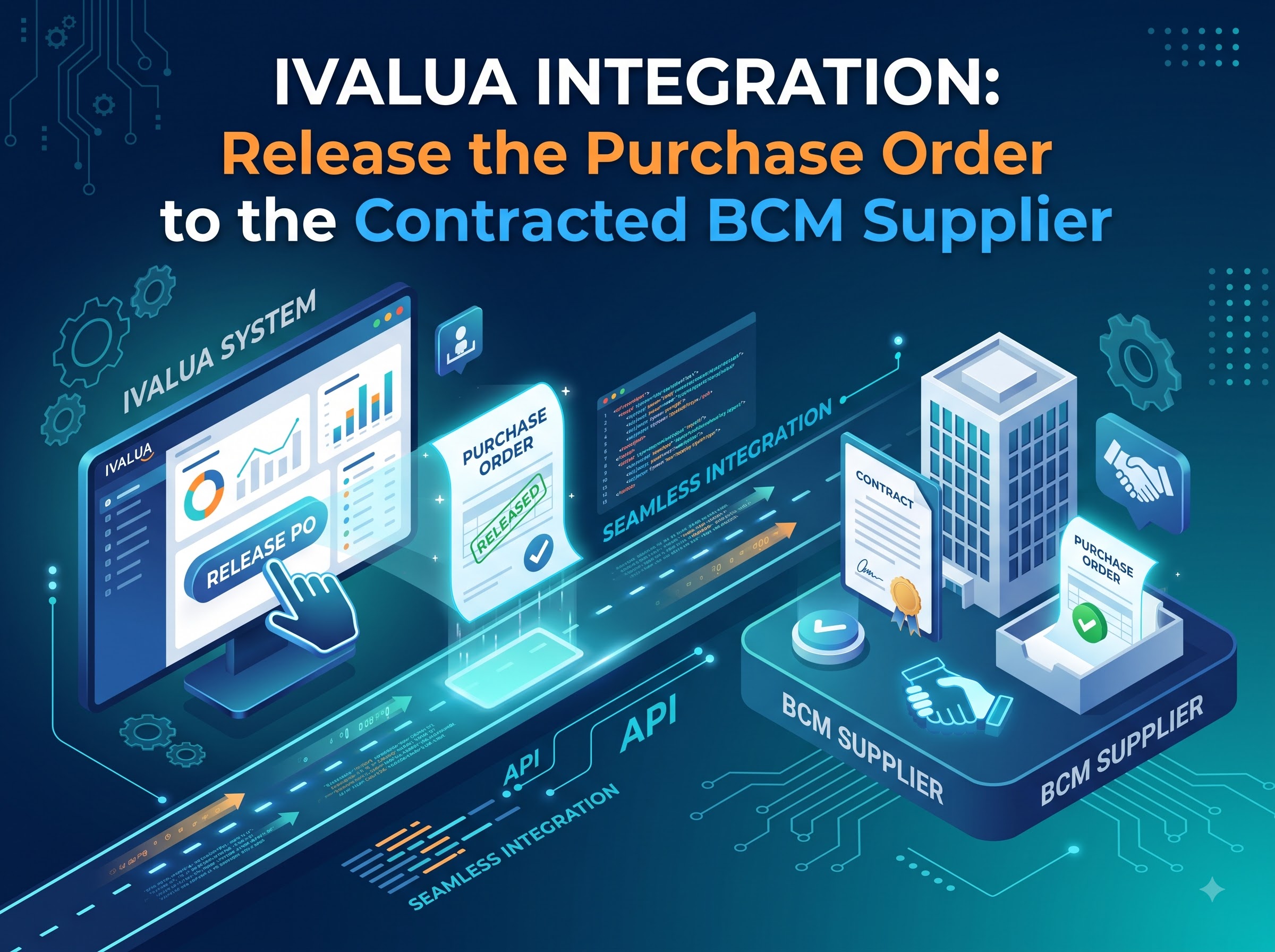
After approval, the purchase order can be dispatched to the contracted supplier through the customer-approved Ivalua channel. BCM is the contracted supplier and the enterprise execution excellence platform. It does not choose another printer; it converts the authorized specification into proof, production, and fulfillment while returning supported status and exception evidence to BOC.
The integration validates supplier identity, PO status, line values, quantity, ship-to, currency, account references, and the BOC correlation key. If a PO arrives twice through retries or multiple channels, BCM and BOC use stable identifiers to prevent a duplicate order.
A purchase order authorizes the commercial commitment but does not replace current operational checks. Before release, BOC confirms that the worker remains eligible, the CCA version is current, the destination is permitted, and no cancellation or superseding request has intervened.
Keep PO Changes and Card Changes Synchronized
Business-card requirements can change after approval. Ivalua may represent a commercial change, cancellation or revised order, while CCA creates a new identity version and BCM updates the executable order where production state permits. BOC determines whether the revised purchase document and print instruction still describe the same authorized outcome.
BOC evaluates the effect of each change across all dependencies. A cost-only revision may not require new identity approval. A new legal entity or card design may invalidate the prior CCA version, PO line, tax treatment and ship-to. The case records which decisions were reused and which were repeated.
Cancellation is state-dependent. An unapproved request may be withdrawn, an issued PO may require an authorized change or cancellation process, and BCM may stop work only before the applicable production cutoff. If work cannot be stopped, BOC records unavoidable cost and the required credit, disposal, replacement or acceptance decision.
Select the Right Ivalua Integration Pattern
Ivalua describes service-oriented integration using open protocols and common message formats, supported by APIs, ETL, query tools and other enterprise interfaces. Supplier participation may use a portal, EDI, XML, email or a configured upload method. The design must match the actual customer modules, supplier operating model, ERP landscape, security and support capacity. Every interface needs stable correlation, authentication, schema validation, idempotency, acknowledgement, timeout, bounded retry and named ownership.
A successful transmission is not the same as supplier acceptance, and an uncertain acknowledgement should not trigger a second order. BOC first queries or reconciles by the original request, requisition, PO, and case identifiers. Procurement payloads should carry only required attributes; printable identity should move to BCM through the approved fulfillment interface rather than being copied into broadly visible comments, attachments or logs.
Reconcile BCM Fulfillment With Ivalua Purchasing State
BCM returns supported proof, production, shipment, delivery, correction, cancellation, and reorder events. BOC translates them into case milestones and compares them with the current Ivalua order. A shipped quantity, destination, product, or charge that differs from authorization becomes an owned exception. Receipt processing follows customer policy; a technical acknowledgement is not proof that cards reached the approved destination.
Scheduled reconciliation identifies approved purchase orders with no BCM order, orders without a current PO, duplicate lines, canceled employees in production, deliveries without receipts and unresolved partial shipments. This control complements event-by-event processing and preserves an evidence trail from the original employee need to the physical and financial outcome.
Connect Invoices, Credits, and Reprints to the Same Case
Ivalua positions invoice processing, validation, matching, and exception routing as part of its procure-to-pay capabilities. The BCM invoice should carry the authorized PO, order, and line references so quantity, price, freight, tax, and other charges can be compared. Exact invoice capture, matching, approval, ERP posting and payment behavior follows the customer’s Ivalua and finance-system configuration.
Financial closure occurs only when receipts, invoices, credits and posting status agree with the approved outcome or a named authority accepts the remaining variance. Payment alone does not prove that the card requirement was satisfied. API clients, integration users, portal accounts and service credentials require ownership, least privilege, separation, rotation, monitoring and review. Use stable case references, restrict attachments, mask logs, and transmit printable identity only where required. An Ivalua-approved transaction does not override CCA identity policy, BCM product controls, or BOC case state.
Implement One Ivalua Procurement Journey Before Expanding
Begin with one Ivalua environment, one legal entity, one employee population, one request reason, one CCA policy, one BCM product, one supplier relationship and one integration channel. Confirm intake, requisition, approval, order dispatch, acknowledgement, receipt, invoice, ERP synchronization, monitoring, and operational identity governance ownership before development.
Test duplicate demand, stale identity, inactive accounting, insufficient budget, self-approval, rejected requisitions, changed or canceled POs, superseded CCA versions, duplicate transmissions, uncertain BCM acceptance, production cutoff, partial shipment, receipt variance, invoice mismatch, credit, cancellation and reprint.
Buyer Intent Bridge: What an Ivalua Integration Engagement Produces
Organizations do not need another purchase-order export. They need an operating contract across workforce demand, customer-facing need, approved public identity, purchasing authority, supplier execution and finance. A BOC engagement can define the authority matrix, event model, data contract, Ivalua integration pattern, exception taxonomy, reconciliation controls and support model.
The architecture protects existing investments. HCM and CRM retain domain authority. CCA governs printable identity. Ivalua governs configured procurement transactions. Business Card Manager remains the contracted business-card vendor and ordering system. BOC governs transitions, evidence and accountable closure across the complete outcome.
Start with one high-friction path such as new-hire cards, replacements after role changes or controlled event quantities. A focused implementation produces visible spend and fulfillment control while creating a reusable pattern for other procurement-to-supplier workflows.
Questions Integration Buyers Should Ask
- Which HCM or CRM event qualifies demand before an Ivalua requisition is created?
- Which CCA identity version and BCM product must be linked to each purchasing transaction?
- Which Ivalua intake, requisition, approval, PO, receipt, invoice and supplier channels are configured and approved?
- How are the worker, BOC case, CCA version, requisition, PO, BCM order, shipment and invoice correlated?
- How are PO changes, duplicate transmissions, cancellations, credits and reprints reconciled?
- Who owns credentials, mappings, approvals, supplier exceptions, receipts, retention and support?
Frequently Asked Questions
Does BOC replace Ivalua? No. Ivalua remains the configured procurement platform. BOC governs the cross-system business outcome, evidence, and closure.
Does an approved Ivalua purchase order automatically release production? No. BOC must also verify current eligibility, CCA identity approval, BCM readiness, and the absence of a superseding change.
Is a universal native connector claimed? No. This article describes a configurable architecture using customer-approved Ivalua capabilities and downstream interfaces.
What is Business Card Manager? Business Card Manager is the contracted business-card vendor governance and ordering system that manages configured products, proof, production, fulfillment, corrections, and reorders.
Connect one Ivalua procurement lifecycle to a governed business card outcome. Business Ops Center can define the authority model, requisition and PO architecture, CCA identity approval, BCM supplier execution, integration controls, exception handling and reconciliation required for a controlled implementation. Start with one high-friction buying path and turn it into a reusable enterprise pattern.