

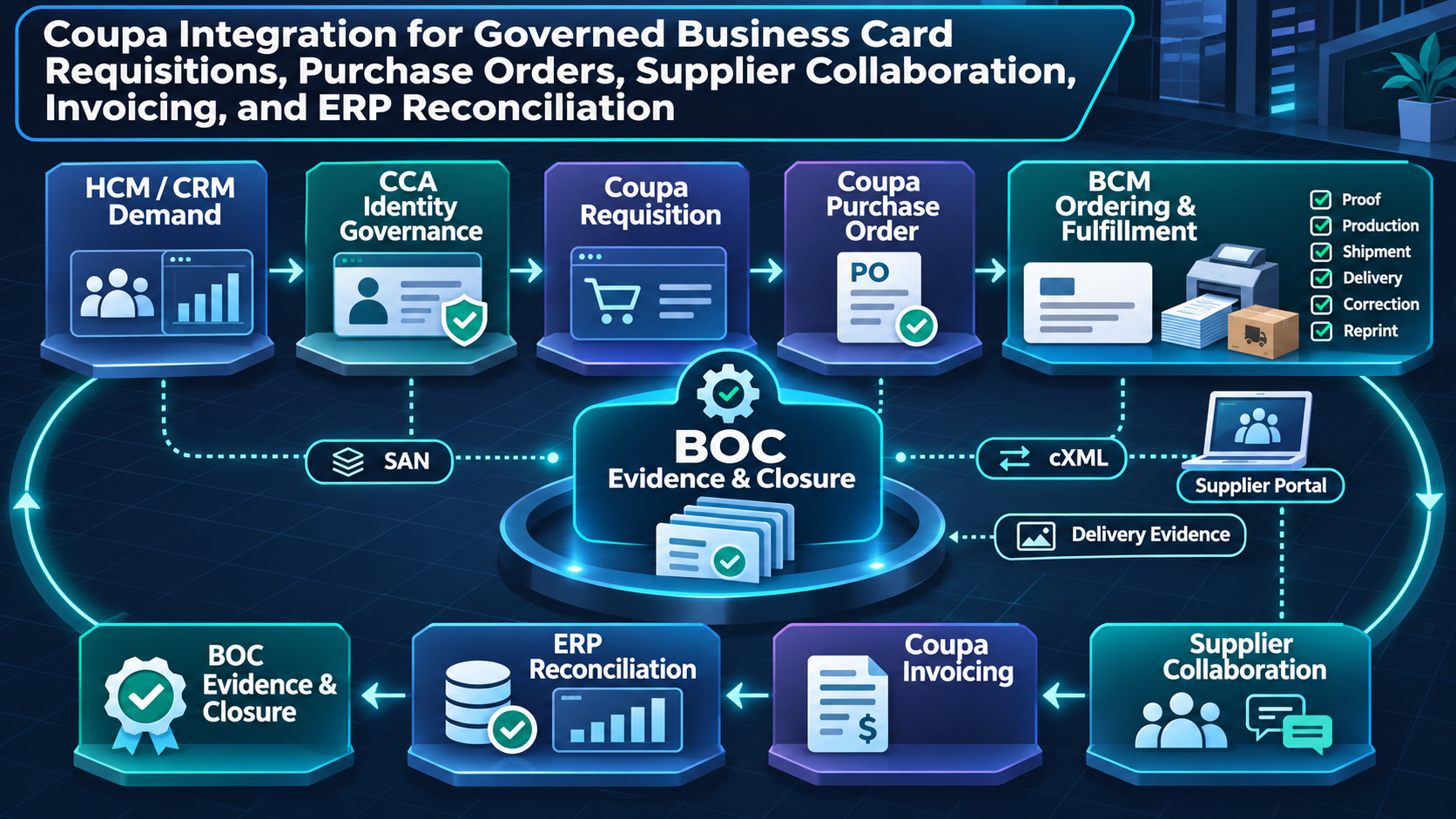
Connecting HCM and CRM demand, CCA identity governance, BCM fulfillment, Coupa procure-to-pay, supplier channels and ERP evidence through BOC.
In a Coupa business card procurement integration, Coupa can govern configured requisitions, approvals, purchase orders, supplier collaboration, invoicing and ERP integration for business card spend. Suppliers may interact through the Coupa Supplier Portal, Supplier Actionable Notifications, cXML or other customer-approved channels. Those commercial controls do not approve the public identity printed on an employee business card or prove that the correct cards were produced and accepted. BOC governs the cross-system outcome, CCA governs printable identity, Business Card Manager governs ordering and fulfillment, and the ERP retains customer-designated financial authority.
Printed Business Card Identity and Coupa Financial Authority Require Different Governance
A printed business card is a public identity artifact, while a Coupa requisition, purchase order, receipt or invoice is a commercial record. The printed artifact publishes an employee name, role, contact data and brand identity. The Coupa record authorizes or evidences procurement and invoicing activity. Treating one approval as authority for the other creates a gap between identity governance and financial governance.
CCA approves the printable identity version. Business Card Manager, or BCM, converts that approved specification into an order and manages proof, production, shipment, delivery, correction and reprint. Coupa may control a requisition, purchase order, supplier interaction, receipt, invoice and ERP integration according to the customer configuration.
BOC connects the domains while preserving their boundaries. A Coupa approval can authorize procurement or payment but cannot approve a title for publication. A BCM shipment can demonstrate physical delivery but cannot prove correct coding, payment or ERP acceptance. The case closes only when supported identity, commercial, fulfillment and financial evidence agree.
Why Business Card Purchasing Needs More Than a Finance Workflow
Business-card demand may begin with a new hire, transfer, promotion, office move, territory assignment, event or partner campaign. The requirement crosses workforce or customer data, identity rules, brand policy, commercial approval, supplier production, logistics, accounts payable and accounting. A completed task inside one system is therefore not the same as a completed business outcome.
An approved requisition or purchase order may exist before CCA approves the identity. A correctly coded invoice may refer to cards printed with an obsolete title. A BCM delivery may be accepted while the invoice is duplicated or rejected by the ERP. BOC prevents these partial successes from being mistaken for end-to-end closure.
The governed case retains the source event, CCA version, Coupa requisition and approval, purchase order, BCM order and fulfillment history, invoice and ERP evidence, optional payment evidence, exceptions and closure authority. Teams can investigate one trace without assigning universal ownership to any single application.
Keep Authority Clear Across HCM, CRM, CCA, BCM, Coupa, and the ERP
HCM remains authoritative for worker status, manager, organization, cost center, location and effective dates. CRM may be authoritative for event, campaign, partner or territory demand. These sources establish why cards are required and when the requirement is eligible; they do not approve printable identity or vendor payment.
CCA governs the public-facing name, title, contact details, location, template and approved identity version. BCM is the business-card ordering system and contracted vendor, responsible for proof, production, shipment, delivery and corrections. Coupa governs configured procurement, supplier onboarding, accounts-payable and payment activity. The ERP or accounting system retains the authoritative financial master and posting records defined by the customer.
BOC governs transitions, prerequisites, correlation, duplicate prevention, exception ownership, reconciliation and closure. This division allows each system to do the work it is designed to do without letting procurement become an identity editor or fulfillment become an accounting substitute.
What Coupa Contributes to the Connected Process
Coupa can govern requisition intake, approval, purchase orders, receipts and invoices according to the customer configuration. For a business card program, these records can authorize commercial commitment and support invoice review while CCA and BCM retain their separate identity and fulfillment roles.
The Coupa Supplier Portal allows suppliers to view purchase orders, configure delivery methods, create catalogs, submit invoices or advance ship notices and check transaction status when those features are enabled by the customer. Supplier Actionable Notifications can also let a supplier acknowledge, comment on or invoice from a purchase order email. The selected channel must match supplier capability, volume, security and control requirements.
Coupa documents Core API, CSV, cXML and other integration approaches for third-party systems. Availability and record coverage vary by release, module, instance, role, supplier route and configuration. This article describes a configurable architecture and does not claim a released universal native connector among Coupa, BOC, CCA and BCM.
The Governed Coupa Business Card Requisition-to-Reconciliation Lifecycle
| Lifecycle stage | Authoritative context | BOC control | Required outcome |
|---|---|---|---|
| Demand | HCM or CRM source event | Qualify purpose, timing, owner and duplicate state | Trusted BOC case |
| Identity | CCA policy and approved version | Preserve identity authority and version | Approved card specification |
| Requisition | Coupa requisition and approval | Correlate need, entity, budget and approval | Authorized procurement path |
| Order | Coupa PO and BCM order reference | Prevent duplicate release and preserve lineage | Executable supplier order |
| Fulfillment | BCM proof, production, shipment and delivery | Monitor milestones and physical exceptions | Verified physical outcome |
| Invoice | Coupa invoice, PO, receipt and supplier context | Reconcile commercial and physical evidence | Supported invoice or owned exception |
| Posting | ERP accounting and optional payment response | Track export, posting, credit and settlement state | Supported financial outcome |
| Closure | Physical, financial and decision evidence | Authorize closure or assign residual work | Auditable closed case |
Qualify HCM and CRM Demand Before Spend Is Requested
BOC begins with an authenticated source event and a stable business identifier. A new hire may qualify only after the start date is confirmed. A transfer may change the title, legal entity, location, cost center, delivery address or required date. A CRM event may justify cards for a controlled participant list rather than the general employee population.
Eligibility rules should stop unsupported demand. Terminations, leave, duplicate events, incomplete profiles, expired campaigns, uncertain delivery points and missing managers create a hold or owned exception. The case records why cards are needed, who owns the request, which entity pays, what quantity is permitted and when the requirement becomes effective.
Only a qualified case proceeds to CCA and the Coupa commercial path. The same BOC correlation key follows the requirement through identity approval, requisition and PO authorization, BCM ordering and delivery, supplier invoicing, ERP synchronization, optional payment evidence and final closure.
Approve Printable Identity in CCA Before Commercial Release
BOC sends the minimum required identity attributes to CCA. CCA applies naming, title, contact, location, template and brand policy and returns an approved version. That controlled version is the specification BCM may use for proof and production.
A requester or finance approver must not repair identity in a free-text spend request, PO description, memo or invoice line. When an authoritative field conflicts, BOC routes the issue back to the owning system. This prevents procurement convenience from creating an unauthorized public identity.
If the identity changes after commercial approval, BOC evaluates the production state. The request may be updated, the BCM order may be paused, or a cancellation, credit, replacement or named acceptance may be required. Both versions and the resulting decision remain linked to the case.
Use Coupa Requisitions and Approval Workflows for the Buying Decision
A governed business-card purchasing decision can enter Coupa through a requisition or another customer-approved intake integrated through BOC. The record should include the BOC case reference, legal entity, cost center, business reason, controlled quantity, needed date, destination, BCM supplier relationship and expected invoice route.
The financial approver needs purpose, price, budget and ownership context. The approver does not need to reapprove the identity fields already governed in CCA. BOC verifies that the approved request and the CCA identity refer to the same case version before an order is released.
Approval chains should preserve segregation of duties. Automated approval may be appropriate for a supported low-risk request, but it must never silently approve printable identity, a physical variance or an unsupported vendor record. The rule, inputs, result and escalation route must remain explainable.
Create, Transmit, and Govern the Coupa Purchase Order Deliberately
An approved Coupa requisition can become a purchase order according to the configured procurement workflow. The customer should define who can request, approve, create, change, transmit, acknowledge, receive and close a purchase order. The PO documents the commercial commitment but does not approve printable identity or prove physical fulfillment.
The PO should carry the correct supplier, entity, cost center, product description, quantity, amount, delivery terms, BCM and BOC references and other controlled fields needed for invoice matching and ERP synchronization. BOC links the Coupa PO to the CCA version and BCM order without duplicating master data.
Changing routes requires control. If an approved PO becomes non-PO spend or is replaced, BOC records the reason, authority and replacement reference. Retries, manual intervention and uncertain acknowledgements use idempotency and reconciliation controls so they do not create duplicate orders, purchase orders, invoices or payments.
Connect BCM Ordering and Fulfillment to Coupa Supplier Collaboration
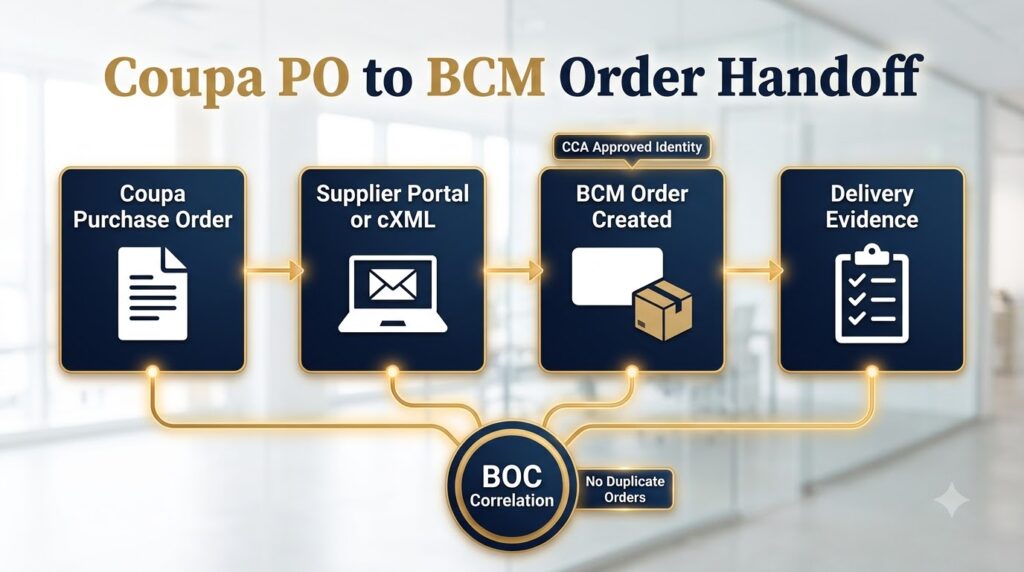
BCM receives the approved CCA identity version, product, quantity, destination and Coupa commercial reference. It creates the business-card order, manages proof and production, ships the cards and returns milestone and exception evidence. Depending on customer design, BCM may receive the PO through the Coupa Supplier Portal, Supplier Actionable Notifications, cXML or another controlled channel. BCM remains the ordering and fulfillment authority even when Coupa governs the commercial record.
A successful API response, portal submission, purchasing-card authorization or PO transmission does not prove that the intended BCM order exists. BOC confirms the worker or campaign context, approved version, product, quantity, address, commercial reference and BCM order number before the transition is complete.
Shipment is not automatically acceptance. BOC records delivery, recipient or receiving confirmation, shortage, damage, incorrect identity, reprint, cancellation and credit state. Physical evidence becomes a prerequisite for the customer-defined receiving, invoice approval, payment and closure decisions.
Capture, Validate, and Route the BCM Invoice Through Coupa
A supplier may submit an invoice through the Coupa Supplier Portal, Supplier Actionable Notifications, cXML, email PDF or another customer-approved channel, depending on the available configuration. A BCM invoice should carry the approved supplier and entity, invoice number, PO or non-PO route, BCM order, line items, quantity, price, freight, tax, currency, credit reference and BOC case identifier required by the customer design.
BOC validates the invoice against authoritative context. It checks supplier and entity, duplicate state, reference integrity and whether the BCM order is active, fulfilled, cancelled, disputed or under correction. Missing or conflicting evidence creates an owned exception rather than an invented default.
Approval notes can explain a variance but cannot replace a governed decision. An AP reviewer cannot change the CCA identity, accept defective cards for the operational owner, or alter supplier payment details without the proper control. BOC preserves the decision maker, evidence, timestamp and downstream effect.
Match the Bill to the Purchase Order and Physical Outcome
Coupa can associate invoices with purchase orders and receipt information according to the configured buying and invoicing process. That commercial match should be supplemented with the business outcome. For printed business cards, product, quantity, approved identity version, delivery destination and accepted fulfillment state matter alongside invoice amount, receipt evidence and PO balance.
A financial tolerance may permit a small price or freight variance, but it must never authorize an incorrect public identity or unapproved product substitution. Partial shipments, split invoices, reprints, credits and replacements retain lineage to the original case so the organization can see what the supplier delivered and what finance paid.
Receiving rules must be explicit. A carrier scan may support delivery evidence without proving recipient acceptance. The customer defines which evidence is sufficient to record receipt, approve an invoice, release payment and close the operational case.
Integrate Coupa with the ERP Without Competing Master Data
Coupa documents API, CSV, web-service, cXML and integration-provider approaches for connecting third-party systems. The implementation must validate the supported route and record coverage for users, suppliers, requisitions, purchase orders, receipts, invoices, credits, GL accounts, departments, projects, entities and other required dimensions. Invoice exports and ERP responses need dedicated integration ownership and failure handling.
The ERP or accounting platform remains authoritative for the customer-designated financial masters and postings. BOC must not invent a substitute vendor, account, entity, dimension, tax treatment or payment term when the required record is missing or inactive. It retains the failed context and assigns resolution.
Every interface needs authentication, least privilege, schema validation, correlation, idempotency, bounded retries, asynchronous error handling, monitoring and named ownership. Test and production credentials, controlled mapping changes and reconciliation totals reduce the chance that a technically successful sync hides an incomplete business outcome.
Reconcile Physical, Payment, and Accounting Evidence Before Closure
BOC combines event-driven processing with scheduled reconciliation. It can identify approved Coupa requisitions without BCM orders, purchase orders without supplier acknowledgement, BCM orders without fulfillment, fulfilled orders without supported invoices, invoices without valid PO or receipt context, invoice exports without accepted ERP responses, credits still pending and delivered cards with unresolved identity or quantity exceptions.
Financial closure requires a supported invoice, credit and accepted ERP evidence, plus payment evidence when payment is in scope. Operational closure requires the intended cards to be produced, delivered and accepted or a named authority to accept the variance. Neither side substitutes for the other, and a paid invoice alone never proves correct fulfillment.
The final case records source demand, CCA version, Coupa requisition and approval, purchase order, supplier acknowledgement, BCM order and delivery, invoice, ERP response, optional payment evidence, exceptions and closure authority. Procurement, finance, identity, operations and audit can understand the complete outcome from one trace.
Implement One Coupa Business Card Journey First
Begin with one entity, one ERP, one worker population, one demand reason, one CCA policy, one BCM supplier record, one product, one Coupa requisition workflow and one supplier invoice channel. Confirm identity approval, procurement authorization, PO transmission, ordering, delivery, invoicing, ERP posting, reconciliation and ownership before expanding.
Test difficult paths deliberately: duplicate HCM events, stale identity, rejected requests, inactive vendors, duplicate BCM submissions, partial delivery, incorrect cards, invoice before receipt, duplicate invoice, PO overage, changed payment details, API errors, Coupa rejection, ERP sync failure, returned payment, credit memo and uncertain acknowledgement.
Measure business outcomes rather than interface availability. Useful measures include qualified-demand accuracy, duplicate prevention, first-proof accuracy, request-to-order time, delivery-to-invoice lag, supported-match rate, exception age, ERP-posting success, credit closure time and the percentage of cases with complete identity, physical and financial evidence.
Buyer Intent Bridge: What a Coupa Integration Engagement Produces
Organizations do not need another isolated connector. They need an operating contract across workforce or campaign demand, public identity, requisitioning, purchase orders, BCM execution, supplier collaboration, invoicing and ERP accounting. A BOC engagement can define the authority matrix, event model, data contracts, Coupa integration method, supplier channel, security boundary, exception taxonomy, reconciliation controls and support model.
The architecture protects existing investments. HCM and CRM retain source authority, CCA governs printable identity, BCM remains the business-card ordering system and vendor, Coupa governs configured procurement and invoicing activity, and the ERP retains financial authority. BOC governs transitions, evidence and accountable closure across those domains.
The first implementation should produce a reusable blueprint containing source-event rules, CCA approval contract, Coupa requisition and PO design, BCM ordering contract, Supplier Portal or cXML interaction, invoice and ERP interfaces, access controls, monitoring, reconciliation, ownership and measurable acceptance criteria.
Questions Integration Buyers Should Ask
- Which HCM or CRM event qualifies demand before CCA approval and a Coupa requisition?
- Which role approves printable identity, procurement spend, a physical variance, an invoice exception and final closure?
- Which Coupa requisition, PO, receipt, invoicing, Supplier Portal, cXML, API, CSV and ERP capabilities are licensed and configured?
- Which references correlate the BOC case, CCA version, Coupa requisition and PO, BCM order, invoice and ERP record?
- How are duplicate orders, purchase orders, invoices, credits and uncertain acknowledgements reconciled?
- What physical and financial evidence is required before closure?
Frequently Asked Questions
Does BOC replace Coupa? No. Coupa remains the configured spend management and invoicing platform. BOC governs cross-system transitions, evidence and closure.
Does Coupa approve printable business card identity? No. CCA governs printable identity. Coupa governs configured procurement and financial activity.
Does a Coupa purchase order prove that BCM produced the cards? No. BCM production, delivery and acceptance evidence is still required.
Must BCM use the Coupa Supplier Portal? No. The supplier interaction channel may be the portal, Supplier Actionable Notifications, cXML or another approved method supported by the customer configuration.
Is a universal native connector claimed? No. The architecture uses customer-approved interfaces and validated licensed capabilities.
Connect one Coupa requisition, purchase-order and invoicing path to a governed business-card outcome. Business Ops Center can define the authority model, CCA identity approval, Coupa requisition and PO controls, BCM supplier collaboration and fulfillment, invoice and ERP integration, exception handling and reconciliation required for a controlled implementation. Start with one high-friction journey and turn it into a reusable enterprise integration pattern.