

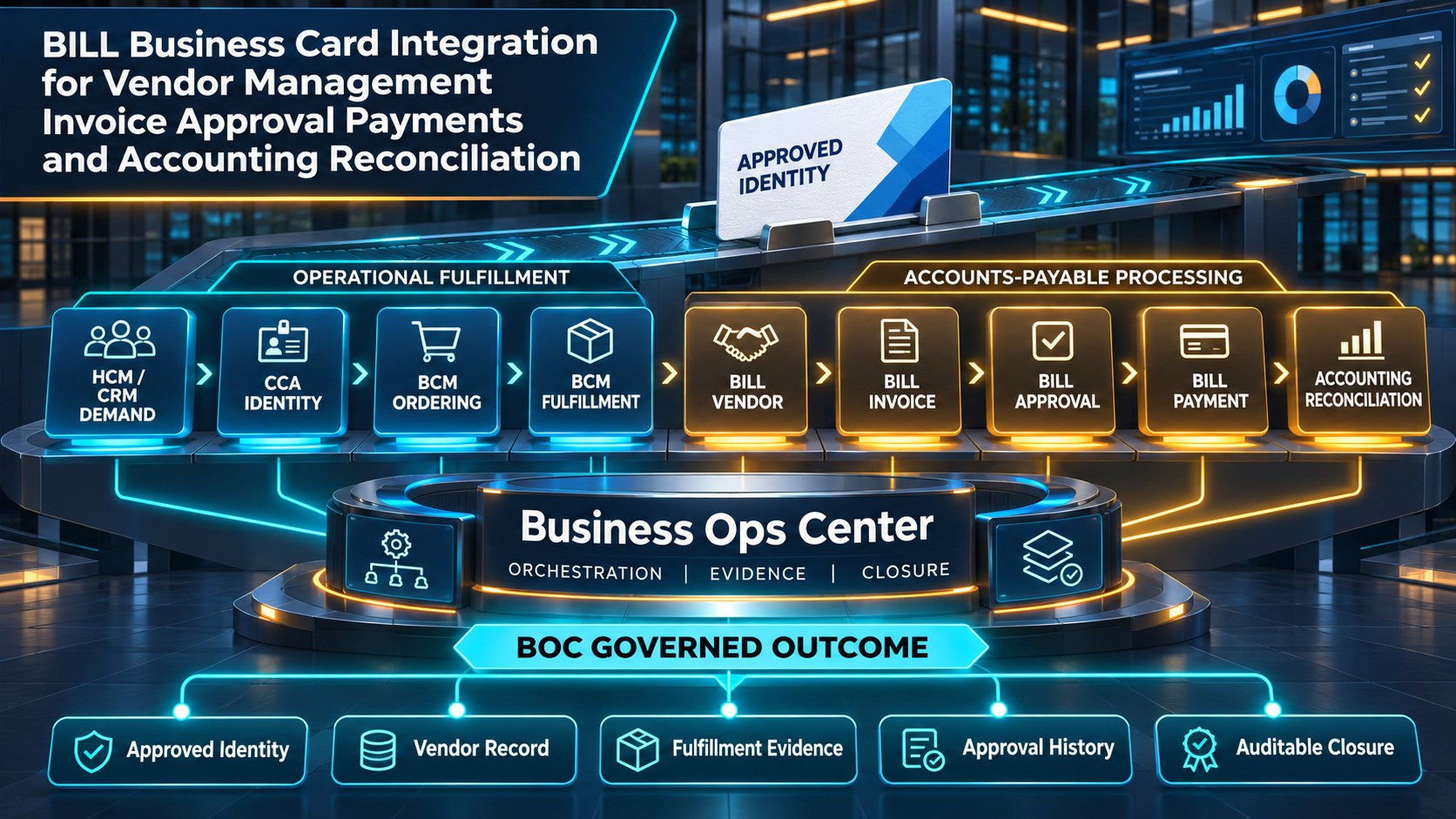
Connecting HCM and CRM demand, CCA identity governance, BCM fulfillment, BILL accounts payable controls and financial evidence through BOC.
In a BILL business card accounts payable integration, BILL can support configured invoice intake, approval routing, vendor payments and accounting synchronization, but a paid bill does not prove that the correct employee received correctly produced business cards. Business Ops Center governs the complete cross-system outcome. HCM or CRM qualifies demand, CCA governs printable identity, Business Card Manager is the ordering system and contracted vendor, BILL governs configured accounts-payable activity, and the accounting or ERP platform remains authoritative according to the customer’s design.
Accounts Payable Automation Still Needs Operational Outcome Governance
Business-card purchasing may look like a routine low-value expense, yet the transaction connects workforce or campaign demand, public identity, brand policy, delegated spending, supplier production, delivery, receiving, invoicing, payment and accounting. Each platform can complete its own task while the overall business result remains incomplete or wrong.
A bill may receive every required financial approval even though the printed title is obsolete. A payment may settle while a shipment is damaged or delivered to the wrong location. The correct cards may arrive while a duplicate bill, missing receipt or failed accounting sync prevents financial closure. BOC prevents the status of one system from being mistaken for evidence of the entire outcome.
BOC creates one governed case that follows the source event, approved CCA identity version, commercial authorization, BCM order and proof, production and shipment milestones, BILL vendor and bill records, approval history, payment state, accounting response, credits, exceptions and final closure authority. This correlation turns disconnected transactions into a reviewable operational record.
Keep Authority Clear Across HCM, CRM, CCA, BCM, BILL, and Accounting
HCM remains authoritative for worker status, manager, organization, location and effective dates. CRM may remain authoritative for customer-facing campaign, event, partner or territory demand. These systems establish why cards are needed and when the request becomes valid; they should not approve printable identity or determine whether a vendor bill is payable.
CCA governs the approved public-facing name, title, contact information, location, brand template and identity version. Business Card Manager converts that approved specification into an executable order and manages proof, production, shipment, delivery, correction and reprint activity. BILL governs configured vendor, bill, approval and payment activity. The accounting or ERP platform retains the financial records and reporting authority defined by the customer.
BOC governs the transitions. It validates prerequisites, preserves stable identifiers, prevents duplicate actions, assigns exceptions, reconciles physical and financial evidence, and requires the correct authority before the case advances or closes. This division preserves the value of each platform without forcing one system to become the master of every domain.
What BILL Contributes to the Connected Process
BILL currently describes an accounts-payable platform that can capture invoice data, route approvals, process payments and synchronize with supported accounting systems. Its official materials also describe vendor management, policy-driven approval workflows, separation-of-duties controls, two- and three-way matching in supported configurations, multiple payment methods, accounting integrations, file-based integration options and an API platform.
These functions can support the financial portion of a governed business-card lifecycle. BILL can hold the configured vendor and bill context, route approvals under customer policy, record payment activity and return accounting-sync status. BOC can connect those events to the upstream demand, approved identity and BCM fulfillment evidence that financial processing alone does not own.
Availability depends on the BILL plan, enabled products, accounting platform, entity design, payment method, geography, vendor eligibility, permissions and customer configuration. This article describes a configurable integration architecture. It does not claim that BILL, BOC, CCA and BCM provide one universal released native connector.
The Governed BILL Business Card Accounts Payable Lifecycle
| Lifecycle stage | Authoritative context | BOC control | Required outcome |
|---|---|---|---|
| Demand | HCM or CRM source event | Qualify timing purpose owner and duplicate state | Trusted BOC case |
| Identity | CCA policy and approved version | Preserve authority and current version | Approved card specification |
| Order | BCM order and commercial reference | Correlate release and prevent duplicates | Executable supplier order |
| Fulfillment | BCM proof production shipment delivery | Monitor milestones and exceptions | Verified physical outcome |
| Vendor | BILL vendor record and controls | Correlate BCM and contracted entity | Controlled vendor context |
| Bill | Invoice PO receipt and policy rules | Reconcile commercial and physical evidence | Supported bill or owned exception |
| Approval | BILL routing and decision history | Confirm authority and separation of duties | Authorized financial decision |
| Payment | BILL payment and accounting response | Track release settlement credit and failure | Supported financial outcome |
| Closure | Physical and financial evidence | Authorize closure or assign residual work | Auditable closed case |
Qualify HCM and CRM Demand Before a Bill Exists
BOC begins with an authenticated source event and a stable source identifier. A new hire may qualify only after a confirmed start date. A transfer may require a new title, location or delivery destination. A field campaign can justify a controlled quantity for active participants. A partner or customer-facing request may require a separate identity policy from an employee default.
Eligibility rules should suppress unsupported demand. Termination, leave, duplicate events, expired campaigns, incomplete external-contact records, uncertain destinations and missing managers should create a hold or owned exception instead of an order. The case must explain why cards are needed, who owns the request, when it becomes effective and where the product must go.
Only after qualification does BOC advance identity, ordering and financial preparation. The case reference follows the requirement through CCA approval, BCM ordering and delivery, BILL bill and payment processing, accounting synchronization and closure.
Create a Controlled CCA Identity Before BCM Production
BOC sends only required identity attributes to CCA. CCA applies naming, title, contact, location, brand and template policy and returns an approved version. That version is the controlled public identity that BCM may use for proof and production.
A requester should not repair a governed title inside a purchase-order description or bill field. Accounts payable must not become an alternate identity system. When identity data conflicts, BOC assigns the exception to the authoritative source and resumes only after a supported correction.
If identity changes after ordering, BOC determines whether BCM can alter production or whether the order must be cancelled, credited, replaced or accepted through a named decision. Both versions and the linking decision remain available for audit.
Connect BCM Ordering and Fulfillment Evidence to BILL
Business Card Manager is the business-card ordering system and contracted vendor. BCM receives approved product and identity references, creates the order, manages proof and production, ships the cards, and returns status and exception evidence. A commercial reference connects the order to the purchase order or other approved buying record.
A successful API response, portal submission or purchase-order transmission does not prove that BCM created the intended order. BOC correlates the worker or campaign context, CCA version, product, quantity, destination, commercial reference and BCM order number before the handoff is complete. Stable idempotency keys prevent retries or manual intervention from creating duplicate orders.
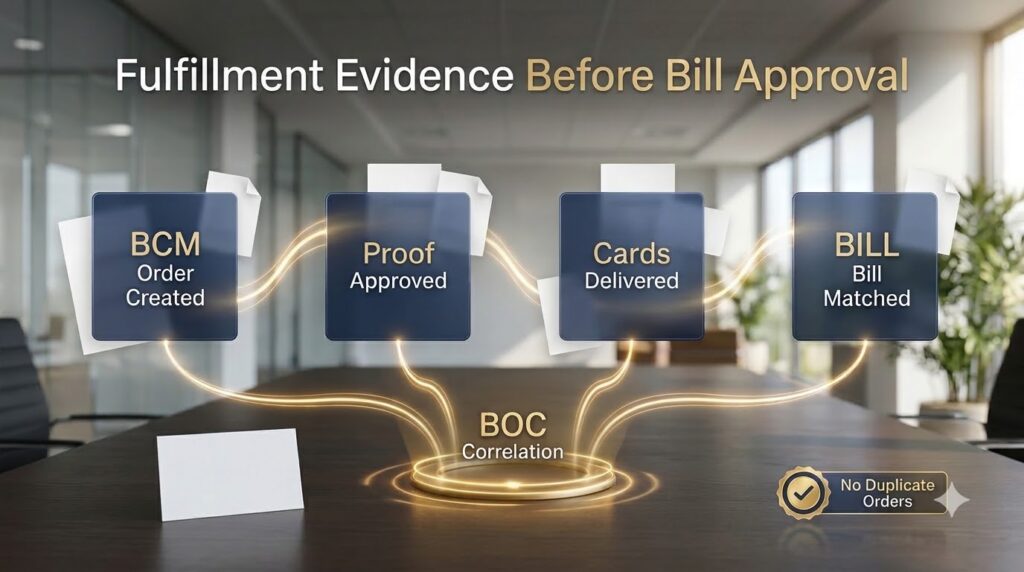
Shipment status is not final acceptance. BOC records delivery, recipient or receiving confirmation, quantity variance, damage, correction, reprint and cancellation state. This evidence becomes operational context for bill matching, approval and payment decisions.
Manage BCM as a Controlled Vendor in BILL
BILL vendor management can support a controlled vendor record and payment relationship. BOC does not duplicate BILL permissions, vendor-network controls or payment setup. It ensures that the approved BCM relationship and the vendor record used for billing and payment refer to the same contracted entity, legal entity, currency and commercial arrangement.
Vendor creation and change requests need explicit ownership. Bank-account, tax, address or payment-method changes should not be inferred from a card order or accepted only because a bill arrived. Customer-approved validation, separation of duties and exception routing remain prerequisites to financial use.
BOC preserves stable vendor references across procurement, BILL, BCM and the accounting platform. If records conflict, the case is held with the evidence and owner required for correction rather than creating a substitute vendor or bypassing the configured controls.
Capture and Match the BCM Bill With Physical Evidence
The BCM bill should carry customer-approved references needed for processing: vendor, legal entity, purchase order or approved non-PO route, BCM order, line, quantity, unit price, freight, tax, currency and credit references. BOC preserves the case identifier needed to connect the financial document to the identity and fulfillment outcome.
Invoice transport may use BILL invoice intake, a supported integration, file exchange, an API or another customer-approved path. BOC treats arrival as an event requiring validation. It checks expected vendor and entity, duplicate state, reference integrity and whether the associated order is active, delivered, cancelled or under correction. Invalid or ambiguous documents enter a governed exception queue rather than being silently enriched with unsupported values.
BILL describes two- and three-way matching in supported configurations. For business cards, a financial match should also be supported by the physical result. Quantity, product, destination and accepted fulfillment state matter alongside price, tax and purchase-order references. A tolerance may permit a small financial variance, but it must never authorize an incorrect public identity or unapproved production change.
Partial shipments, split bills, credits, reprints and replacements need lineage to the original case. BOC records whether a credit resolves the financial variance, whether BCM fulfilled the corrected order and whether residual work remains after a bill has been approved or posted.
Govern Approval Routing and Payment Decisions
BILL describes configurable approval policies, automatic routing, approval tracking, dual control and separation of duties. Those controls are valuable only when the approval context is reliable. BOC supplies the supported demand, commercial reference, identity version and fulfillment evidence required for a reviewer to understand what is being authorized.
Automation should have explicit authority boundaries. A rule may route a supported bill or advance a low-risk match, but it should not silently approve public identity, accept a physical variance, alter vendor payment information or close a disputed outcome. BOC records the rule, input context, action, reason, system response and escalation path.
Useful exception classes include unknown order, duplicate bill, inactive vendor, changed account, missing receipt, quantity variance, price or tax variance, incorrect card, damaged delivery, late cancellation, credit pending, accounting rejection, returned payment and payment uncertainty. Each class needs a named owner, service target, evidence requirement and allowed resolution.
Integrate BILL and Accounting Without Competing Master Data
BILL officially describes two-way synchronization with supported accounting platforms, import and export options for other systems, and an API platform for custom financial workflows. The implementation should select the supported interface for each vendor, bill, approval, payment and reconciliation scenario instead of assuming one method fits every entity or accounting environment.
Accounting and financial master data remain authoritative. Vendor, company, account, cost center, tax, currency, payment term, purchase order and accounting records should move through controlled interfaces with ownership and effective dates. BOC must not invent substitute values when a required record is missing or inactive; it creates an exception and preserves the failed context.
Every interface needs authentication, least privilege, schema validation, idempotency, correlation, bounded retry, asynchronous error handling, monitoring and named ownership. Separate test and production credentials, controlled version changes and reconciliation totals reduce the risk that technical success hides incomplete business processing.
Reconcile Physical, Payment, and Accounting Evidence Before Closure
BOC combines event-driven processing with scheduled reconciliation. It can identify fulfilled BCM orders without bills, bills without supported orders, deliveries without receipts, receipts with open physical exceptions, approved bills without released payments, failed or returned payments, credits still pending and BILL records without an accepted accounting response.
Financial closure requires supported bill, accounting and payment or credit evidence. Operational closure requires the intended cards to be produced, delivered and accepted or a named authority to accept the variance. Neither side substitutes for the other.
The final case records the triggering demand, CCA version, BCM order and fulfillment history, BILL vendor, bill, approval and payment references, accounting response, exception decisions and closure authority. Procurement, finance, identity, operations and audit can then understand the same outcome without turning any one application into the owner of every domain.
Implement One BILL Business Card Accounts Payable Journey First
Begin with one legal entity, one accounting platform, one worker population, one request reason, one CCA policy, one BCM vendor record, one product, one bill route and one payment method. Confirm demand qualification, identity approval, ordering, delivery, bill intake, matching, approval, payment, synchronization, reconciliation and ownership before expanding.
Test the difficult paths deliberately: duplicate HCM events, stale identity, vendor-record conflict, duplicate BCM submissions, partial delivery, incorrect card, bill before receipt, duplicate bill, split bill, credit memo, tax variance, changed payment detail, missing purchase order, API error, BILL rejection, accounting failure, returned payment and uncertain acknowledgement.
Acceptance criteria should measure business outcomes rather than only interface availability. Useful measures include qualified-demand accuracy, duplicate prevention, first-proof accuracy, delivery-to-bill lag, touchless-match rate, exception age, accounting-posting success, credit closure time and percentage of cases with complete physical and financial evidence.
Buyer Intent Bridge: What a BILL Integration Engagement Produces
Organizations do not need another isolated payment interface. They need an operating contract across workforce or customer demand, approved public identity, BCM execution, vendor and bill controls, payment and accounting. A BOC engagement can define the authority matrix, event model, vendor and invoice data contracts, BILL integration pattern, security boundary, matching prerequisites, exception taxonomy, reconciliation controls and support model.
The architecture protects existing investments. HCM and CRM retain domain authority. CCA governs printable identity. BCM remains the contracted business-card vendor and ordering system. BILL governs configured vendor, bill, approval and payment activity. The accounting platform retains financial authority. BOC governs transitions, evidence and accountable closure across the complete outcome.
The first implementation should produce a reusable blueprint: source-event rules, CCA approval contract, BCM ordering and fulfillment contract, purchase-order and receipt mapping, BILL vendor, bill, approval and payment interfaces, accounting response model, access controls, monitoring, reconciliation schedule, ownership and measurable acceptance criteria.
Questions Integration Buyers Should Ask
- Which HCM or CRM event qualifies demand before CCA approval and BCM ordering?
- Which role can approve printable identity, spend, physical variance, bill exception and final closure?
- Which BILL vendor, invoice, matching, approval, payment, integration and accounting capabilities are licensed and configured?
- Which references correlate the BOC case, CCA version, BCM order, purchase order, receipt, bill, payment and accounting record?
- How will duplicate orders, bills and uncertain acknowledgements be reconciled across channels?
- What physical and financial evidence is required before the case can close?
Frequently Asked Questions
Does BOC replace BILL? No. BILL remains the configured accounts-payable and payment platform. BOC governs cross-system transitions, physical evidence and closure.
Does an approved or paid bill prove successful fulfillment? No. It supports financial control, but BCM delivery and acceptance evidence is still required for operational closure.
Does BILL approve business card identity? No. CCA governs printable identity, while BILL governs configured vendor and financial processing.
Is a universal native connector claimed? No. This article describes a configurable architecture using customer-approved interfaces and licensed capabilities.
Connect one BILL vendor-to-payment lifecycle to a governed business-card outcome. Business Ops Center can define the authority model, CCA identity approval, BCM ordering and fulfillment contract, BILL vendor, bill, approval and payment integration, accounting evidence, exception handling and reconciliation required for a controlled implementation. Start with one high-friction accounts-payable path and turn it into a reusable enterprise integration pattern.