

Connecting HCM and CRM demand, CCA identity governance, Zycus intake and purchasing controls, Business Card Manager fulfillment and enterprise evidence through BOC.
In a Zycus procure to pay business card integration, Zycus can govern configured requisitions, approvals, purchase orders, supplier collaboration, receiving and invoicing, but a successful procurement transaction does not by itself prove that the right employee received correctly produced business cards. Business Ops Center governs the complete cross-system outcome. CCA governs the approved public identity. Zycus governs the configured buying and invoice process. Business Card Manager is the contracted business-card ordering system and vendor responsible for proof, production, shipment, correction and fulfillment evidence.
Procure to Pay Automation Still Needs Outcome Governance
A business-card purchase can appear simple inside a procurement platform. The request has a catalog item, an approver, a supplier, a purchase order and an invoice. The operational requirement is more demanding. A worker or customer-facing event creates demand; identity policy determines what may be printed; procurement authorizes spending; the supplier produces a physical artifact; receiving confirms the result; and finance reconciles the invoice. Each stage has a different authority and a different failure mode.
A Zycus purchase order can be approved and transmitted while an employee title is obsolete. Cards can be delivered while the receipt remains missing. An invoice can match financially while the product is incorrect. Conversely, correct cards may arrive while a tax, coding, credit or payment exception remains unresolved. BOC prevents one system status from being treated as proof of the entire business outcome.
BOC correlates the initiating HCM or CRM event, the current CCA identity version, the Zycus requisition and purchase order, supplier acknowledgement, the BCM order and fulfillment evidence, receiving state, invoice, ERP response and closure decision. The result is a governed case rather than a chain of loosely related transactions.
Keep Business Authority Separate Across the Lifecycle
HCM remains authoritative for worker status, manager, organization, location and effective dates. CRM can remain authoritative for campaign, event, partner, territory or customer-facing purpose. Those systems establish and qualify demand; they should not approve spend or define printable identity.
CCA governs the public-facing name, title, contact information, brand template and approved identity version. Zycus governs configured requisition, approval, purchasing, supplier, receipt and invoice activity. BCM converts an authorized specification into proof, production, shipment, delivery, correction and reprint activity. The connected ERP retains accounting and payment authority according to the customer’s design.
BOC governs transitions among those authorities. It authenticates source events, preserves references and versions, checks prerequisites, prevents duplicates, assigns exceptions and requires sufficient physical and financial evidence before closure. This division protects existing systems while eliminating the gaps between them.
What Zycus Contributes to a Connected Buying Process
Zycus describes a procure-to-pay platform covering guided requisitions, catalog and non-catalog purchasing, purchase orders, receiving, invoicing, matching and supplier collaboration. Its current materials also position Merlin Intake as an AI-guided entry point and describe automation across requisition-to-invoice workflows. Those capabilities can improve procurement experience, but they remain subject to the customer’s licensed modules, release, configuration and control design.
Zycus materials describe ERP and third-party integration through prebuilt connectors, APIs and integration services, with supplier interaction through the Zycus Supplier Network and connected supplier systems. Master data, purchasing documents, receipts, invoices and payment-related status can participate in the broader architecture, while the ERP remains authoritative for configured financial records and payment execution.
This article therefore describes a configurable integration architecture, not a claim that Zycus, BOC, CCA and BCM have a universal released native connector. APIs, connectors, portal workflows, agent permissions, approval rules, matching tolerances, ERP interfaces and supplier channels must be validated in the customer’s environment.
Keep Agentic Procurement Automation Inside Governed Boundaries
Zycus currently positions Merlin agents and AI-guided intake across procurement and accounts-payable workflows. In a business-card process, an agent may help interpret demand, suggest a buying path, match an item, route an exception or summarize supplier activity. Those actions can reduce friction, but they should not silently become authority to approve public identity, release production, accept a physical variance or close a financial exception.
BOC treats every automated recommendation and action as a governed event. The event should identify the model or agent, input context, applicable policy, action taken, confidence or reason where available, human escalation path and resulting system state. Customer-approved controls define which steps may execute automatically, which require confirmation and which must always remain with a named human role.
This boundary protects the base purpose of each platform. Zycus can automate configured procurement work. CCA remains the authority for printable identity. BCM remains responsible for the executable order and physical fulfillment. BOC ensures that automation carries trustworthy context across the systems and that evidence is sufficient before the lifecycle advances or closes.
The Governed Zycus Business Card Procure to Pay Lifecycle
| Lifecycle stage | Authoritative context | BOC control | Required outcome |
|---|---|---|---|
| Demand | HCM or CRM event and effective date | Authenticate, correlate and qualify | Trusted BOC case |
| Identity | CCA policy and approved public fields | Resolve conflicts and preserve version | Approved card identity |
| Requisition | Zycus request, cart or requisition | Validate buying context and references | Controlled request |
| Approval | Zycus approval and budget authority | Verify independent identity and spend decisions | Authorized commitment |
| Supplier | PO, channel and BCM acknowledgement | Correlate handoff and prevent duplicates | Accepted BCM order |
| Fulfillment | BCM proof, production and delivery | Monitor milestones and exceptions | Verified physical outcome |
| Receiving | Zycus receipt or correction state | Reconcile physical evidence | Supported receipt |
| Invoice | Invoice, credit and ERP state | Reconcile value and references | Supported financial outcome |
| Closure | Physical and financial evidence | Authorize closure or assign work | Auditable closed case |
Qualify HCM and CRM Demand Before Creating a Zycus Requisition
BOC begins with an authenticated source event and a stable source identifier. A new hire may qualify only after a confirmed start date. A transfer may require a new title or destination. A field campaign can justify a controlled quantity for active participants. A partner program may require a customer-facing identity that differs from an employee default. The demand record must state why cards are needed, who owns the request, when it becomes effective and where the product must be delivered.
Eligibility rules should also suppress unsupported demand. Termination, leave, duplicate events, expired campaigns, incomplete external-contact records or uncertain destinations should create a hold or owned exception instead of a requisition. This prevents convenient procurement intake from becoming a route around workforce, identity or campaign policy.
Only after qualification does BOC create or advance the Zycus request. The BOC case reference follows the requirement through requisition, approval, PO, BCM order, receipt and invoice, providing a correlation key that business users can understand and technical services can enforce.
Convert Qualified Demand Into a Controlled CCA Identity
BOC sends only the required identity attributes to CCA. CCA applies naming, title, contact, location, brand and template policy and returns an approved version. That version is more than a collection of fields: it is the controlled representation that BCM may use for proof and production.
Identity conflicts remain with the authoritative source. A requester should not change an active-status conflict or governed title in a Zycus description, and procurement or accounts payable should not repair printable data in an invoice. BOC records the conflict, assigns it and resumes the workflow only after a supported correction.
If identity changes after the Zycus requisition or PO is approved, BOC determines whether the procurement commitment, supplier instruction or BCM order must be changed or cancelled. It preserves both versions and the decision that connected them so the final card can be traced to the approval that authorized it.
Build a Zycus Requisition With the Right Commercial Context
When demand and identity are ready, BOC can create or support a Zycus requisition with the customer’s required buying context: contracted BCM supplier, catalog or item reference, category, quantity, price basis, currency, legal entity, ship-to location, requester, account or cost center, project where applicable and stable BOC case identifier.
The requisition should reference the approved card specification without placing unnecessary personal information in broadly visible descriptions, comments or attachments. A protected reference or controlled token can link Zycus to the CCA version and BCM instruction while respecting access boundaries.
Master data remains authoritative. If an account, supplier site, ship-to location, tax rule, catalog item or approval route is missing or inactive, BOC creates a commercial exception instead of inserting an ungoverned substitute. This keeps procurement convenience from weakening accounting or identity controls.
Apply Zycus Approval Without Replacing Identity Approval
Zycus approval can govern configured spend, organization, account, category, supplier, quantity and policy conditions. CCA approval governs printable identity. BOC keeps these decisions distinct, attributable and current before it authorizes BCM production.
Approval routing should preserve segregation of duties, delegation, escalation and expiry according to customer policy. If quantity, price, destination or accounting changes materially after approval, BOC determines whether the requisition or purchase order requires reapproval. A prior decision must not silently authorize a materially different outcome.
The production release condition combines qualified demand, a current CCA identity, an approved Zycus commercial commitment and an executable BCM specification. If any prerequisite is absent, BOC holds the case with a visible reason, named owner and controlled route to resolution.
Connect Zycus Purchase Orders to BCM Fulfillment
After commercial approval, Zycus can issue a purchase order through a configured supplier channel. Zycus describes supplier collaboration through its Supplier Network, portal experiences and connected supplier systems. The right pattern depends on the customer’s licensed configuration, integration architecture and BCM’s approved transaction channel.
BCM is the business-card ordering system and contracted vendor. It receives the authorized commercial and production references, creates the order, manages proof and production, ships the cards and returns status and exception evidence to BOC. The payload should carry the minimum information needed to execute the order while protecting identity data from unnecessary exposure.
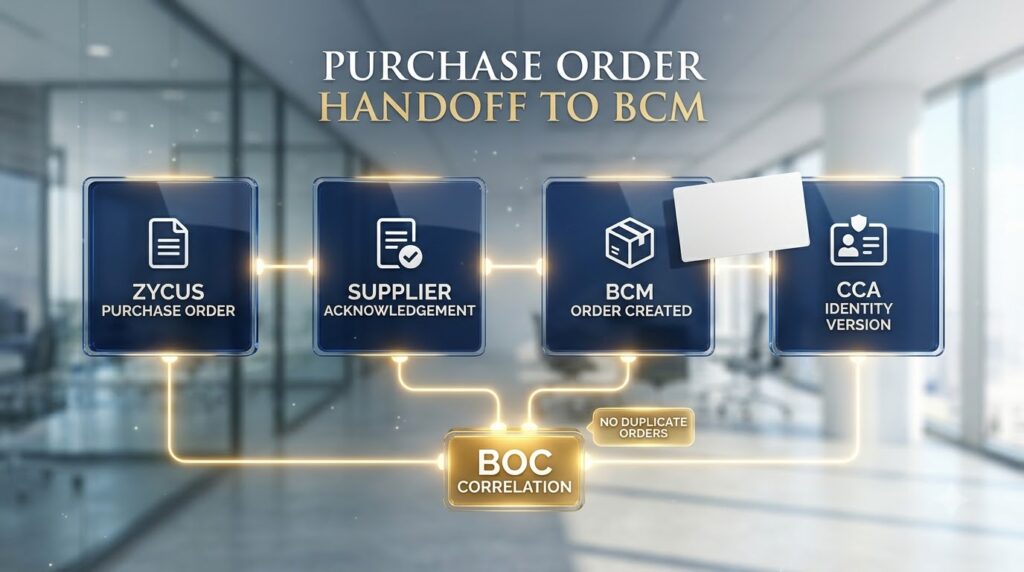
Supplier acknowledgement is a control point, not a convenience. A transmitted PO or successful API response does not prove that BCM created the intended order. BOC correlates the Zycus requisition, PO and supplier acknowledgement with the BCM order number, CCA version, product, quantity and destination before the handoff is complete.
Prevent Duplicate Orders Across APIs, Connectors, Portals, and Retries
Enterprise integrations must assume timeouts, retries and uncertain acknowledgements. A user may also attempt to reorder manually while an automated request is in flight. BOC uses stable idempotency and correlation rules across API, connector, portal and file-based paths so the same demand cannot create multiple BCM orders.
When acknowledgement is uncertain, BOC first queries or reconciles using the original case, requisition, PO and supplier references. It does not create another order merely because an interface timed out or a user cannot yet see a downstream status. Retry limits, quarantine rules, escalation and ownership should be explicit.
Duplicate detection should compare more than a transaction ID. Worker or campaign identity, CCA version, product, quantity, destination, effective date and active order state provide the operational context needed to distinguish a valid reorder from an accidental duplicate.
Govern Changes, Cancellations, and Production Cutoffs
Business-card requirements frequently change after approval. Zycus can represent purchase-order changes and cancellations; CCA may issue a new identity version; BCM can alter the executable order only while production state permits. BOC determines whether those representations still describe the same authorized outcome.
A quantity increase, destination change, title correction, freight charge, tax change or product substitution can require different authorities. BOC classifies the change, checks the production cutoff and routes the smallest valid correction while preserving prior versions and decision history.
Cancellation is state dependent. A draft requisition may be withdrawn, an issued PO may require a formal change or cancellation, and BCM may stop production only before the applicable cutoff. If work cannot be stopped, BOC records unavoidable cost and the required credit, disposal, replacement or acceptance decision.
Choose a Zycus Integration Pattern With Clear Ownership
The design can use supported Zycus APIs, prebuilt connectors, supplier-network processes, ERP integration services, middleware, files or another customer-approved pattern. The choice depends on licensed functions, available interfaces, transaction volume, supplier capability, security constraints, latency and support capacity.
Every interface needs stable correlation, authentication, schema validation, idempotency, acknowledgement, bounded retry, monitoring and named ownership. Integration users, OAuth clients, certificates and file channels require least privilege, rotation, revocation and auditable administration.
Payloads should contain only required attributes. Printable identity should move through the approved fulfillment interface rather than being copied into unrestricted requisition descriptions, invoice fields, AI prompts or diagnostic logs. BOC can preserve evidence without turning every connected system into an identity repository.
Reconcile BCM Delivery With Zycus Receiving
BCM returns supported proof, production, shipment, delivery, correction, cancellation and reorder events. BOC translates them into case milestones and compares them with the current Zycus PO and receipt state. A product, quantity, destination or charge that differs from authorization becomes an owned exception. Shipment status or supplier acknowledgement is not final proof of delivery.
Scheduled reconciliation complements event processing. It can identify approved requisitions without POs, POs without BCM orders, duplicated lines, cancelled workers in production, shipments without receipts, partial deliveries, receipt corrections and stale exceptions. This ensures that missed events do not become invisible failures.
Receiving rules should reflect the physical product. A receipt may require delivery confirmation, recipient acknowledgement, quantity validation or exception acceptance. BOC records the evidence and the role that authorized any variance before allowing the case to proceed to financial closure.
Connect Zycus Invoice Control to ERP and Fulfillment Evidence
Zycus invoice resources support purchase-order-associated invoice processing, while customer configurations define matching, tolerances, approval and ERP handoff. The BCM invoice should carry authorized PO, order and line references so quantity, price, freight, tax and credits can be compared with the commercial commitment.
Financial closure occurs only when receipt, invoice, credit, ERP and payment evidence agree with the approved result or a named authority accepts the variance. An approved or matched invoice does not prove that the right cards were produced and accepted. Reprints, refunds and credits remain attributable to the original BOC case, with cause, cost and decision recorded.
BOC gives finance a controlled operational context without replacing Zycus or the ERP. Accounts payable can see whether a physical exception is open, procurement can see whether a supplier correction is pending, and operations can see whether payment or credit evidence remains incomplete.
Implement One Zycus Business Card Buying Journey First
Begin with one Zycus environment, one buying entity, one worker population, one request reason, one CCA policy, one BCM product, one supplier relationship and one integration pattern. Confirm demand qualification, identity approval, requisition, approval, PO issuance, supplier acknowledgement, production, receipt, invoice, ERP exchange, monitoring and ownership before expanding.
Test the difficult paths deliberately: duplicate HCM events, stale identity, inactive accounting values, rejected requisitions, self-approval, PO changes, cancellations, uncertain acknowledgements, duplicate API or connector submissions, production cutoff, partial shipment, receipt variance, invoice mismatch, credit, ERP failure and reprint.
Acceptance criteria should measure the business outcome, not only interface success. Useful measures include qualified-demand accuracy, duplicate prevention, approval latency, supplier acknowledgement time, first-proof accuracy, exception age, delivery-to-receipt lag, invoice-match quality, credit closure and percentage of cases with complete evidence.
Buyer Intent Bridge: What a Zycus Integration Engagement Produces
Organizations do not need another isolated purchase-order interface. They need an operating contract across workforce or customer demand, approved public identity, buying authority, supplier execution, receiving and finance. A BOC engagement can define the authority matrix, event model, data contract, Zycus integration pattern, security boundary, exception taxonomy, reconciliation controls and support model.
The architecture protects existing investments. HCM and CRM retain domain authority. CCA governs printable identity. Zycus governs configured procure-to-pay transactions and supplier collaboration. Business Card Manager remains the contracted business-card vendor and ordering system. BOC governs transitions, evidence and accountable closure across the full outcome.
The first implementation should produce a reusable blueprint: source-event rules, CCA approval contract, requisition and PO mapping, supplier handoff, receipt and invoice contract, ERP evidence, access model, monitoring, reconciliation schedule, service ownership and measurable acceptance criteria.
Questions Integration Buyers Should Ask
- Which HCM or CRM event qualifies demand before a Zycus requisition is created?
- Which role can approve printable identity, spend, production release, receipt variance, invoice exception and final closure?
- Which Zycus intake, requisition, PO, supplier-network, receiving, invoice, API, connector and ERP capabilities are licensed and configured?
- Which references correlate the BOC case, CCA version, Zycus requisition, PO, BCM order, receipt and invoice?
- How will duplicate orders and uncertain acknowledgements be reconciled across channels?
- What physical and financial evidence is required before the business-card case can close?
Frequently Asked Questions
Does BOC replace Zycus? No. Zycus remains the configured procurement and spend platform. BOC governs the cross-system business outcome, evidence and closure.
Does a Zycus purchase order automatically release production? No. BOC must also verify current demand, CCA identity approval, BCM readiness and the absence of a superseding change.
Is a universal native connector claimed? No. This article describes a configurable architecture using customer-approved Zycus and downstream capabilities.
Does an approved invoice prove successful fulfillment? No. It supports financial control, but BCM delivery and acceptance evidence is still required for operational closure.
Connect one Zycus procure-to-pay lifecycle to a governed business-card outcome. Business Ops Center can define the authority model, requisition and supplier architecture, CCA identity approval, BCM execution, interface controls, exception handling and reconciliation needed for a controlled implementation. Start with one high-friction buying path and turn it into a reusable enterprise integration pattern.