


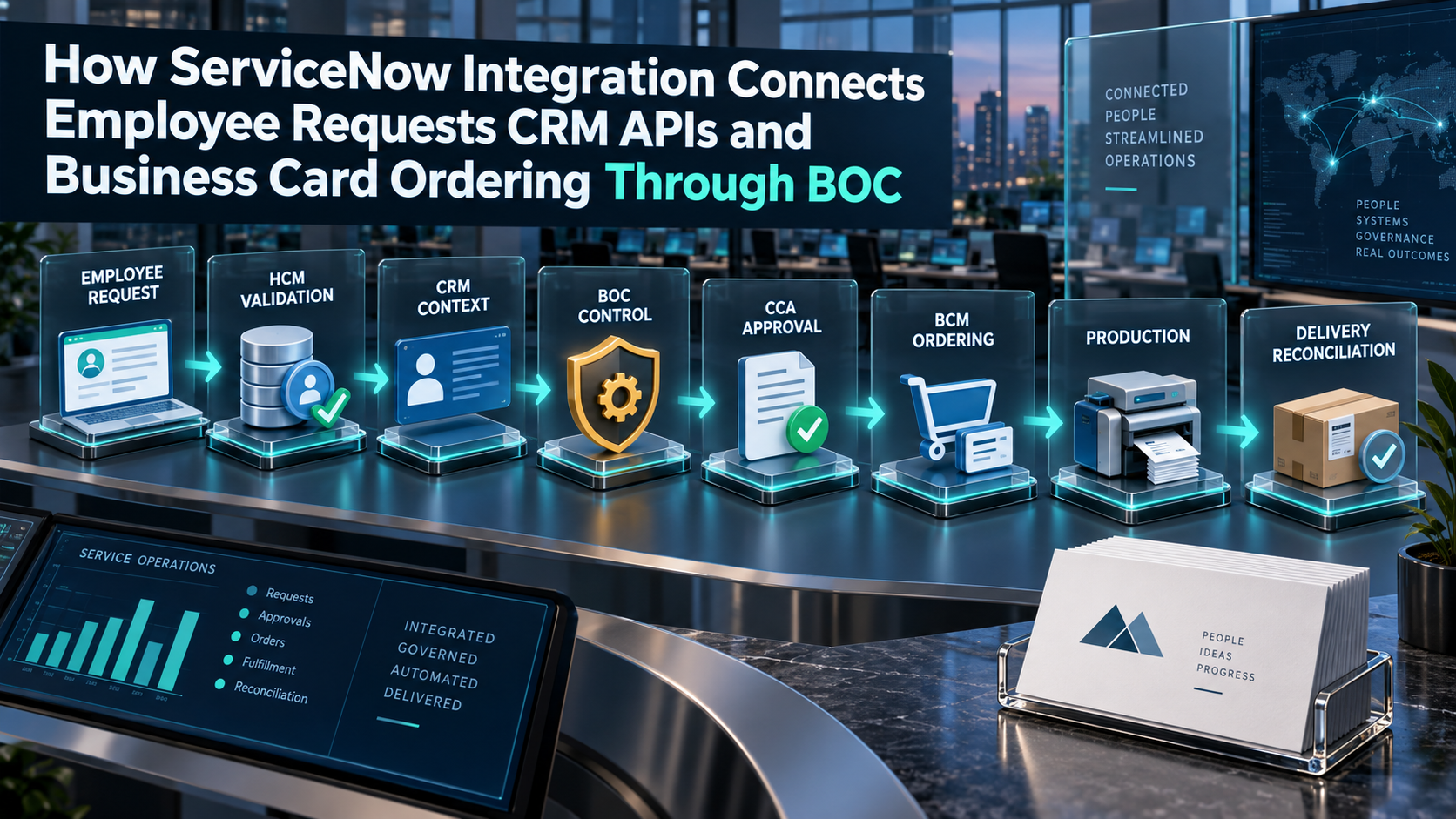
A governed service workflow from employee request to approval, identity-controlled ordering, delivery, and financial closure.
Category: Integration | Content Bucket: Employee Service and Identity Operations | Buyer Stage: Consideration
ServiceNow can give employees and service teams a structured place to request business cards, but the request record alone does not prove that the correct card was authorized, produced, delivered, and reconciled. BOC governs that outcome across ServiceNow, HCM, CRM, CCA, BCM, suppliers, and finance while preserving each system’s authority.
BOC Connects Service Requests to Verified Business Outcomes
An employee can submit a business card request through ServiceNow in minutes. The difficult work begins after submission. The organization must confirm that the requester is active, establish whether the role requires printed cards, validate the name and title, select the correct legal entity and brand, obtain the right approvals, create an order, monitor production, verify delivery, and match the supplier charge. Those decisions draw on information that ServiceNow should not own by itself.
Business Ops Center provides the operational control layer for this cross-system work. ServiceNow remains the employee or service-team entry point and retains the request or case history. The HCM platform owns workforce identity and status. CRM owns customer, territory, account, campaign, and other commercial context. Color Card Administrator governs the identity and brand values approved for print. Business Card Manager converts the approved identity into a controlled order. Finance and procurement retain accounting and supplier authority.
BOC correlates those records, applies policy, routes decisions, manages exceptions, monitors deadlines, and records the evidence required for closure. This preserves BOC’s base purpose: governing business operations that cross application boundaries without trying to replace the applications that perform specialized work.
ServiceNow Creates a Practical Integration Entry Point
ServiceNow is often where employees already request help, track service status, and respond to follow-up questions. A business card management item can fit that familiar experience. The form can capture the stated need, requested date, delivery location, quantity, reason, replacement reason, and supporting details. The requester receives one place to see progress instead of chasing HR, a manager, brand, administration, and a printer through email.
A structured intake also creates a strong customer-acquisition opportunity for BOC. Organizations can begin with one visible process that currently depends on rekeying and informal approvals. The implementation can measure request completion, missing-data rates, approval time, duplicate prevention, proof corrections, delivery performance, exception aging, and invoice variance. The same control pattern can later support equipment, access, badges, facilities, uniforms, and other employee services.
The entry point must not become the source of truth for every field. A requester may suggest a preferred name or report an office change, but an HCM or identity owner may still need to approve it. ServiceNow captures the request and conversation. BOC determines which facts are authoritative, which are assertions, and which need resolution before an order can proceed.
ServiceNow Supports Connected Request Workflows
ServiceNow describes Integration Hub as a way to connect workflows with modern API-enabled systems through prebuilt spokes, custom spokes, flow templates, REST, SOAP, JDBC, JSON, inbound REST triggers, webhooks, and SSO integration capabilities. Service Catalog workflows can associate a defined process with a catalog item. Employee Center and HR Service Delivery can provide employee-facing experiences where licensed and configured. The exact products, features, and entitlements vary by customer and ServiceNow release.
These capabilities can initiate or update a BOC case when a request is submitted, approved, changed, cancelled, or completed. BOC can return a concise operational status to ServiceNow while maintaining the richer cross-system evidence outside the request record. That separation keeps the employee experience simple and gives operations teams the context needed to resolve exceptions.
Integration technology does not define the business decision. A successful REST response confirms that an endpoint accepted a message. It does not confirm that the employee was eligible, the identity was approved, the supplier used the authorized artwork, the package arrived, or the invoice matched. BOC connects technical events to those business conditions.
The Governed Business Card Request Lifecycle
| Lifecycle stage | Authoritative context | BOC control | Required outcome |
|---|---|---|---|
| Request intake | ServiceNow request case catalog item and requester statement | Authenticate, correlate, classify, and acknowledge | One traceable case with a defined purpose |
| Workforce validation | HCM status name title manager entity location and effective date | Retrieve minimum data and route conflicts | Verified employment and identity context |
| Business need | CRM role territory account campaign event and customer-facing assignment | Test need timing and policy eligibility | Evidence that physical cards are required |
| Identity approval | CCA approved name title company contact details brand language and template | Control corrections versions and approval authority | Production-ready identity and artwork |
| Order conversion | BCM product quantity stock finish supplier shipping and address | Apply purchasing rules and route exceptions | Controlled order linked to its authority |
| Fulfilment | Supplier proof production shipment tracking delivery and cancellation events | Monitor service targets and assign recovery work | Verified delivery or an owned exception |
| Reconciliation | Receipt invoice purchase order cost allocation credits and open obligations | Compare approved expected and actual results | Evidence-backed operational and financial closure |
HCM Validates Workforce Identity and Eligibility
The HCM platform should provide the approved workforce facts needed for the decision. These may include a stable worker identifier, active status, employment type, start date, legal or preferred name under policy, job title, department, manager, company, work location, work email, work phone, and effective date. The integration should exclude compensation, bank, tax, government identifier, home contact, and demographic data that the card process does not need.
BOC compares the HCM record with the ServiceNow request instead of assuming that requester-entered values are authoritative. If the title differs, BOC routes the conflict to the owner of the HCM or publishing policy. The employee has not started, the workflow can wait for a readiness condition. If a hire is cancelled or a worker becomes inactive, BOC checks whether an unsubmitted, approved, or in-production order can still be stopped.
HCM events can also create work before an employee submits a request. A customer-facing new hire, promotion, office transfer, legal-entity change, or departure may trigger evaluation. BOC can open or update the corresponding ServiceNow record, apply the same policy, and avoid duplicate cases when both an automated event and an employee request refer to the same need.
CRM Establishes the Commercial Reason for a Card
Workforce data explains who the employee is. CRM can explain why printed cards are needed. Useful context may include account ownership, sales territory, partner responsibility, event participation, customer-facing assignment, opportunity support, branch coverage, or field-service responsibility. This prevents a rule that automatically orders cards for every active worker.
CRM remains authoritative for commercial assignments, while HCM remains authoritative for employment facts. BOC combines the evidence for the eligibility decision and sends conflicts to the correct owner. It should not copy a CRM role into HCM or allow a ServiceNow form entry to overwrite an account assignment.
The context also supports proportionate decisions. An employee assigned to an imminent customer event may qualify for expedited handling. A routine reorder may follow a standard service target. An unusually large quantity for a campaign can require budget and brand review. BOC records the basis for each treatment so similar requests follow the same rule.
Governs Qualification Approval and Exceptions
BOC evaluates the request against employment status, customer-facing need, permitted quantity, previous orders, replacement reason, brand, entity, country, delivery location, required date, budget, and supplier rules. A standard request within delegated limits can proceed. Missing data, a disputed title, premium stock, rush shipping, temporary status, an unapproved address, or repeated reorders can require review.
Each approver answers a specific question. A manager confirms business need. HR resolves workforce facts. Sales operations confirms commercial context. Brand approves published identity and template. Procurement or finance authorizes exceptional cost. BOC assigns the decision to the correct role and records the actor, timestamp, evidence, policy basis, and result.
ServiceNow can display the employee-facing state, while BOC maintains the control state. Awaiting information, awaiting workforce correction, awaiting approval, approved for identity, in proof, in production, shipped, delivered, cancelled, and exceptioned are materially different conditions. Clear mappings prevent a generic ticket status from hiding unfinished work.
CCA Controls the Identity and Brand Used for Print
Color Card Administrator governs the values that may appear on the physical card. It validates the approved name, title, company, office, phone, email, language, legal text, brand, logo, and template. CCA receives only the data required for this purpose and returns an approved identity version that BCM can use.
Version control matters when a record changes after approval. If HR corrects a title while the proof is pending, BOC must decide whether to invalidate the proof, cancel the order, or apply the correction only to a future reorder. The case records which HCM facts, CRM context, ServiceNow request, and CCA version authorized production.
Global organizations can apply central policy while preserving approved local variation. Legal entity, language, address format, phone convention, brand, and required text can vary by country or business unit. BOC routes exceptions without allowing ad hoc edits to bypass CCA authority.
BCM Converts an Approved Identity into a Controlled Order
Business Card Manager turns the approved CCA identity into a product and fulfilment transaction. It applies the permitted card format, quantity, paper or stock, finish, language, supplier, shipping service, delivery address, and proof rules. It returns proof, production, shipment, tracking, delivery, cancellation, and reorder events to BOC.
BOC interprets those events as work. A rejected proof returns to the identity or brand owner. A production delay creates a supplier exception. A failed delivery may require address validation and reshipment approval. A shipment event can update ServiceNow for visibility, but it should not close the case when receipt or financial evidence is still required.

Every BCM order should carry the BOC case identifier, ServiceNow request reference, HCM worker identifier, CCA identity version, approval reference, and the minimum CRM context needed to explain the order. Correlation makes the full history available without putting every sensitive field into every system.
APIs Connect Systems Without Erasing Ownership
A ServiceNow implementation may use Integration Hub spokes, custom spokes, REST APIs, inbound triggers, webhooks, or an enterprise integration platform. BOC can consume ServiceNow events and call approved HCM, CRM, CCA, BCM, procurement, supplier, and finance interfaces. The architecture should choose the simplest supported pattern that meets volume, latency, security, monitoring, and recovery requirements.
Every interface needs a contract covering the event, schema, required fields, source identifier, effective date, idempotency key, authentication method, authorization scope, response, timeout, retry policy, error classification, and support owner. Version changes must be tested before production. Dead-letter or quarantine handling should retain enough context to recover without exposing full payloads.
BOC uses correlation identifiers and source references instead of building another uncontrolled master database. It retrieves or receives the minimum facts, records the decision evidence, and sends approved actions to the system that owns execution. This allows an organization to change a CRM, HCM, or supplier interface without redesigning the entire operating policy.
Security and Data Minimization Protect Employee Information
Integration identities should use minimum permissions, protected secrets, environment separation, credential rotation, monitored failures, and regular access reviews. Service accounts should not inherit broad administrator rights merely because the workflow crosses several systems. Production data should not appear in development or test environments without an approved protection method.
The data contract should list every field, why the process needs it, which systems may receive it, and how long it is retained. Supplier payloads normally need approved print and delivery data, not workforce history or CRM account details. Operational logs should favor identifiers, timestamps, status, and error codes over complete employee records.
BOC should reject or quarantine messages that fail authentication, authorization, schema, freshness, signature, token, or required-field checks. Repeatedly retrying an unauthorized request does not recover the workflow. It creates noise and can conceal a broken access control.
Request State, Order State, and Outcome State Must Stay Distinct
A ServiceNow request can be fulfilled from the service desk perspective while the supplier is still printing. A BCM order can be shipped while the employee has not received it. An employee can confirm delivery while finance still has an unmatched invoice. BOC keeps these states separate and defines the evidence needed to move between them.
The employee-facing record should show useful, comprehensible progress without exposing internal or sensitive detail. Operations teams need deeper states, owners, deadlines, dependencies, and exception reasons. Finance needs purchase, receipt, invoice, credit, and allocation references. BOC connects these views through a shared case and controlled mappings.
Closure is an authorization decision. The case closes when the approved card has reached the required recipient or location and all material residual obligations are resolved, accepted, or assigned under policy. An API success response or a closed ServiceNow task is only one piece of that evidence.
New Hires, Changes, Reorders and Departures Need Separate Rules
A new-hire workflow can begin before the start date, wait for final title, work email, location, manager, CRM assignment, and delivery address, then release the order when the readiness threshold is met. ServiceNow can present the employee or manager with missing tasks. BOC prevents premature production while maintaining a visible target date.
Promotions, transfers, office moves, new phone numbers, preferred-name updates, company changes, and new customer responsibilities require different treatments. BOC compares the newly approved CCA version with the last produced card. A material printed change may require replacement, while a manager or cost-center change may require no card action.
Reorders must retain control. Normal replenishment within quantity and timing limits may proceed quickly. Lost shipments, damage, frequent requests, premium upgrades, or event quantities can require evidence and approval. A departure or cancelled hire can stop a pending request, attempt supplier cancellation, or record an authorized unavoidable cost when production cannot be reversed.
Reconciliation Connects Delivery to Financial Closure
The approved order creates a purchasing and accounting obligation. BOC can connect BCM fulfilment with procurement, ERP, or accounting systems while those systems retain authority for suppliers, purchase orders, receipts, invoices, tax, payment, cost centers, entities, and credits.
Operational reconciliation compares the authorized product, quantity, shipping service, expected price, proof result, production status, delivery confirmation, supplier invoice, cost allocation, cancellation fee, and credit. Duplicate charges, unexpected rush fees, missing receipts, price differences, incorrect entity coding, or an invoice for a cancelled request become owned exceptions.
This control gives ServiceNow a truthful final status. The request can close only after the physical outcome and material financial obligations are evidenced. BOC preserves the relationship among the employee request, workforce authority, commercial need, approved identity, order, shipment, receipt, and accounting result.
Common ServiceNow Integration Failures
The most common design error is treating a completed request workflow as a completed business outcome. Other failures include trusting requester-entered identity data, ordering for every employee, letting CRM replace HCM ownership, putting excessive worker data in supplier messages, and closing after an API call succeeds.
Duplicate submissions can create duplicate orders. Incomplete new-hire records can produce provisional cards. Manual corrections can remain outside the authoritative system. Credentials can expire without an owner. Broad API rights can expose unnecessary data. Weak correlation can separate a supplier invoice from the request and approval that authorized it.
BOC addresses these risks by defining the trigger, source-of-truth matrix, minimum field set, decision rule, delegated authority, exception path, correlation key, service target, evidence requirement, reconciliation method, and closure condition. Those controls form the reusable operating contract for the integration.
A Practical ServiceNow Integration Roadmap
Begin with one ServiceNow request type, one employee population, one HCM source, one CRM context, and one card product. Map the current process from request to delivered card and supplier payment. Identify field owners, approvals, common exceptions, request volumes, timing needs, supplier commitments, and the evidence required for closure.
Configure the supported ServiceNow integration method, then build request correlation, authentication, schema validation, HCM lookup, CRM context retrieval, eligibility rules, CCA approval, BCM conversion, employee-facing status updates, exception routing, monitoring, and reconciliation. Test duplicates, cancellations, missing data, effective-date changes, title conflicts, authorization failures, timeouts, proof rejection, supplier delay, delivery failure, and invoice variance.
Production readiness requires business and technical owners, access reviews, credential rotation, retention rules, mapping governance, change control, support procedures, supplier escalation, and periodic reconciliation. Measure time to readiness, straight-through processing, approval time, correction rate, duplicate prevention, exception aging, delivery success, avoidable spend, and cases with complete evidence.
BOC Creates a Reusable Employee Service Control Pattern
The value of BOC comes from coordinating decisions that remain distributed. ServiceNow owns the request experience and service history. HCM owns workforce facts. CRM owns commercial assignments. CCA owns approved identity and brand. BCM owns order conversion and fulfilment activity. Finance owns accounting records. BOC governs how their decisions and evidence produce one accountable result.
A focused discovery engagement can define the source matrix, request and event catalogue, minimum data set, API architecture, eligibility policy, approval model, exception taxonomy, state mappings, reconciliation rules, implementation backlog, and measurement plan. Business cards provide a visible result with a clear recipient, physical outcome, supplier obligation, and closure test.
Organizations evaluating BOC should start with a ServiceNow request that still creates manual handoffs after submission. Business card ordering is a useful candidate because it crosses employee service, HCM, CRM, identity, brand, procurement, production, delivery, and finance. The resulting control pattern can then support additional employee services without weakening system ownership.
Questions Integration Buyers Should Ask
- Which ServiceNow product request type APIs Integration Hub capabilities, and entitlements support the intended workflow?
- Which systems own worker status published identity commercial need brand order fulfilment and financial records?
- How will BOC prevent duplicate orders and handle delayed incomplete changed or cancelled requests?
- Which requests may proceed automatically and which require manager HR sales operations brand procurement or finance approval?
- How are the ServiceNow request HCM worker CRM context BOC case CCA version BCM order delivery and invoice correlated?
- Who owns API credentials, permissions, monitoring, retries, reconciliation exceptions and platform changes?
Connect one ServiceNow employee request to a verified business card outcome. Business Ops Center can map the current request, define system ownership and minimum data requirements, connect HCM and CRM through secure APIs, coordinate CCA identity approval and BCM ordering, and implement employee-facing status, exception handling, delivery evidence, and financial reconciliation. Start with one manual handoff and turn it into a governed service that can scale.