
How the Business Ops Center connects policy, authority, controls, change, execution, evidence, and improvement into a continuously governed enterprise operating model.
Enterprise Assurance Must Operate as a System
Enterprises do not lack controls. They lack continuity between the disciplines intended to keep those controls effective. Policy teams define obligations. Identity teams manage authority. Operations design workflows. Technology connects systems. Projects deliver change. Control teams validate. Risk teams manage findings. Monitoring tools generate signals. Business leaders make decisions. Audit reviews the evidence later.
Each function may perform well while the enterprise remains exposed between them. A policy update is approved but not reflected in workflow rules. A role change reaches identity but not active approvals. Validation finds a deficiency that does not improve monitoring. A signal is investigated, yet the decision is not traced to execution. Tasks close, but outcomes do not reconcile. Evidence exists, but it cannot reconstruct the full obligation.
Business Ops Center provides the enterprise operational control framework layer that connects these disciplines. BOC creates a closed-loop assurance model in which authorized intent is translated into controlled execution, observed through evidence, compared with expected outcomes, governed through exceptions and decisions, and used to improve the living control model. Assurance becomes an operating capability rather than a periodic reconstruction exercise.
What Closed-Loop Operational Assurance Means
Closed-loop operational assurance is the continuous, governed process of defining what must remain true, assigning authority and ownership, implementing controls across workflows and systems, validating their effectiveness, observing real execution, responding to deviation, verifying outcomes, preserving evidence, and updating the operating model when conditions change.
The model retains a common chain of context: policy and control versions, authoritative data, decision rights, business populations, workflows, integrations, actions, exceptions, operational reconciliations, evidence, residual risk, monitoring, and improvement. Each governance event can be traced backward to its obligation and forward to its operational consequence.
Closed loop does not imply that every activity is automated or real-time. It means that no material obligation ends in an organizational or system blind spot. Where automation is appropriate, it accelerates evidence and response. Here judgment is required, the correct authority is identified. Where uncertainty remains, assumptions, residual risk, monitoring, and expiry are explicit.
Why Linear Governance Models Break
Traditional governance is often represented as a sequence: define policy, design control, implement, test, deploy, and audit. The sequence is useful for planning, but real enterprise operations do not remain still after deployment. Roles change, transactions cross versions, data degrades, vendors alter behavior, systems evolve, exceptions accumulate, and people create new workarounds.
A linear model treats closure as an end state. A closed-loop model treats closure as an evidenced checkpoint that feeds the next operating cycle. Remediation changes monitoring. Monitoring changes decision priorities. Decisions change actions. Reconciliation changes risk understanding. Recurring exceptions change control design and future validation.
The difference is material. Linear governance can prove that required activities occurred. Closed-loop assurance can show whether the enterprise obligation remains authorized, controlled, observable, reconcilable, and accountable under current conditions.
The Core Objects BOC Connects
- Obligation and policy: the requirement, scope, effective date, thresholds, prohibitions, retention, evidence, and version that define what the enterprise must achieve.
- Authority and ownership: the roles, delegations, limits, segregation, expirations, accountable owners, reviewers, risk acceptors, and closure authorities permitted to act.
- Control and workflow: the assertion, trigger, sequence, routing, approval, integration, exception, reconciliation, monitoring, and closure logic that operationalize the obligation.
- Business event and population: the identities, requests, transactions, orders, vendors, customers, entities, locations, systems, and in-flight work to which governance applies.
- Evidence and outcome: the decisions, versions, timestamps, execution records, acknowledgements, actual state, differences, corrections, residuals, and retained proof.
- Change and learning: the events, findings, root causes, remediation, signals, recurrence patterns, performance metrics, and improvements that keep the model current.
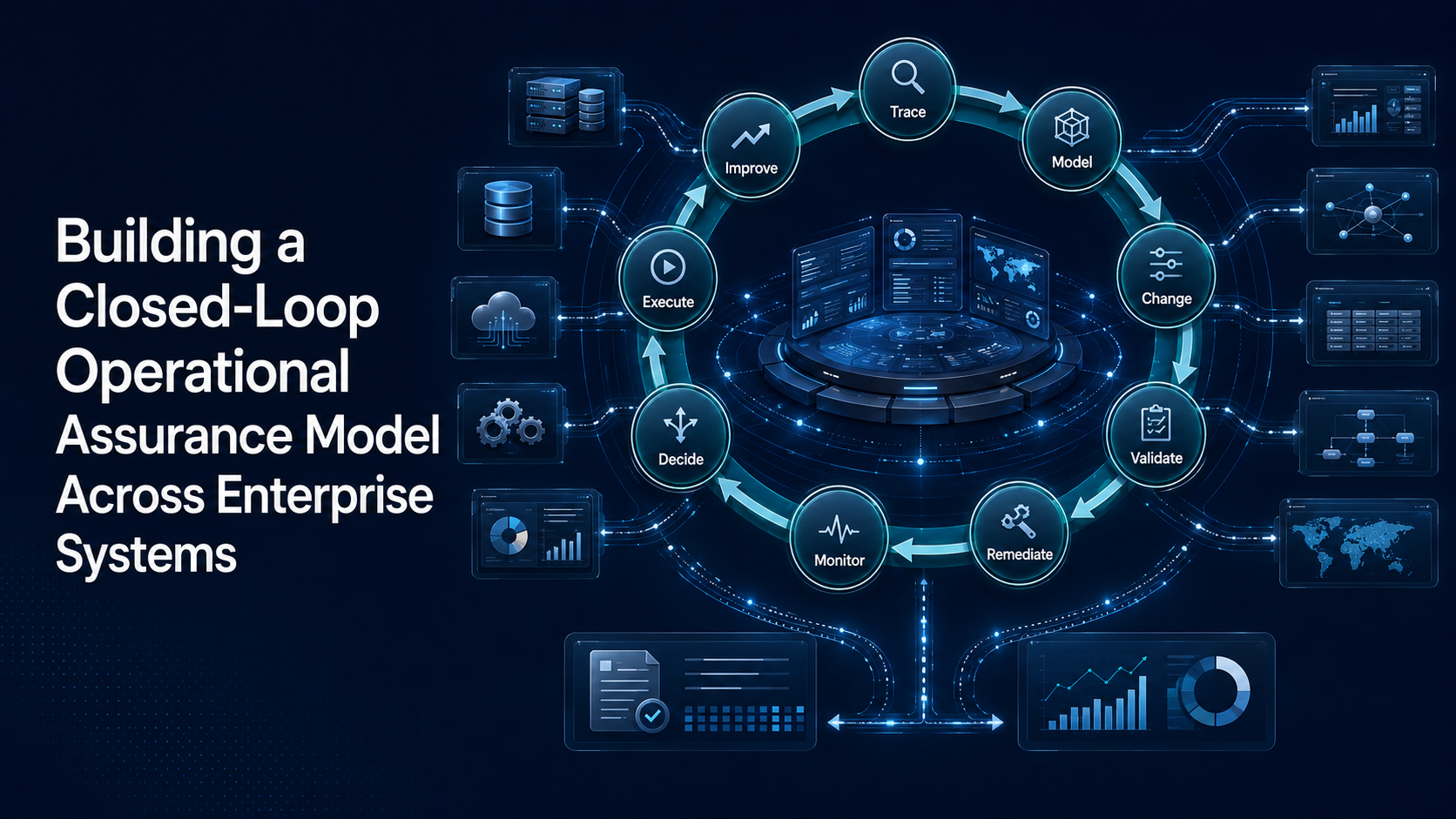
A Closed-Loop Operational Assurance Lifecycle
| Stage | Governance question | Control output |
|---|---|---|
| Trace | What obligation and authority apply? | Policy, control, population, versions |
| Model | How is the obligation operationalized? | Living control, workflow, dependencies |
| Change | What may alter control effectiveness? | Impact, approval, transition, rollback |
| Validate | Does design and execution meet intent? | Assertions, scenarios, evidence, readiness |
| Remediate | How is a deficiency contained and corrected? | Root cause, fix, retest, reconciliation |
| Monitor | Does the control remain effective? | Signals, sources, thresholds, health |
| Decide | What authorized response is required? | Investigation, containment, disposition |
| Execute | Did the mandate become the right outcome? | Actions, verification, reconciliation, closure |
| Improve | What must change in the operating model? | Governed learning and control evolution |
1. Establish Policy-To-Execution Traceability
The loop begins with an explicit obligation. BOC connects policy language to control objectives, authoritative sources, decision rights, workflow rules, evidence standards, and expected outcomes. This creates a common reference for operations, technology, risk, compliance, identity, procurement, and external providers.
Traceability makes interpretation visible. The enterprise process intelligence can see which policy version applies to which population, which role may decide, which system facts are authoritative, which tolerance is permitted, and which evidence demonstrates compliance. They can identify the dependent controls and events when an assumption or interpretation changes.
Without this foundation, later monitoring and testing become generic. Teams can demonstrate that an application worked without proving that they enforced the policy obligation. BOC ensures that assurance begins with the business condition that must remain true.
2. Maintain The Living Control Model
A living control model links policies, authority, workflows, integrations, owners, exceptions, evidence, dependencies, and business populations as current enterprise objects. It is not a static control library or process diagram. It records the versions and relationships that determine operational behavior now.
The model gives every governance activity context. Change-impact analysis can identify dependent controls. Validation can derive scenarios. Monitoring can target observable assertions. Signals can inherit policy and authority. Remediation can update the conditions that allowed failure. Decisions can carry exact scope into execution.
BOC keeps the model current through governed change rather than uncontrolled editing. Owners, approvals, effective dates, validation requirements, and evidence apply to control-model updates. The enterprise preserves history so it can reconstruct which model governed a past event.
3. Govern Change Before Control Drift Occurs
Enterprise conditions continually change: policy, roles, data, system configuration, workflow, integration contracts, vendors, thresholds, locations, and organizational structure. BOC treats these events as potential changes to operational control, not merely technical or administrative updates.
Governed impact analysis identifies affected policies, authority, controls, dependencies, active populations, evidence obligations, transition events, and rollback needs. Materiality determines review, approval, testing, monitoring, and activation requirements. The enterprise can move quickly because consequence and ownership are explicit.
Transition governance is essential. Queued events, cached identity, open approvals, active orders, partial fulfillment, and transactions spanning effective dates can fall between versions. BOC defines which control applies and how the transition population will be reconciled.
4. Validate Design, Implementation, and Operation
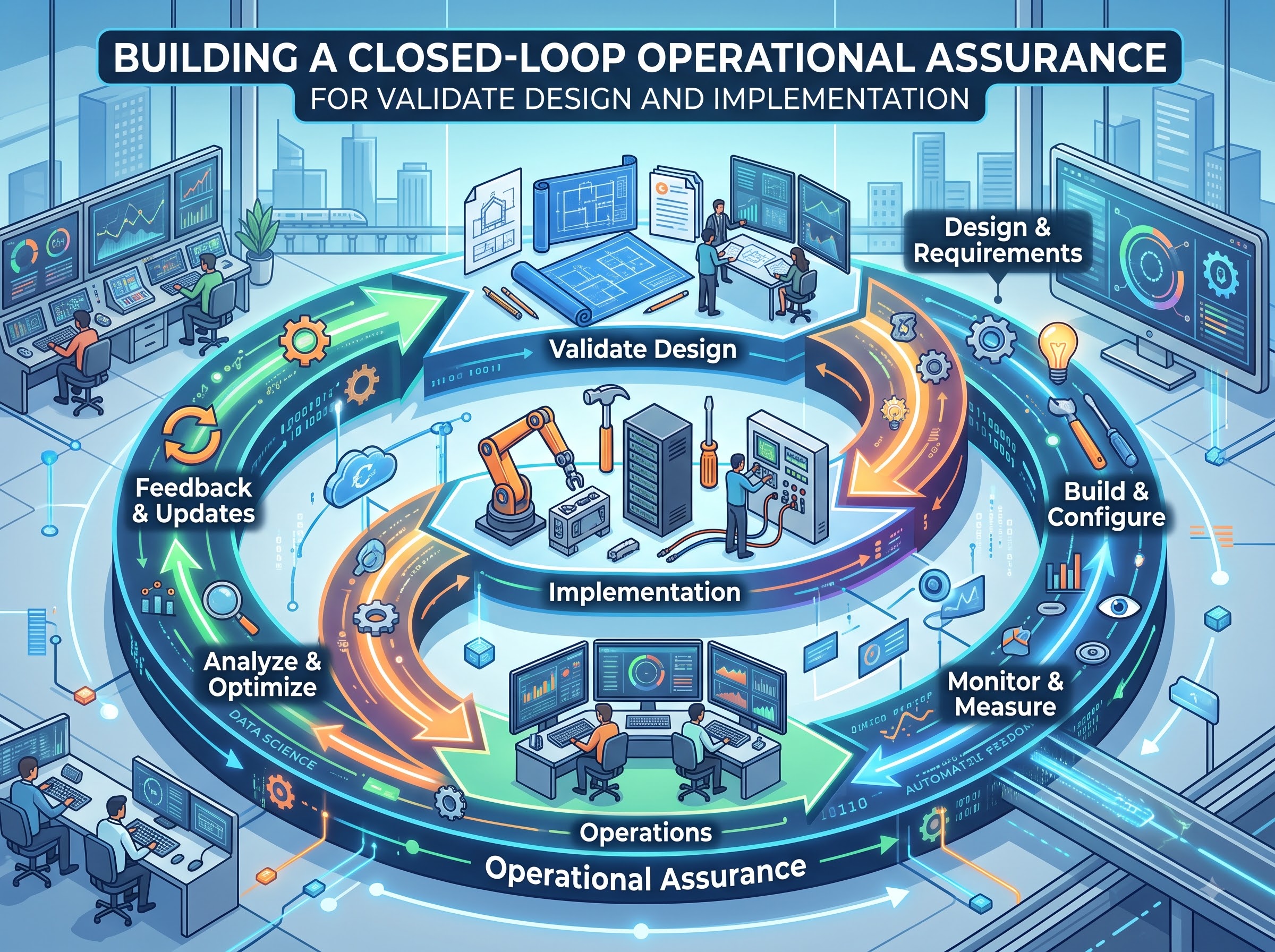
Validation converts control intent into observable assertions and risk-based scenarios. BOC tests whether the control is appropriately designed, implemented consistently across systems, and effective under representative operating conditions. Normal, boundary, negative, exception, recovery, and transition cases are linked to expected evidence.
A local pass result cannot substitute for an end-to-end outcome. The approval engine may route correctly while the approver lacks current authority. An API may respond successfully while a downstream acknowledgement is missing. A transaction may close while required evidence remains incomplete. Validation follows the governed event.
The output is an authorized readiness decision with findings, conditions, residual risk, monitoring, and post-activation obligations. Failed assertions do not disappear into project issue tracking; they become governed remediation connected to the original control objective.
5. Remediate Deficiencies and Preserve Learning
Governed remediation moves a confirmed deficiency through materiality, containment, root-cause analysis, corrective design, authorization, implementation, retesting, retrospective reconciliation, and closure. BOC keeps the failure connected to the affected population and business consequence as work crosses teams.
The unit of closure is restored control, not a completed fix. Correcting a configuration does not resolve decisions made under invalid authority. Restoring an integration does not reconcile missing downstream outcomes. Permanent correction, prior-population treatment, evidence, residual risk, and authorized closure remain distinct obligations.
Remediation improves the loop. Root causes update dependency maps, validation scenarios, monitoring signals, tolerances, ownership rules, data contracts, and change-impact standards. The same weakness should become easier to detect and harder to repeat.
6. Monitor Control and Operating Conditions
Continuous control monitoring observes the configurations, authority, events, exceptions, outcomes, and evidence that demonstrate whether controls remain effective. Frequency follows consequence: some conditions require event-level detection, while others justify daily, monthly, or risk-based review.
Teams must link monitoring requirements to explicit assertions, authoritative sources, populations, thresholds, owners, response times, evidence, and limitations. BOC also monitors the monitors: source health, data freshness, population completeness, rule execution, false positives, missed events, and overdue reviews.
The purpose is not alert volume. It is early, reliable evidence of material variation. A quiet dashboard cannot represent assurance when a source feed has stopped, a population is excluded, or a rule no longer reflects the approved control.
7. Convert Signals Into Authorized Decisions
A monitoring observation becomes a governed signal when it is qualified and connected to policy, control, business event, population, authority, and consequence. BOC prioritizes the signal through materiality, assigns an accountable owner, structures investigation, and governs containment before complete certainty when exposure warrants action.
Decision rights remain explicit. The authority to investigate, dismiss, contain, remediate, accept risk, reopen operations, or close may belong to different actors. Automation and AI can enrich, correlate, recommend, and route, but accountable judgment remains visible where policy requires it.
Every disposition preserves evidence, rationale, scope, residual uncertainty, conditions, monitoring, expiry, and improvement requirements. The decision can then become an executable mandate rather than a status stored in a case.
8. Trace Decisions Through Action and Closure
- The mandate defines exact scope, owners, actions, dependencies, versions, constraints, timing, acknowledgements, verification, reconciliation, and closure criteria. Work can be delegated across systems, functions, and providers without losing end-to-end obligation ownership.
- BOC distinguishes submitted, received, accepted, executed, verified, reconciled, and closed states. It governs exceptions and amendments during execution so workarounds cannot silently expand the decision. Evidence proves actions; reconciliation proves outcomes.
- Conditional closure retains residual obligations, compensating controls, owners, monitoring, due dates, expiry, and reopening conditions. Final closure is authorized only when the enterprise can demonstrate that the operating state matches approved intent or that the remaining difference has been accepted by the correct authority.
9. Feed Outcomes Back Into The Control Model
The loop closes when evidence from validation, monitoring, exceptions, decisions, standardizing identity execution, and reconciliation changes how the enterprise governs future work. BOC identifies recurring causes, ineffective tolerances, blind populations, bottlenecks, weak ownership, excessive overrides, and controls that do not produce the intended outcome.
- Improvements may revise policy interpretation, authority, workflow design, integration contracts, evidence standards, monitoring, testing, vendor obligations, or escalation. Each change re-enters governed impact analysis and validation rather than being applied informally.
- This feedback makes operational assurance adaptive. The model learns from real execution while preserving authority and control. Continuous improvement becomes governed evolution, not uncontrolled optimization.
- Where Closed-Loop Assurance Creates Enterprise Value
- Operations leaders gain one operating view of obligations, controls, changes, findings, signals, decisions, actions, outcomes, and unresolved risk across connected processes.
- Technology and integration teams gain precise business assertions, dependency context, evidence requirements, and outcome criteria that improve delivery and reduce ambiguous rework.
- Risk, compliance, internal control, and audit teams gain reconstructable lineage from policy through authority, execution, evidence, remediation, and continuous improvement.
- Enterprise leaders gain governance velocity: faster decisions and change because materiality, ownership, conditions, evidence, and residual exposure are visible in one closed loop.
- Buyers gain a clearer platform distinction. BOC operates as the assurance and operational-control layer, CCA supplies identity authority and governance, and BCM executes governed business-card conversion and fulfillment within the larger enterprise model.
Metrics For A Closed-Loop Assurance Model
- Traceability coverage: percentage of material obligations linked to authority, controls, populations, systems, evidence, and outcomes.
- Change assurance: proportion of material changes with impact analysis, validation, activation authority, transition treatment, and post-change verification.
- Control effectiveness: assertion coverage, first-pass validation, defect escape, recurring root cause, and observed outcome variance.
- Signal-to-decision performance: detection, qualification, ownership, containment, decision latency, evidence quality, and recurrence.
- Decision-to-outcome performance: action timeliness, acknowledgement integrity, verification, reconciliation coverage, and closure defects.
- Residual-obligation health: aging, materiality, monitoring completeness, expiry adherence, compensating-control effectiveness, and reopen rate.
- Learning yield: proportion of material findings, signals, and closure evidence that produce validated improvements to the control model.
Implementation Priorities For Enterprise Leaders
- Select one consequential cross-system business event and map the complete chain from policy and authority through execution, evidence, reconciliation, and closure.
- Create the common governance objects: obligation, control, population, change, validation, finding, remediation, signal, decision, action, outcome, evidence, and improvement.
- Define decision rights and ownership separately for design, change, validation, containment, remediation, risk acceptance, operational release, and closure.
- Connect authoritative sources and stable business identifiers before expanding automation; incomplete lineage creates faster uncertainty.
- Implement risk-based validation and monitoring standards that include negative, exception, recovery, transition, and outcome conditions.
- Measure end-to-end assurance latency and quality rather than local task, ticket, deployment, or alert performance alone.
- Use every material failure and exception to improve the living control model through governed change.
From Fragmented Governance To Continuous Operational Assurance
Posts 61–69 developed the essential disciplines of continuous governance: policy-to-execution traceability, the living control model, governed change, validation, remediation, monitoring, signal-to-decision workflows, and action-to-closure evidence. Post 70 brings them together as one operating model.
Business Ops Center does not replace the enterprise systems that hold data, identity, workflow, transactions, or fulfillment. It connects their business events to the authority, controls, decisions, evidence, and outcomes that determine whether operations remain governed.
The result is a closed-loop assurance capability: the enterprise knows what must remain true, who may decide, how controls operate, what changed, what evidence shows, where outcomes differ, who owns response, and how each lesson improves the next operating cycle.
If your assurance model still depends on separate policy libraries, identity tools, project systems, monitoring dashboards, ticket queues, evidence repositories, and retrospective audit reconstruction, the enterprise remains exposed between disciplines. Explore how Business Ops Center can create a closed operational loop across authority, change, execution, evidence, decisions, reconciliation, and improvement.