


A Decision Is Not an Outcome
Post 68 established the governed signal-to-decision workflow: observed variation is qualified, contextualized, prioritized, assigned, investigated, contained, and decided through current authority. Yet even a correct and well-evidenced decision can fail if the enterprise cannot translate it into controlled action and prove that the intended operational result occurred.
This failure is common across connected operations. A leader approves containment, but not every system applies the restriction. A control owner authorizes remediation, but in-flight work remains on the prior version. A risk acceptance is recorded, but monitoring and expiry are never activated. A vendor receives revised instructions, yet fulfillment continues under an obsolete specification. The decision exists; the enterprise process intelligence outcome does not.
Business Ops Center connects the authorized decision to execution, confirmation, exception handling, reconciliation, evidence, and closure. BOC treats the decision as the beginning of a governed action lifecycle rather than the endpoint of a meeting, approval, or case. The result is traceability from what was authorized to what changed in the real operating environment.
What Action-to-Closure Traceability Means
Action-to-closure traceability is the provable chain from an authorized decision through every required action, owner, system, provider, evidence source, verification step, unresolved condition, and closure authority. It preserves the exact decision version, scope, constraints, effective date, expiry, assumptions, and expected outcome as work moves into execution.
The record identifies the originating signal or obligation, decision-maker and authority basis, approved treatment, affected population, action plan, sequence, dependencies, assignees, due dates, system and workflow versions, acknowledgements, exceptions, reconciliations, outcome evidence, residual risk, monitoring requirements, and final closure decision. Each element remains linked rather than reconstructed after the fact.
Traceability is proportional. A low-risk correction may require owner confirmation and a controlled evidence artifact. A decision involving privileged access, financial release, regulated data, customer commitments, procurement, external fulfillment, or multi-system remediation may require staged activation, segregation, independent verification, transaction-level reconciliation, and continuing assurance after closure.
Why Approval Records Are Not Enough
Approval systems prove that a person selected an option at a point in time. They rarely prove that the approved version reached every execution channel, that action occurred within the authorized scope, or that downstream outcomes matched the decision. An approved request can still produce an unauthorized business result.
Project and ticketing tools provide task visibility but usually make the task—not the governed obligation—the unit of closure. A technical implementation can be marked complete while business operational reconciliation, evidence collection, vendor confirmation, customer correction, or residual-risk monitoring remains open. Status aggregation then creates the appearance of closure without operational proof.
BOC retains the decision object across organizational and system boundaries. Tasks can be delegated, integrations can execute, and providers can respond, but the enterprise obligation remains open until evidence demonstrates that the authorized outcome has been achieved or an authorized leader accepts the remaining difference.
The Traceability Context BOC Must Preserve
- Decision context: the issue, policy, control objective, options considered, approved treatment, rationale, authority, decision time, effective date, expiry, and conditions.
- Scope context: affected population, legal entities, geographies, customers, suppliers, identities, transactions, systems, in-flight work, exclusions, and version boundaries.
- Action context: accountable owners, required steps, sequence, dependencies, due dates, segregation, approval gates, fallback, rollback, and evidence requirements.
- Execution context: deployed configurations, workflow and integration versions, acknowledgements, vendor instructions, manual interventions, timestamps, retries, and status transitions.
- Outcome context: actual access, fulfillment, financial treatment, customer commitment, operational state, exception disposition, and comparison with authorized intent.
- Closure context: reconciliation, validation, residual risk, compensating control, monitoring, expiry, independent review, closure authority, and retained evidence.
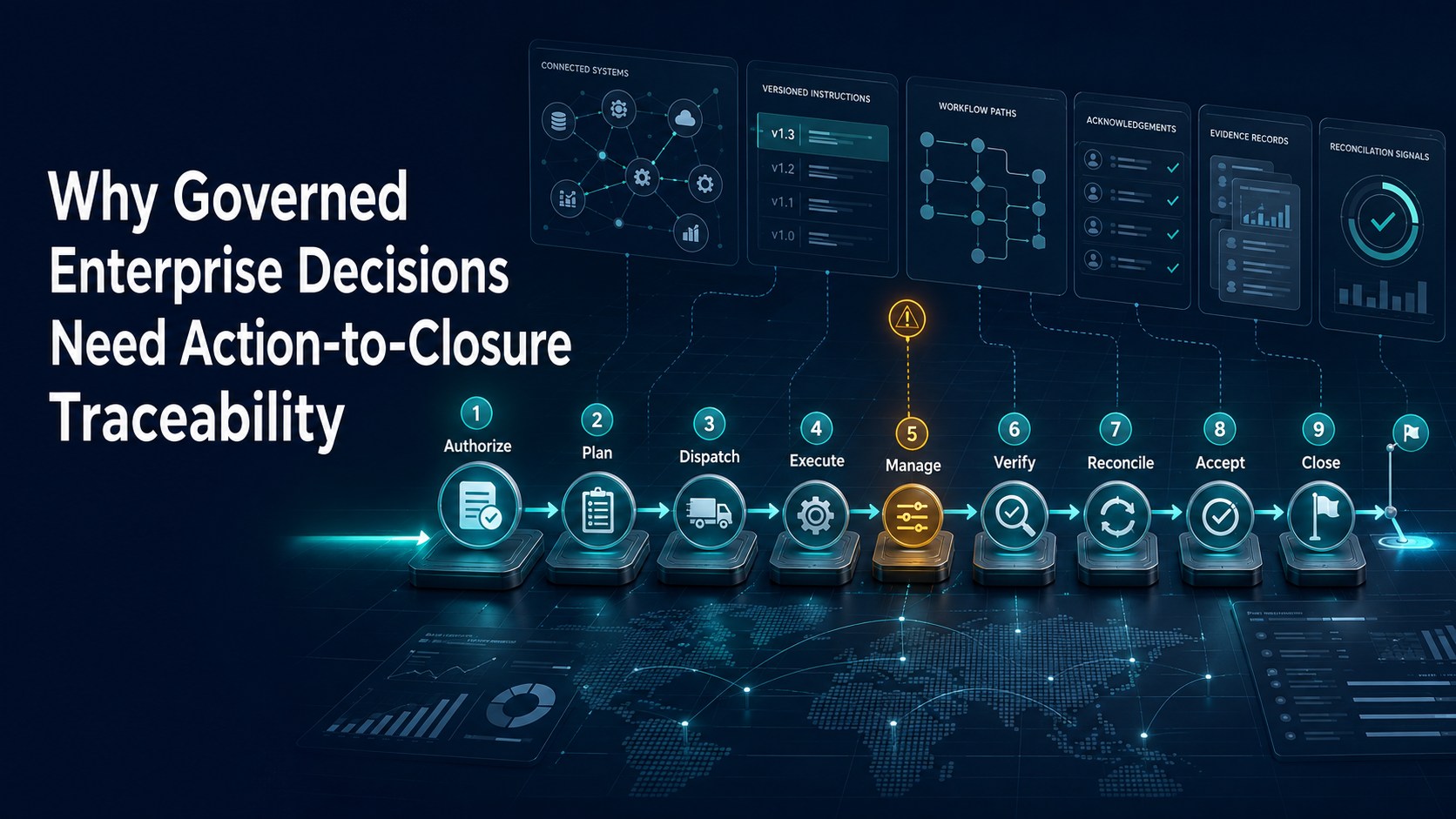
A Governed Action-to-Closure Lifecycle
| Stage | Governance question | Control output |
|---|---|---|
| Authorize | What exact outcome and constraints were approved? | Decision mandate, scope, authority, version |
| Plan | Which actions, owners, dependencies, and evidence are required? | Controlled action plan and closure criteria |
| Dispatch | Did every execution channel receive the correct mandate? | Versioned instruction and acknowledgement |
| Execute | Were actions performed by permitted actors and systems? | Execution records, timestamps, approvals |
| Manage | How were failures, changes, and exceptions governed? | Containment, amendment, escalation, disposition |
| Verify | Does evidence prove each required action? | Independent confirmation and evidence set |
| Reconcile | Does actual outcome match authorized intent? | Population comparison, corrections, residuals |
| Accept | Who may accept remaining difference or conditions? | Residual-risk decision, monitoring, expiry |
| Close | Is the obligation complete and defensible? | Authorized closure and retained evidence |
Translating the Decision Into an Executable Mandate
The first obligation is precision. BOC converts the decision into an executable mandate that identifies what must happen, what must not happen, who may act, which population is affected, when the change becomes effective, what dependencies matter, and what evidence will prove completion. Ambiguous approval language cannot govern distributed execution.
The mandate preserves the exact approved version. If scope, timing, treatment, or assumptions change, BOC requires a new authorized decision or controlled amendment rather than allowing enterprise execution excellence teams to reinterpret the original instruction. Version lineage prevents a later outcome from being attributed to a decision that did not actually authorize it.
Constraints travel with the mandate. A temporary restriction, compensating control, customer-notification requirement, legal review, rollback condition, or evidence standard remains visible to every downstream action owner. This reduces the risk that execution optimizes for speed while dropping the conditions that made the decision acceptable.
Decomposing Work Without Fragmenting Accountability
Enterprise decisions often require coordinated action across operations, technology, identity, finance, procurement, risk, compliance, customer teams, vendors, and external fulfillment. BOC decomposes the mandate into owned actions while preserving the relationship between each task and the overall obligation.
Each action has an accountable owner, due date, prerequisite, permitted actor, required approval, expected evidence, completion criteria, and escalation path. Dependencies make sequence explicit: access cannot be restored before validation, an order cannot close before acknowledgement, and a compensating control cannot be removed before permanent remediation is proven.
The obligation owner remains responsible for end-to-end closure even when work is delegated. BOC distinguishes action assignment from outcome accountability and decision authority. A collection of completed tasks cannot automatically close the governed object when evidence, reconciliation, or risk acceptance remains incomplete.
Executing Across Systems and Providers
Controlled execution may occur through workflow automation, APIs, configuration changes, service platforms, manual procedures, or vendor instructions. BOC links each execution event to the authorized mandate, current version, permitted actor, timestamp, and target object. This creates a consistent evidence model across heterogeneous channels.
Acknowledgement is more than message delivery. The enterprise needs to know whether the receiving system or provider accepted the instruction, applied the correct version, acted on the intended population, and returned a status whose meaning is understood. BOC distinguishes submitted, received, accepted, executed, verified, and reconciled states.
Manual execution must remain governed as well. Temporary workarounds record the operator, source information, approvals, evidence, segregation, exception handling, and reconciliation requirement. A manual path should not become an invisible channel that bypasses the traceability expected of automated systems.
Managing Exceptions During Execution
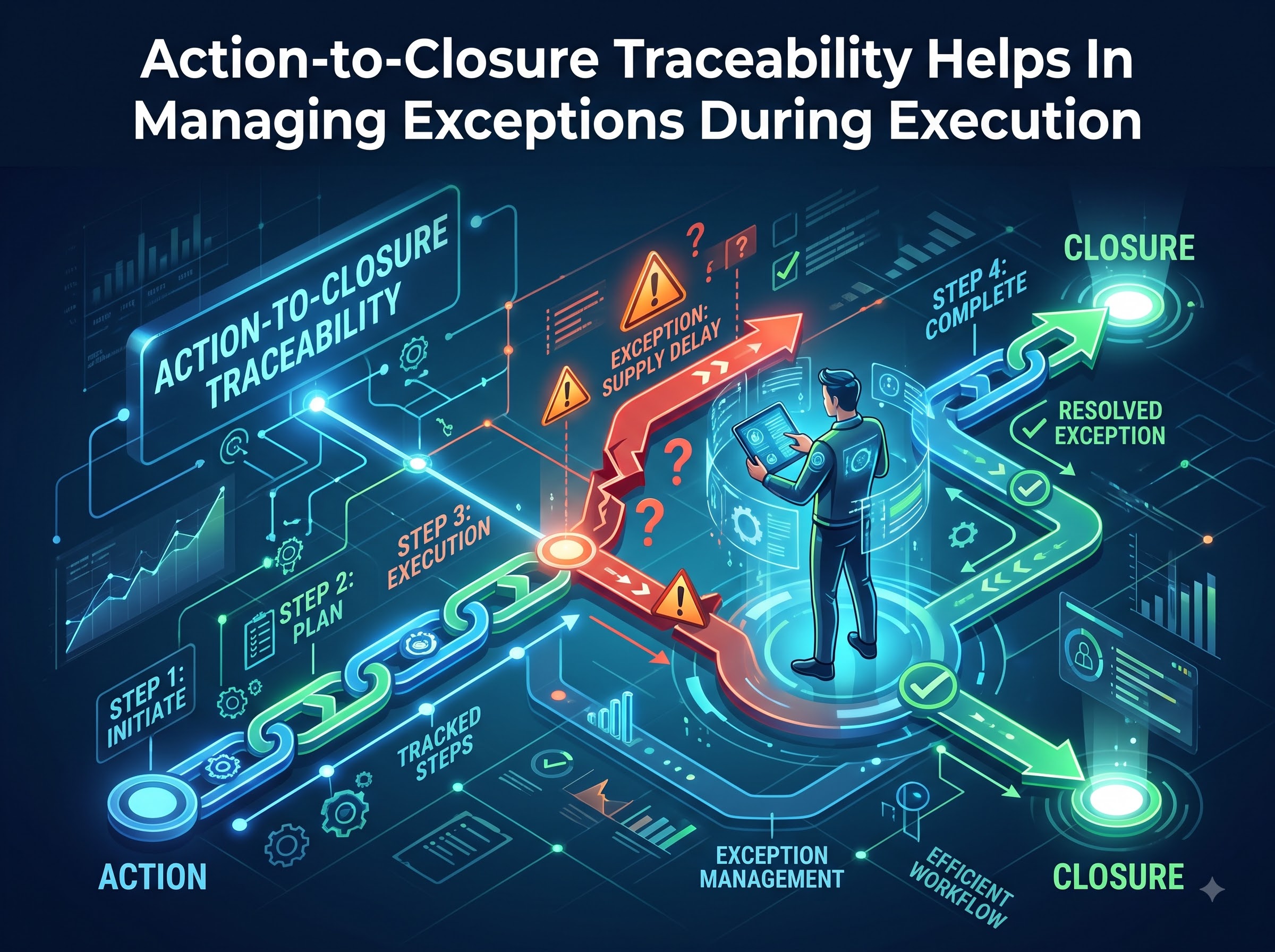
Execution rarely follows the ideal path. Systems may be unavailable, identities may not match, transactions may be duplicated, suppliers may reject instructions, evidence may arrive late, or dependencies may change. BOC creates governed exceptions attached to the decision and affected action rather than leaving failures in local logs or communications.
Each exception carries materiality, owner, due date, containment, escalation, affected population, evidence, and allowed disposition. The workflow determines whether standardizing identity execution can continue, must pause, requires an amendment, or needs a new decision. This prevents an operational workaround from silently expanding the authorized scope.
Exception patterns also reveal whether the decision was operationally feasible. Repeated failures may indicate incomplete impact analysis, inadequate data, unrealistic timing, unclear ownership, a weak vendor agreement, or a control design that cannot survive actual conditions. BOC feeds that evidence back into the living control model.
Verifying Action Before Declaring Completion
Action completion should require evidence appropriate to the obligation. A configuration screenshot may show that a setting changed, but it does not prove that the correct population inherited the change. A vendor email may acknowledge instruction without proving fulfillment. A successful API response may not establish downstream business state.
BOC defines evidence at design time: source records, configuration versions, approvals, event histories, acknowledgements, test results, transaction comparisons, access-state checks, fulfillment proof, financial postings, customer confirmation, or independent review. Evidence remains tied to the relevant action and decision version.
Verification is separate from performance where consequence warrants independence. The implementer can report completion, while an authorized reviewer confirms that evidence is sufficient and the action achieved the intended control outcome. This separation protects the enterprise from self-attested closure.
Reconciliation as the Core of Operational Truth
Reconciliation compares authorized intent with actual execution. BOC determines whether the exact population, scope, timing, values, identities, vendors, and outcomes match the decision. It can identify omissions, duplicates, unauthorized substitutions, partial execution, stale versions, delayed results, and evidence gaps that component-level success cannot reveal.
The reconciliation population must include work already in flight when the decision became effective. Queued messages, open approvals, cached access, active orders, partial fulfillment, and transactions spanning time zones can cross the version boundary. BOC applies explicit transition rules so these events do not disappear between the old and new operating states.
Differences do not all require the same response. Some can be corrected, some need expanded investigation or remediation, and some may be accepted as residual risk by the proper authority. Every variance remains visible until treated, evidenced, and connected to the final closure decision.
Conditional Closure and Residual Obligations
Closure may be conditional when part of the approved outcome is complete, but a bounded obligation remains. BOC records the unresolved scope, rationale, compensating control, owner, monitoring frequency, evidence requirement, due date, expiry, escalation, and authority that accepted the condition.
Conditional closure is not disappearance. Open obligations remain active and return for review before expiry. Missed milestones, monitoring failure, population growth, new exceptions, or deterioration in the compensating control can reopen the decision or suspend the operating state.
BOC distinguishes action completion, outcome verification, risk acceptance, and final closure. These states make executive reporting more truthful: leaders can see what has been executed, what has been proven, what remains exposed, and which authority is accountable for the difference.
Where Action-to-Closure Traceability Creates Value
- Operations leaders gain a single view of decision execution, action ownership, exceptions, evidence, reconciliation, and unresolved obligations across functions and systems.
- Technology, integration, and vendor teams receive precise mandates, version context, dependencies, acknowledgements, and verification criteria that reduce interpretation and rework.
- Risk, compliance, internal control, and audit teams gain reconstructable traceability from decision authority through execution, evidence, variance treatment, residual risk, and closure.
- Enterprise leaders gain confidence that reported completion represents operational truth, not merely approved requests, deployed changes, or closed tasks.
Metrics That Reveal Closure Quality
- Mandate completeness: percentage of decisions translated into versioned scope, owners, dependencies, evidence, reconciliation, and closure criteria.
- Action-on-time rate: proportion of required actions completed within the decision’s authorized timing and sequence.
- Acknowledgement integrity: percentage of downstream instructions with unambiguous receipt, acceptance, execution, and status evidence.
- First-pass verification: percentage of actions whose evidence proves the expected outcome without rework or expanded investigation.
- Reconciliation coverage: proportion of the affected population compared with authorized intent, including in-flight and transition events.
- Decision-to-outcome latency: elapsed time from authorization to verified business outcome, separated from task completion time.
- Conditional-closure aging: number, materiality, and duration of open residual obligations, compensating controls, and accepted risks.
- Closure defect rate: cases reopened because population, evidence, authority, outcome, or residual obligation was incomplete at closure.
Implementation Priorities for Enterprise Leaders
- Start with consequential decisions that cross multiple systems, functions, or providers and currently fragment into project plans, tickets, emails, and local evidence.
- Define a governed decision mandate containing scope, version, constraints, effective date, owners, actions, dependencies, evidence, reconciliation, and closure criteria.
- Separate action assignment from obligation ownership, verification authority, risk acceptance, and final closure authority.
- Require downstream acknowledgements to distinguish receipt, acceptance, execution, verification, and reconciliation rather than using a generic success status.
- Include in-flight work and transition populations in every material decision so events cannot escape between operating versions.
- Keep execution exceptions, amendments, residual obligations, monitoring, and expiry connected to the original decision.
- Measure decision-to-outcome latency and closure quality—not merely approval time, deployment completion, or task closure.
Questions Enterprise Buyers Should Ask
- Can the platform preserve the exact authorized decision, version, scope, constraints, effective date, expiry, and authority basis through execution?
- Can it decompose cross-functional work without losing end-to-end obligation ownership and decision lineage?
- Can execution across APIs, workflows, systems, manual paths, and vendors produce consistent acknowledgement and evidence states?
- Can exceptions change execution, containment, escalation, amendment, and decision requirements without silently expanding scope?
- Can the platform reconcile authorized intent with actual outcomes across the full population, including in-flight and transition events?
- Can conditional closure enforce owners, compensating controls, monitoring, evidence, due dates, expiry, and reopening rules?
- Can leaders distinguish action completion, outcome verification, residual-risk acceptance, and authorized final closure?
From Governed Decisions to Verified Operational Closure
Business Ops Center preserves the mandate as work crosses teams, systems, integrations, and external providers. It keeps actions versioned, owners accountable, exceptions governed, acknowledgements meaningful, and evidence connected. Reconciliation determines whether the real operating state matches what leadership authorized.
The result is not more task tracking. It is a defensible enterprise business card analytics record showing how a decision became an outcome, which differences remained, who accepted them, and why the organization could legitimately declare the obligation closed.
If your organization can approve enterprise actions but cannot prove that the exact mandate reached every execution channel, produced the intended outcome, reconciled the affected population, and closed residual obligations through current authority, decision governance remains incomplete. Explore how Business Ops Center can connect authorization, action, evidence, reconciliation, and closure across enterprise operations.