


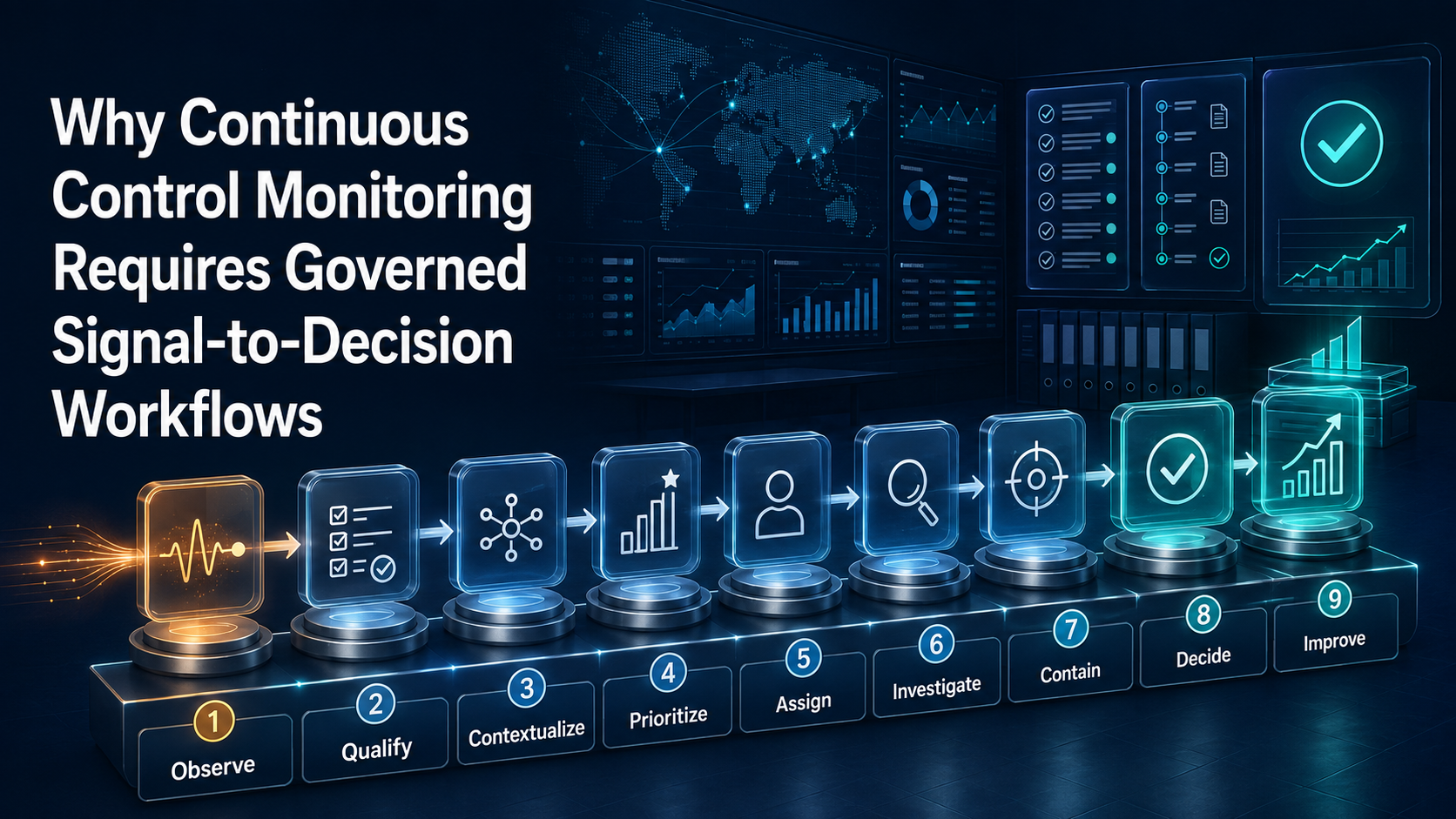
Detection Creates Awareness; Governance Creates Action
Continuous control monitoring gives the enterprise earlier visibility into policy drift, invalid authority, workflow deviation, integration failure, exception aging, unreconciled outcomes, and missing evidence. But detection alone does not restore control. A signal must become accountable work, and accountable work must reach a decision that is appropriate to the business consequence.
This transition is where many monitoring programs weaken. Technical tools produce alerts, dashboards, scores, and anomaly notifications, yet the information arrives without the policy context, control objective, authoritative population, materiality, owner, response obligation, or decision right required for action. Teams debate severity while exposure continues, or they close alerts without proving that the underlying obligation remained intact.
Business Ops Center creates a governed signal-to-decision workflow. BOC connects the observation to the affected policy, authority model, workflow version, system dependency, business event, prior governed control remediation, expected evidence, accountable owner, and authorized disposition. The result is not simply better alert management. It is a defensible chain from observed variation to operational truth and enterprise action.
What a Governed Signal-to-Decision Workflow Means
A governed signal-to-decision workflow is the structured process through which an observed control condition is contextualized, qualified, prioritized, assigned, investigated, contained, decided, evidenced, and used to improve the operating model. Every stage preserves lineage to the control assertion and the population or event that produced the signal.
The record includes the signal and rule versions, source systems, time window, business identifiers as governance, affected population, expected and observed condition, data-quality status, materiality, owner, service level, escalation, investigation evidence, containment, root cause, decision authority, disposition, residual risk, closure evidence, and improvement action. This context keeps operational response from becoming detached ticket work.
Governance is proportional. A low-confidence deviation may require validation of source completeness before business escalation. A prohibited access grant, unauthorized financial release, regulated-data exposure, or customer-impacting fulfillment variance may require immediate containment and senior authority. The workflow must adapt without sacrificing traceability or allowing urgency to bypass accountability.
Why Alert Management Is Not Decision Governance
Alert-management tools are generally designed to collect, deduplicate, route, acknowledge, and close notifications. These capabilities are useful, but a closed alert may mean only that someone reviewed the message. It does not prove that the affected business population was understood, that exposure was contained, that the correct authority decided the outcome, or that the control model was improved.
Enterprise operational excellence materiality also differs from technical severity. A short interface delay can be immaterial when reconciliation completes within tolerance, while one technically successful transaction can be material if it used expired approval authority. A small data variance can matter greatly in a regulated population. BOC evaluates consequence through policy, value, scope, duration, reversibility, detectability, and downstream impact.
Decision governance therefore changes the unit of work. The enterprise is not managing an alert; it is governing a potential deviation from an operational obligation. BOC keeps the signal attached to the obligation until evidence supports dismissal, correction, remediation, acceptance, or closure.
The Signal Context BOC Must Preserve
- Control context: the policy, control objective, assertion, expected outcome, tolerance, effective date, and evidence standard that give the signal meaning.
- Authority context: the current owner, reviewer, containment authority, risk acceptor, escalation authority, delegations, limits, segregation requirements, and expirations.
- Business-event context: the request, transaction, enterprise identity infrastructure, order, approval, vendor, legal entity, location, customer commitment, or other governed object affected.
- System context: authoritative sources, integrations, rule and configuration versions, identifiers, acknowledgements, data freshness, completeness, and known blind spots.
- Exposure context: population, materiality, duration, value, recurrence, reversibility, affected stakeholders, and the possibility that the observed sample indicates a broader condition.
- Decision and evidence context: investigation history, containment, disposition, residual risk, retest or reconciliation requirements, supporting evidence, and improvement commitments.
A Governed Signal-to-Decision Lifecycle
| Stage | Governance question | Control output |
|---|---|---|
| Observe | What condition did monitoring detect? | Raw signal, source, rule version, timestamp |
| Qualify | Is the signal credible and complete? | Health check, deduplication, coverage, confidence |
| Contextualize | Which obligation and population may be affected? | Policy, control, event, authority, exposure |
| Prioritize | What consequence and response time apply? | Materiality, severity, SLA, escalation |
| Assign | Who owns investigation and coordination? | Accountable owner, reviewers, decision authorities |
| Investigate | What explains the signal and its scope? | Evidence, population, root cause, uncertainty |
| Contain | What action protects operations now? | Authorized restriction, fallback, monitoring, expiry |
| Decide | What disposition is supported and permitted? | Dismiss, correct, remediate, accept, suspend |
| Improve | What must change in monitoring or control? | Rule, scenario, ownership, policy, assurance |
From Observation to Qualified Signal
The workflow begins by preserving the raw observation exactly as the approved monitoring rule produced it. BOC records the source, query or rule version, expected condition, observed value, timestamp, affected identifier, and population coverage. This immutable basis prevents later interpretation from rewriting what the monitoring mechanism actually detected.
Qualification determines whether the observation is technically and operationally credible. The enterprise checks source availability, data freshness, population completeness, duplicate activity, known maintenance, threshold logic, and rule health. A monitoring failure may itself become a governed exception, while an invalid observation can be dismissed only with evidence and authorized rationale.
A qualified signal is then enriched with business context. BOC links the event to policy, authority, workflow, integration, prior findings, open remediation, customer or financial consequence, and required response time. Context transforms a cryptic alert into a decision-ready statement of what may be wrong and why it matters.
Materiality and Priority Must Be Explicit
Priority should reflect business exposure rather than queue order, alert volume, or the preference of the loudest stakeholder. BOC applies governed criteria such as prohibited activity, monetary value, privilege, regulated scope, customer commitment, population size, duration, recurrence, reversibility, and time available for containment.
Materiality can change as investigation expands the population. A single unmatched acknowledgement may initially appear isolated; evidence of an integration backlog can make it systemic. A role variance may become material when it affects an approval threshold or incompatible duty. BOC preserves each reassessment, its evidence, and the authority behind the new classification.
Priority also drives service levels, required independence, escalation, and containment. The enterprise can reserve scarce reviewers for high-consequence conditions without allowing lower-priority items to disappear. Aging, recurrence, expiring temporary controls, and missed evidence can automatically increase attention.
Ownership, Assignment, and Escalation
A signal needs an accountable owner who can coordinate the end-to-end obligation, not merely the component that emitted the alert. The owner may depend on policy domain, business process, legal entity, system, vendor, value, or consequence. BOC applies current assignment rules and preserves the reason an owner was selected.
Assignment does not transfer decision authority automatically. An operations analyst may investigate, technology may correct a source problem, risk may assess exposure, and a control owner may decide disposition. CCA can provide current authority and delegation context while BOC orchestrates the work and evidence across these roles.
Escalation should be a governed response to consequence, time, uncertainty, or failed ownership. BOC can escalate when a material signal remains unacknowledged, containment is overdue, the population expands, a compensating control expires, evidence is insufficient, or the assigned decision exceeds delegated authority.
Investigation as Controlled Enterprise Work
Investigation tests competing explanations. The signal may represent real control failure, source-data error, expected variation, configuration drift, operator behavior, vendor action, incomplete evidence, or a monitoring-rule defect. BOC structures the questions, evidence sources, population expansion, interviews, comparisons, and independent review needed to reach a supported conclusion.
The process should preserve negative as well as confirming evidence. Investigators record what was checked, which versions and time windows applied, what could not be observed, and which assumptions remain. Reproducible queries, source snapshots, event histories, approvals, acknowledgements, and reconciliations reduce reliance on individual memory.
Investigation also searches for related conditions. A failed approval may share a root cause with other business units, thresholds, vendors, or integrations. BOC can relate signals by control, identifier, time, cause, remediation history, or dependency so systemic exposure is not fragmented into apparently isolated tickets.
Containment Before Complete Certainty
Material signals may require protective action before root cause is fully established. BOC governs containment such as pausing release, narrowing permissions, adding secondary approval, switching to a controlled fallback, isolating a vendor or interface, increasing reconciliation, or preventing closure without evidence.
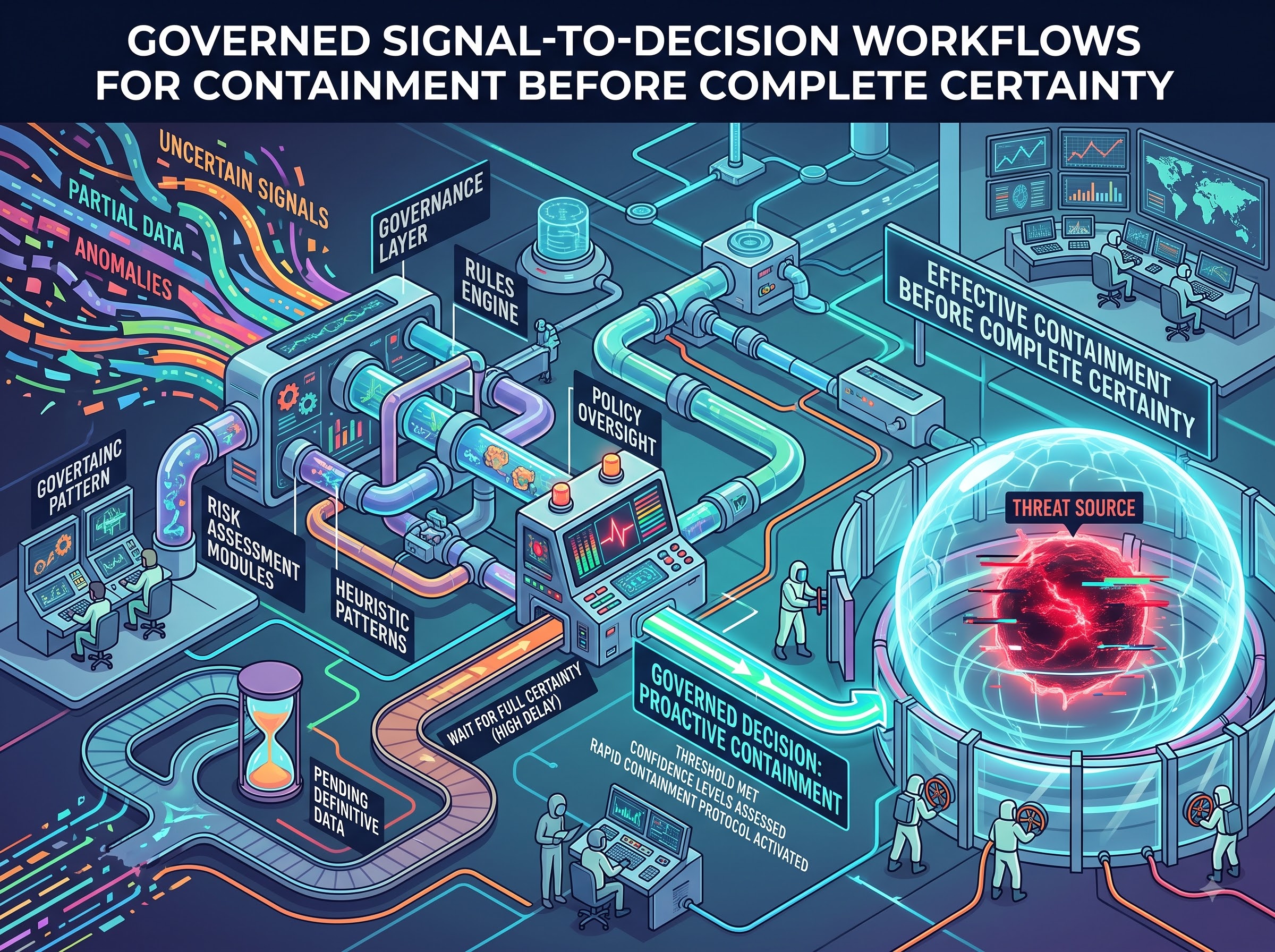
Containment decisions define scope, owner, effective time, authority, monitoring, expiry, evidence, and removal criteria. They also identify operational cost and unintended consequences. A temporary manual path can reduce immediate exposure while creating backlog, segregation, or data-quality risk that requires separate control.
The workflow keeps containment distinct from resolution. A stable environment after restriction does not prove that the original control is effective. Permanent correction, validation, retrospective reconciliation, and authorized closure remain visible obligations.
Decision Rights and Authorized Disposition
A governed workflow separates the authority to investigate, dismiss, contain, remediate, accept risk, reopen operations, and close the case. These rights may be held by different people and may vary by value, population, geography, policy, or control domain. Delegations and expirations must be enforced at the moment of decision.
Disposition options should be explicit: false or non-actionable signal with evidence; expected variation within approved tolerance; operational exception requiring correction; control deficiency requiring remediation and retesting; accepted residual risk with conditions; or immediate suspension and escalation. A generic resolved status hides meaningful differences.
Every disposition records the decision-maker, authority basis, evidence reviewed, rationale, affected population, residual uncertainty, required actions, monitoring, expiry, and conditions that would reopen the case. This produces a defensible record for operations, management, risk, compliance, and audit.
Automation, AI, and Human Accountability
Automation can correlate events, enrich context, apply deterministic rules, calculate aging, identify similar cases, recommend priority, route work, enforce service levels, and assemble evidence. AI can help summarize complex histories or propose investigation paths. These capabilities increase speed when their sources, limitations, and confidence are visible.
The system should not silently replace policy-assigned judgment. Materiality, ambiguous causation, compensating controls, customer or regulatory impact, and residual-risk acceptance often require accountable human decisions. BOC records where automation acted, where a person reviewed, and where the authorized decision differed from a recommendation.
Automation itself must be governed. Models, rules, prompts, thresholds, training or reference data, access, versions, performance, overrides, and change approvals need control. A recommendation that cannot be reconstructed should not become the hidden basis for a material enterprise decision governance.
Where Signal-to-Decision Governance Creates Value
- Operations leaders gain prioritized, contextualized work with visible ownership, containment, aging, dependencies, and decision status instead of disconnected alert queues.
- Technology and integration teams receive precise business impact, evidence requirements, and closure criteria that help them solve the relevant obligation rather than optimize only component health.
- Risk, compliance, internal control, and audit teams gain traceability from monitoring rule and observed population through investigation, authority, disposition, remediation, reconciliation, and improvement.
- Enterprise leaders gain faster, more defensible action because signals reach the correct authority with the context needed to decide, while low-value noise can be challenged systematically.
Metrics That Reveal Workflow Quality
- Context completeness: percentage of qualified signals linked to control, policy, business event, population, authority, source, and evidence requirements.
- Time to qualification: elapsed time from raw observation to a credible, contextualized signal.
- Time to ownership: elapsed time from qualification to accountable acceptance of the case.
- Time to containment: elapsed time from materiality confirmation to active protective action.
- Decision latency: elapsed time from sufficient evidence to authorized disposition, separated from investigation time.
- Reassignment and escalation rate: frequency with which ownership rules, capacity, or authority are insufficient for the signal population.
- Disposition quality: recurrence, reopen rate, missed population, overdue conditions, and evidence defects following closure.
- Learning yield: percentage of material cases that improve monitoring, control design, validation, ownership, or policy interpretation.
Implementation Priorities for Enterprise Leaders
- Start with one material monitoring domain where alerts currently move across dashboards, ticketing, email, risk systems, and spreadsheets before a decision is reached.
- Define the governed signal object: control, observation, source, population, materiality, business context, owner, service level, evidence, and decision rights.
- Separate raw observation, qualified signal, governed exception, control finding, remediation, accepted risk, and closure as distinct states.
- Establish authority for investigation, containment, dismissal, remediation, risk acceptance, operational release, and final closure.
- Make data-quality and monitoring-health checks part of qualification so unreliable signals do not create false assurance or unmanaged blind spots.
- Connect material cases to remediation, retesting, reconciliation, and the living control model rather than ending the workflow at ticket closure.
- Measure latency, recurrence, evidence quality, and learning—not only alert counts and service-level compliance.
Questions Enterprise Buyers Should Ask
- Can the platform preserve lineage from a monitoring observation to the exact policy, control, source, rule version, population, and business event?
- Can it distinguish raw alerts, qualified signals, governed exceptions, control findings, remediation, and residual-risk acceptance?
- Can materiality and priority incorporate authority, value, regulated scope, recurrence, reversibility, duration, and downstream consequence?
- Can ownership, escalation, and service levels change dynamically as evidence or population expands?
- Can containment be authorized, time-bound, monitored, evidenced, and kept separate from permanent resolution?
- Can automation and AI recommendations remain explainable, versioned, reviewable, and subordinate to accountable decision rights?
- Can every disposition feed monitoring improvements, control-model updates, validation scenarios, and future remediation standards?
From Continuous Detection to Governed Enterprise Decisions
Post 67 established how remediation evidence should feed continuous control monitoring. Post 68 addresses the operational obligation created when monitoring detects variation: the enterprise must convert a signal into a timely, contextualized, authorized, and evidenced decision.
Business Ops Center governs that path from observation through qualification, enrichment, materiality, ownership, investigation, containment, disposition, and learning. Authority remains current. Evidence remains connected. Remediation and reconciliation remain visible when a signal exposes genuine control weakness.
The result is not a larger alert-management system. It is an operational control layer that helps the enterprise decide what a signal means, who must act, which protective measure is permitted, what outcome is accepted, and how the control model must improve.
If your organization can detect control deviations but still relies on email, disconnected tickets, meetings, and local judgment to determine ownership, materiality, containment, and closure, monitoring has not yet become governance. Explore how Business Ops Center can connect enterprise signals to accountable decisions, remediation, reconciliation, and continuous control improvement.