


Introduction: Resilience Beyond Disaster Recovery
For many years, enterprise resilience was closely associated with disaster recovery plans, backup systems, emergency communication procedures, and business continuity documentation. These capabilities remain important, but they address only part of the challenge. Most operational disruption does not arrive as a single catastrophic event. It appears as a series of connected pressures: a supplier delay, a policy change, a sudden increase in demand, a cyber incident, a workforce shortage, a failed integration, or a regulatory requirement that affects multiple regions at once.
The operational impact of these events is rarely confined to one department. A procurement delay may affect manufacturing, finance, customer delivery, legal review, and executive forecasting. A cybersecurity issue may require immediate action across IT, HR, communications, compliance, and customer support. A regulatory change may force organizations to redesign workflows, documentation, approval rules, and reporting structures at enterprise scale.
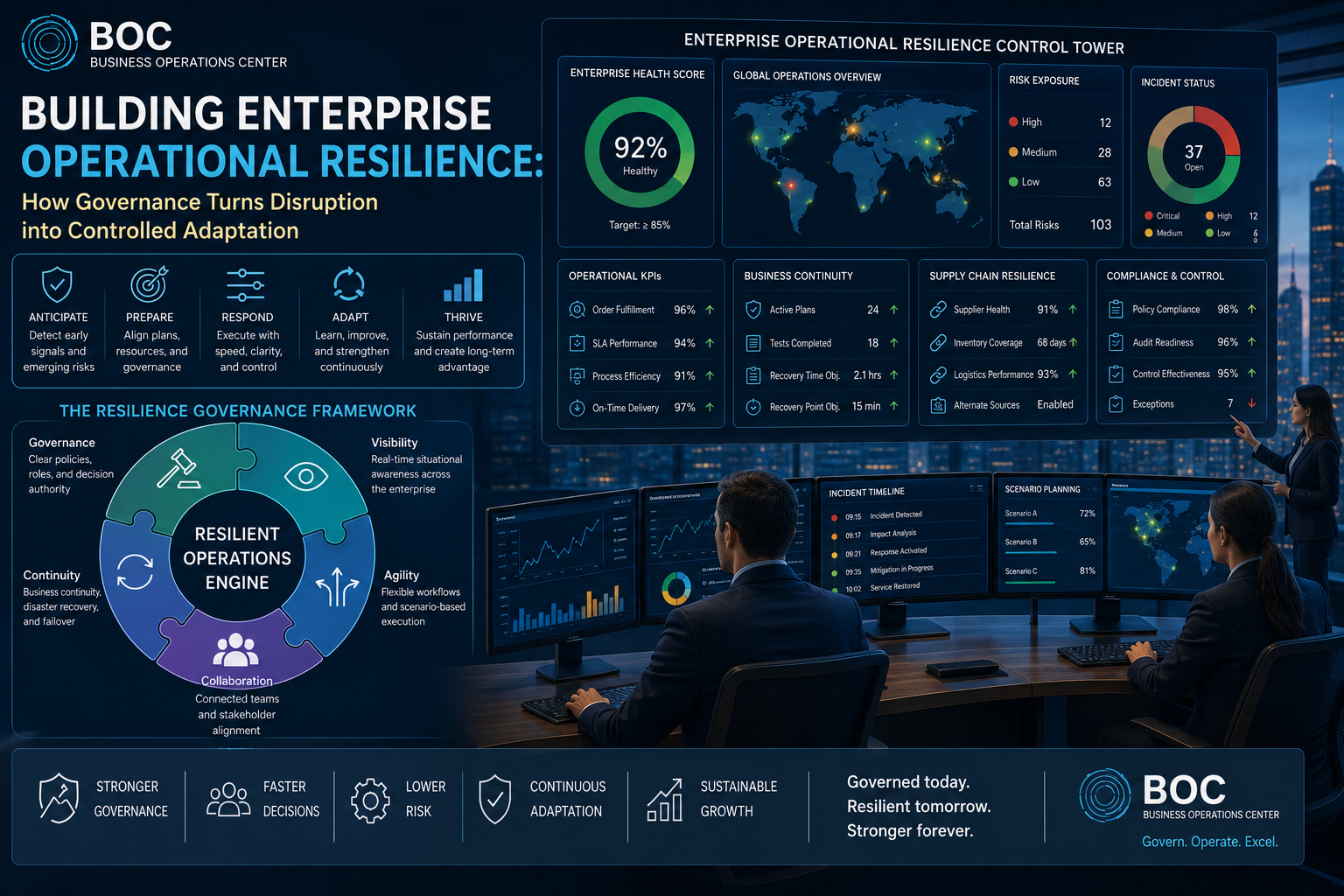
In this environment, resilience depends less on isolated recovery plans and more on the quality of the enterprise operating model. Organizations must be able to see disruption early, understand its consequences, coordinate decisions, adapt workflows, and maintain governance throughout the response. BOC enables this by turning resilience into a governed operational capability rather than an emergency-only function.
Why Traditional Continuity Models Are No Longer Enough
Traditional continuity planning often focuses on restoring specific systems or locations. The underlying assumption is that normal operations are known, disruption is temporary, and the objective is to return to a previous state as quickly as possible. Modern enterprises operate under different conditions. Their systems are interconnected, their teams are distributed, their workflows span internal and external participants, and their regulatory obligations change continuously.
A technically successful recovery can still produce operational failure. Systems may be online while approvals remain stalled. Data may be restored while ownership is unclear. Employees may have access to applications while priority decisions are unresolved. Customers may continue submitting requests while the organization lacks a coordinated method to assess capacity and risk.
The limitation is not simply technological. It is structural. When governance, workflows, communications, and operational intelligence are fragmented, resilience plans become difficult to execute consistently. The enterprise may recover infrastructure without recovering execution. BOC addresses this gap by coordinating the work that must happen across systems, functions, policies, and decision authorities.
The New Definition of Enterprise Operational Resilience
Enterprise operational resilience is the ability to sustain critical outcomes, adapt governed workflows, and preserve decision quality under changing or adverse conditions. This definition expands resilience beyond recovery. It includes anticipation, absorption, adaptation, and improvement.
Anticipation
Organizations identify vulnerabilities, dependencies, capacity constraints, and emerging risk patterns before they become operational failures. Anticipation requires trusted data, standardized metrics, and visibility across workflow boundaries.
Absorption
When disruption occurs, critical operations continue within acceptable thresholds. Work is prioritized, resources are redirected, and temporary controls are activated without losing accountability.
Adaptation
Processes, approval paths, service levels, and execution priorities change in a controlled manner. Adaptation is not improvisation. It is governed flexibility supported by predefined authorities, transparent decision records, and measurable outcomes.
Improvement
Every disruption produces operational knowledge. The enterprise uses that knowledge to improve workflows, risk models, controls, escalation rules, and future response readiness.
Business Operations Center as the Resilience Layer
Business Operations Center acts as the coordination layer between enterprise strategy and day-to-day execution. It does not replace ERP, CRM, HR, finance, risk, or service management platforms. Instead, it connects the workflows, policies, decisions, and operational signals that move across those systems.
During normal operations, BOC standardizes governance, monitors performance, and identifies improvement opportunities. During disruption, the same foundation becomes the resilience layer. Leaders can see which processes are affected, which service levels are at risk, which approvals require intervention, and which teams need coordinated action. Because operational history, ownership, and policies are already embedded in the platform, the enterprise does not have to create a new response structure in the middle of a crisis.
The Seven Capabilities of a Resilient Operating Model
| Capability | Purpose | Enterprise Value |
| Governed workflow orchestration | Coordinates work across systems and functions | Maintains control while execution changes |
| Operational visibility | Provides real-time status, dependencies, and exceptions | Improves early detection and response speed |
| Risk and policy intelligence | Connects operational events to policies and thresholds | Reduces unmanaged exposure |
| Decision authority management | Defines who can decide, approve, override, or escalate | Prevents confusion during high-pressure situations |
| Cross-functional coordination | Aligns teams around shared priorities and actions | Reduces siloed response behavior |
| Adaptive automation | Changes routing and actions based on approved rules | Supports rapid, repeatable adaptation |
| Continuous learning | Captures outcomes, bottlenecks, and lessons | Strengthens future readiness |
Governance as the Foundation of Controlled Adaptation
A common misconception is that governance slows the organization during disruption. Poorly designed governance can create delay, but mature governance does the opposite. It gives the enterprise a reliable structure for accelerated decisions. Teams know which policies apply, which thresholds trigger escalation, who has authority to approve exceptions, and how temporary changes must be documented.
Without this structure, organizations often choose between two undesirable outcomes. They either preserve rigid controls and respond too slowly, or they bypass controls and create unmanaged risk. BOC enables a third option: controlled adaptation. Temporary workflow changes, delegated authority, emergency approvals, and alternative service levels can be activated through governed rules. Every action remains visible, attributable, and auditable.
This is especially important in regulated industries and global enterprises. Resilience cannot depend on informal communication or undocumented decisions. The organization must demonstrate not only that it responded quickly, but that it responded responsibly.
Real-Time Visibility and Early Risk Detection
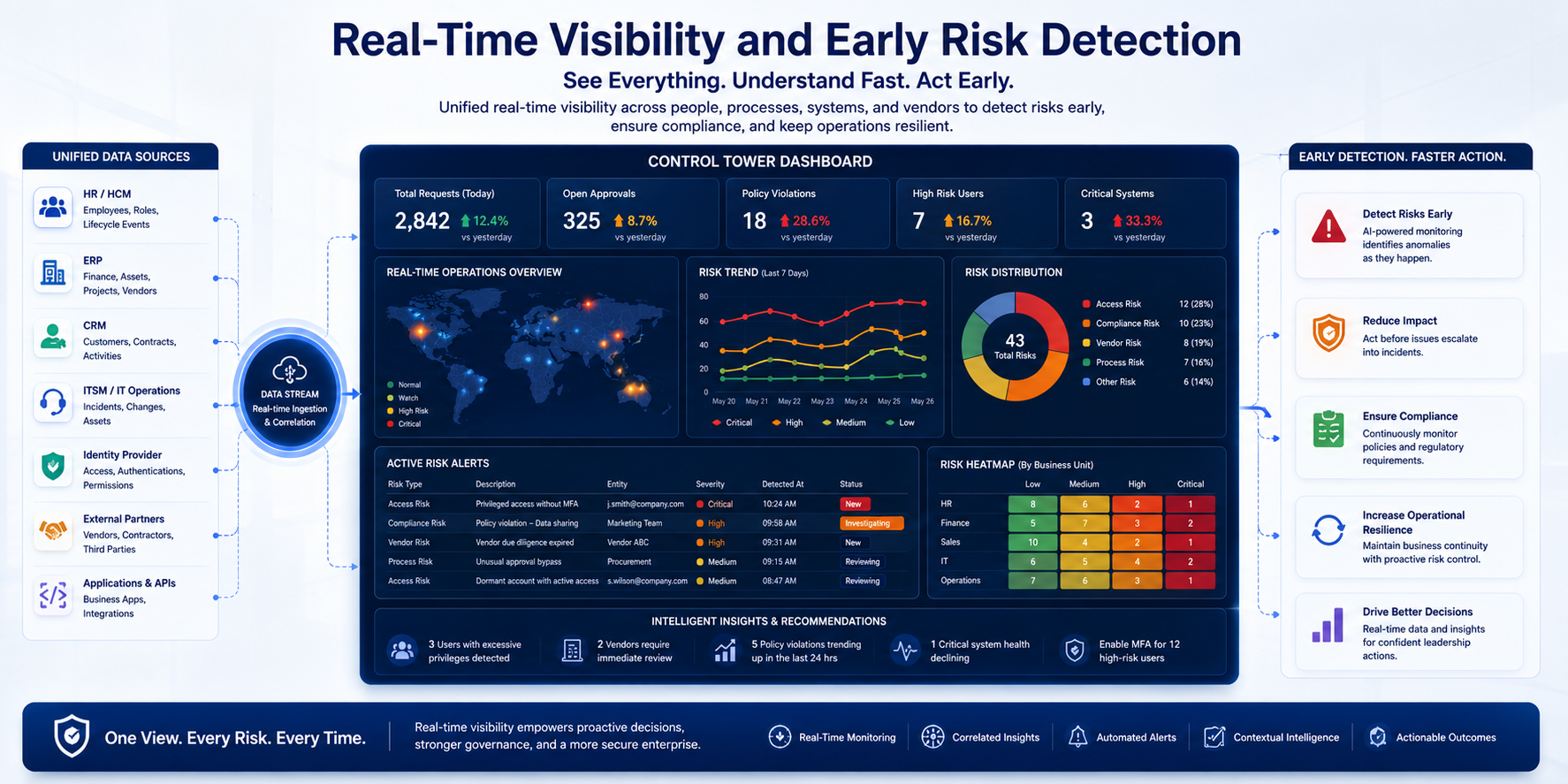
Operational resilience begins with visibility. Many disruptions become expensive because the enterprise detects them too late or understands them too narrowly. A local performance issue may appear manageable until its downstream effects reach customers, financial commitments, or compliance obligations.
BOC combines workflow status, service-level performance, exception volumes, approval delays, resource constraints, and risk indicators into a shared operational view. Leaders can identify patterns such as increasing queue times, repeated policy exceptions, concentration of approvals with one role, or a growing dependency on a constrained supplier.
The objective is not to create more dashboards. It is to provide decision-ready intelligence. A resilient operating model explains what is changing, why it matters, who owns the response, and which governed action should occur next.
Cross-Functional Coordination During Disruption
Disruption exposes the weakness of departmental operating models. Each function may respond competently within its own boundaries while the enterprise response remains fragmented. Finance protects cash, operations protects throughput, legal protects obligations, IT protects systems, and customer teams protect relationships. Without coordination, these priorities can conflict.
BOC establishes a shared operational record. Critical events are linked to affected workflows, owners, decisions, risks, and response actions. Cross-functional teams work from common facts rather than separate spreadsheets, email threads, or meetings. Leadership can see whether actions are complete, delayed, duplicated, or producing unintended consequences.
This shared model improves both speed and accountability. Teams spend less time reconciling information and more time executing the response. Decisions remain connected to enterprise priorities rather than departmental preferences.
Designing Resilient Workflows and Decision Paths
Resilient workflows are not simply automated workflows. They are designed to continue operating when assumptions change. This requires alternative routing, backup ownership, exception handling, service-level thresholds, and decision paths for non-standard conditions.
For example, a procurement workflow may normally require sequential review by a category manager, finance approver, legal reviewer, and business owner. During a supply disruption, the organization may need an accelerated path for approved categories, delegated authority for predefined spending limits, and additional risk review for new suppliers. BOC can activate these changes through policy-based controls while preserving documentation and audit history.
The same approach applies to customer onboarding, employee access, order fulfillment, contract review, incident response, and regulatory reporting. Resilience is created by designing controlled alternatives before disruption forces the organization to improvise.
AI, Automation, and Resilience Intelligence
Artificial intelligence expands the ability to identify patterns, forecast operational stress, and recommend response actions. However, AI-driven resilience depends on governed operational data. Models must learn from consistent workflow history, clearly defined outcomes, and trusted decision records.
Within BOC, AI can support anomaly detection, capacity forecasting, risk prioritization, scenario simulation, intelligent routing, and recommendation generation. An AI model may detect that approval delays and exception volumes are increasing in one region, identify the downstream processes at risk, and recommend workload redistribution or temporary authority changes.
These recommendations should not operate outside governance. Human accountability, approval thresholds, explainability, and auditability remain essential. The most resilient enterprise will not be the one with the most automation. It will be the one that combines intelligent automation with clear operational authority and responsible control.
Enterprise Scenario: Responding to a Multi-Region Disruption
Consider a global manufacturer that relies on a network of specialized suppliers across several regions. A combination of transportation disruption and a new regulatory requirement affects the availability of critical components. The issue initially appears within procurement, but it quickly affects production planning, customer delivery commitments, finance forecasts, contract obligations, and executive reporting.
Before a Governed Resilience Model
Regional teams contact suppliers independently. Procurement maintains one set of priorities while operations uses another. Customer teams receive inconsistent delivery estimates. Finance updates forecasts manually. Legal reviews exceptions through email. Executives receive delayed summaries that reflect different assumptions.
With Business Operations Center
The disruption is registered as an enterprise operational event. BOC identifies affected workflows, contracts, products, service levels, and owners. A predefined resilience playbook activates accelerated supplier review, revised approval paths, customer communication checkpoints, and executive reporting requirements. Operational dashboards track component availability, production impact, customer risk, policy exceptions, and decision status in real time.
The enterprise does not eliminate disruption, but it controls the response. Decisions are faster, dependencies are visible, customer commitments are managed consistently, and every exception remains governed. After the event, performance data is used to improve supplier diversification, workflow rules, and future readiness.
Implementation Roadmap
Phase 1: Identify Critical Outcomes
Define the products, services, obligations, and customer outcomes that must be sustained during disruption.
Phase 2: Map Operational Dependencies
Document systems, teams, suppliers, approvals, data, policies, and decision authorities connected to those outcomes.
Phase 3: Standardize Governance
Establish ownership, thresholds, escalation rules, exception controls, and delegated authority.
Phase 4: Build Operational Visibility
Create shared metrics for workflow health, service levels, risk exposure, capacity, and exceptions.
Phase 5: Design Adaptive Workflows
Configure alternative routing, emergency paths, backup roles, and policy-based automation.
Phase 6: Test and Simulate
Run disruption scenarios to validate decision speed, coordination, and control effectiveness.
Phase 7: Learn and Improve
Use operational history to strengthen controls, update playbooks, and refine resilience metrics.
Measuring Operational Resilience
Resilience should be measured as an operational capability, not only as the absence of failure. Useful indicators include:
- Time to detect emerging operational risk.
- Time to assign accountable ownership.
- Time to activate an approved response path.
- Percentage of critical workflows with tested alternatives.
- Service-level performance during disruption.
- Volume and duration of policy exceptions.
- Decision turnaround for high-priority events.
- Recovery of customer, financial, and compliance outcomes.
- Number of improvements implemented after each event.
These measures provide a more complete picture than infrastructure uptime alone. They show whether the enterprise can maintain outcomes, preserve governance, and improve through experience.
The Future of Resilient Enterprise Operations
The future enterprise will operate through a combination of human teams, intelligent agents, automated workflows, external partners, and real-time data. This operating environment will be faster and more adaptive, but also more interconnected and difficult to govern.
Resilience platforms will increasingly simulate disruption, predict operational stress, recommend alternative execution paths, and coordinate autonomous responses. Digital twins of enterprise workflows may allow leaders to test changes before activating them. AI agents may manage routine adaptations while escalating high-impact decisions to accountable leaders.
These capabilities will only create enterprise value when they operate within a trusted governance framework. BOC provides that framework by connecting intelligence to policy, decisions to authority, and automation to accountability.
Conclusion
Enterprise operational resilience is no longer a specialist continuity discipline. It is a core requirement for strategy execution, customer trust, regulatory confidence, and sustainable growth. Organizations must be able to adapt rapidly without losing control, visibility, or accountability.
Business Operations Center enables this balance. By unifying governance, workflow orchestration, operational intelligence, risk visibility, cross-functional coordination, and continuous improvement, BOC turns resilience into an everyday operating capability.
The goal is not to prevent every disruption. That is impossible. The goal is to ensure that disruption does not produce uncontrolled execution. Enterprises that build governed resilience will respond faster, protect critical outcomes, learn continuously, and convert operational uncertainty into strategic strength.