


Introduction
Operational complexity has become one of the defining realities of the modern enterprise. A single customer commitment may involve sales, finance, legal, procurement, operations, service, and technology teams. A regulatory obligation may depend on several systems, multiple approvals, external partners, and region-specific policies. Strategic initiatives often span departments that use different tools, measurement standards, and decision processes.
In this environment, leaders need more than periodic reports. They need a continuously updated understanding of how work is progressing, where risk is emerging, and which interventions are required. But visibility alone is not enough. Seeing a problem without a governed method for responding to it simply creates awareness without resolution.
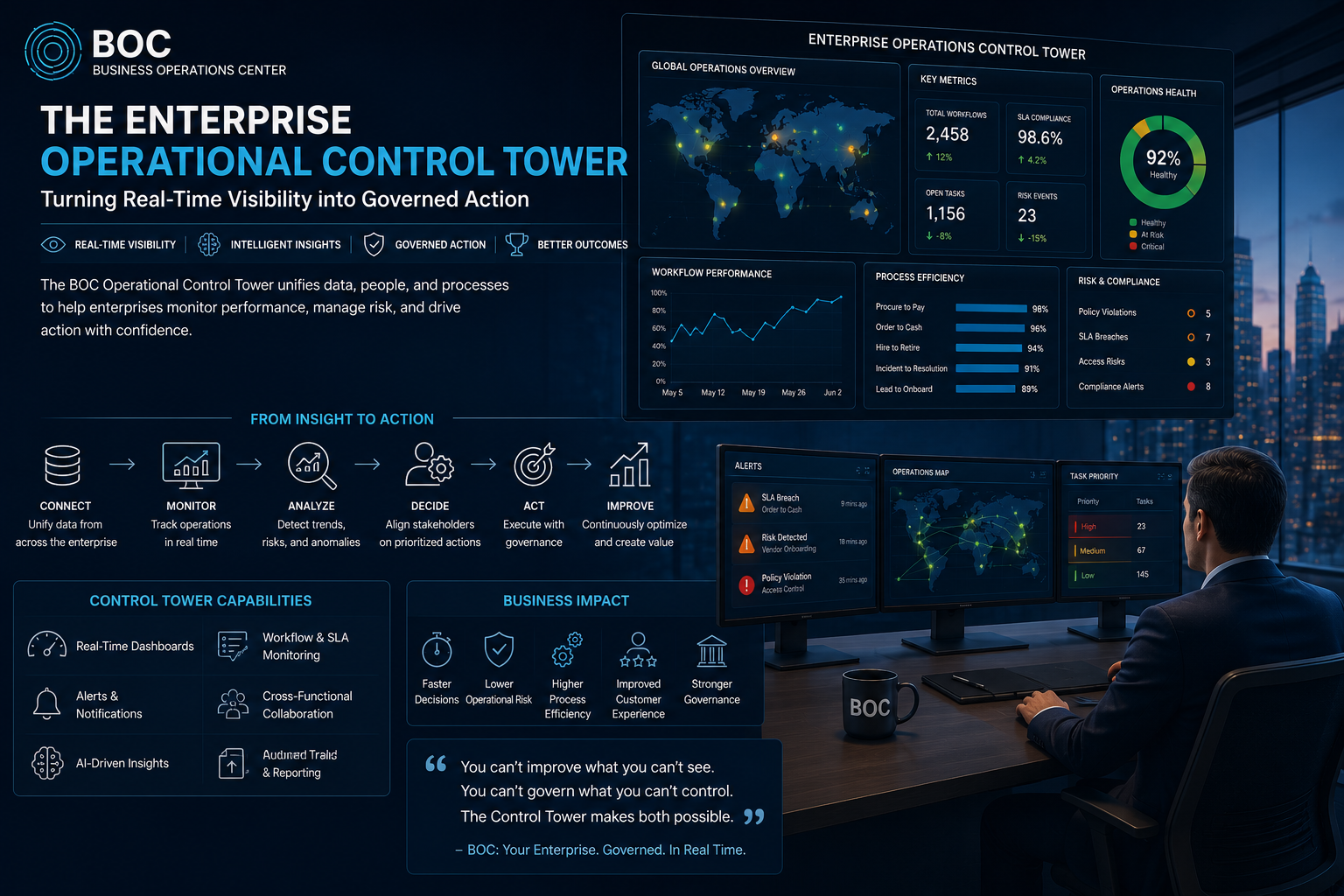
The enterprise operational control tower closes this gap. It creates a connected environment where operational events are monitored, interpreted, prioritized, and translated into accountable action. Business Operations Center enables this by linking operational intelligence directly to workflow governance.
Why Enterprise Visibility Still Fails
Most large organizations already have dashboards. They have analytics platforms, departmental reports, performance scorecards, and status meetings. Yet operational blind spots remain because visibility is fragmented by system, function, geography, and ownership.
A finance dashboard may show budget variance but not the approval bottleneck causing the variance. A service dashboard may show declining response time but not the staffing or policy issue behind it. A procurement report may identify delayed orders without connecting those delays to customer delivery commitments. Each tool presents a partial truth.
The result is a recurring pattern: teams discover issues late, investigate manually, debate ownership, and coordinate remediation through email, chat, and meetings. The enterprise has information, but it lacks an operating mechanism that turns information into action.
An effective control tower must therefore solve three problems at once: fragmented visibility, unclear accountability, and inconsistent response.
What an Enterprise Operational Control Tower Really Is
An enterprise operational control tower is not simply a central dashboard. It is a governance and execution capability that continuously connects operational signals with business context, policy, ownership, and response workflows.
At the visibility layer, it consolidates meaningful events, service levels, risks, exceptions, workload indicators, and outcome metrics. The intelligence layer, it interprets patterns, identifies anomalies, and distinguishes routine variation from material operational risk. At the governance layer, it applies policies, decision rights, escalation thresholds, and accountability. Execution layer, it launches the appropriate workflow, assigns action, tracks resolution, and records the outcome.
This layered model is what separates an operational control tower from conventional reporting. Reporting explains what happened. A control tower helps the enterprise decide what should happen next and ensures that the decision is executed.
From Dashboards to Governed Action
Traditional dashboards are passive. They present information and rely on individuals to interpret it, determine urgency, find the right stakeholders, and coordinate a response. This approach may work at small scale, but it becomes unreliable in complex enterprises.
Business Operations Center enables an active model. When a threshold is breached, the system can identify the accountable owner, apply the correct policy, create a governed case, initiate approval or remediation, notify relevant stakeholders, and maintain an auditable record of every decision.
For example, when a customer onboarding process exceeds its service-level threshold, the control tower should not merely display a red indicator. It should determine whether the delay is caused by missing documentation, a compliance review, capacity constraints, or an approval bottleneck. It should then route the issue to the correct owner, apply escalation rules, and track the corrective action through completion.
The strategic value lies in reducing the distance between insight and intervention.
The Core Capabilities of an Operational Control Tower
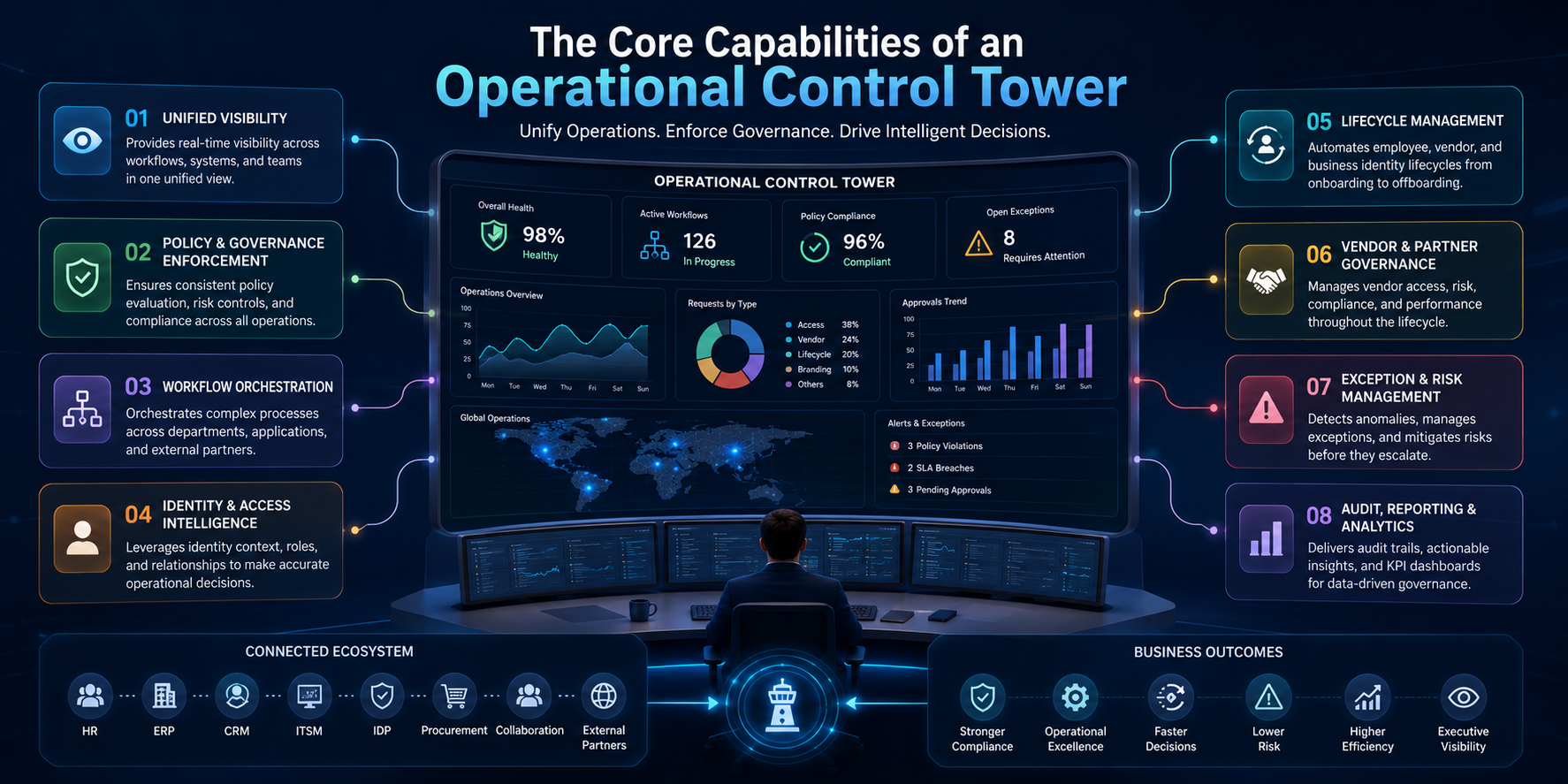
A mature enterprise operational control tower combines several capabilities that are often scattered across different tools.
First, it provides real-time operational observability. Leaders can see workflow status, service-level performance, exception volumes, risk indicators, and workload conditions across the enterprise.
Second, it establishes a common operational model. Processes, ownership structures, definitions, and performance measures are standardized so that teams interpret information consistently.
Third, it supports exception detection and prioritization. Not every delay or variance requires executive attention. The control tower distinguishes material issues from routine noise based on business impact, policy, customer commitment, risk, and strategic priority.
Fourth, it enables governed response workflows. Exceptions become structured operational cases with clear owners, due dates, escalation paths, evidence requirements, and decision records.
Fifth, it creates a continuous improvement loop. Resolution data is analyzed to identify recurring root causes, policy weaknesses, automation opportunities, and capacity problems.
Governance as the Control Mechanism
The word control in control tower should not imply centralized micromanagement. It refers to the enterprise’s ability to maintain consistent operating standards while allowing decisions to occur at the appropriate level.
Governance defines which events matter, who owns them, what thresholds trigger escalation, which approvals are required, what evidence must be captured, and how exceptions are resolved. Without this structure, the control tower becomes another visualization layer that increases awareness but does not improve execution.
BOC embeds governance into the operational response. Decision rights are explicit. Policies are connected to workflows. Escalations follow defined rules. Audit trails preserve context. This enables decentralized execution within a controlled enterprise framework.
Governance also improves speed. When teams know who can decide, what information is required, and which path to follow, they spend less time negotiating process and more time resolving the issue.
Operational Intelligence and Decision Context
Operational intelligence is more valuable than raw data because it includes context. A delayed approval may be insignificant in one workflow and business-critical in another. A small variance may indicate a serious compliance risk. A high workload may be acceptable during a planned peak but dangerous when combined with growing exceptions and declining service levels.
The control tower connects metrics with business meaning. It considers customer impact, regulatory exposure, strategic priority, financial consequence, dependency relationships, and historical patterns. This context enables better prioritization and more confident decisions.
Executive leaders also benefit from a unified view of operational health. Rather than reviewing isolated departmental reports, they can understand how execution across the enterprise affects strategic objectives. This turns operational intelligence into a decision-support capability rather than a reporting exercise.
Exception Management and Escalation
Operational excellence is not the absence of exceptions. It is the ability to detect, manage, and learn from exceptions quickly and consistently.
A strong control tower classifies exceptions according to severity, urgency, risk, customer impact, and required response. Routine issues are resolved at the team level. Significant issues are escalated to process owners. Enterprise-level risks move to executive governance forums.
Escalation must be designed carefully. Too little escalation allows critical issues to remain hidden. Too much escalation overwhelms leadership and weakens accountability. BOC supports graduated escalation based on policy and operational context.
Every exception should retain a complete history: the triggering event, relevant evidence, ownership, decisions, actions, resolution time, and outcome. This history supports audit readiness and provides the data required for continuous improvement.
Cross-Functional Coordination
Many operational failures occur at departmental boundaries. One team completes its task, but the next team does not receive the right information. Approval responsibilities are unclear. Metrics are optimized locally while enterprise outcomes deteriorate.
The operational control tower creates shared visibility and shared accountability across functions. It connects dependencies, clarifies handoffs, and enables teams to coordinate around the business outcome rather than their individual task.
For leadership, this creates a more accurate picture of enterprise execution. It reduces the need to chase updates across email, spreadsheets, and meetings. For customers, it improves consistency because internal coordination becomes more reliable.
Enterprise Scenario
Consider a global technology company that delivers complex enterprise solutions. Each customer deployment involves sales, legal, security, finance, implementation, customer success, and external partners. The company has strong systems in every function, but deployment delays are common because dependencies are difficult to see and ownership shifts across teams.
The organization implements a BOC-powered operational control tower for customer deployment. The control tower monitors contract completion, security review, resource allocation, data readiness, partner dependencies, and customer milestones. Each deployment receives a governed operational record that connects all relevant workflows.
When a security review threatens the launch date, the control tower identifies the risk, calculates the potential customer impact, assigns the issue to the security process owner, and triggers a defined escalation workflow. Leadership sees the issue in context rather than as an isolated delay. The final decision and remediation plan are captured in the operational record.
Over time, the company discovers that a large percentage of security delays originate from incomplete information collected during sales. It changes the intake process, adds automated validation, and reduces deployment cycle time. The control tower therefore delivers both immediate coordination and long-term process improvement.
Implementation Roadmap
Organizations should implement an operational control tower in stages rather than attempting to centralize every process at once.
Phase one is operational discovery. Identify the business outcomes that matter, the cross-functional workflows that influence them, the systems that generate relevant signals, and the governance gaps that currently slow response.
Phase two is common definition. Standardize process names, ownership, status definitions, exception categories, service levels, escalation rules, and outcome measures.
Phase three is visibility integration. Connect the most important operational events and metrics into a unified view. Focus on information that supports decisions rather than collecting every available data point.
Phase four is governed response. Configure workflows for exception handling, approvals, escalation, evidence collection, and closure.
Phase five is operational intelligence. Introduce pattern analysis, root-cause insights, predictive indicators, and executive decision support.
Phase six is continuous optimization. Use control-tower data to improve policies, redesign workflows, expand automation, and strengthen enterprise resilience.
Metrics That Matter
The success of an operational control tower should be measured by improved enterprise outcomes, not by the number of dashboards created.
Important operational metrics include cycle time, service-level compliance, exception volume, escalation rate, time to resolution, approval turnaround, rework, workload balance, and automation coverage.
Governance metrics include policy adherence, evidence completeness, decision traceability, audit readiness, unresolved risk, and ownership accuracy.
Strategic metrics include customer commitment reliability, revenue enablement, operational resilience, transformation execution, and the speed at which leadership can identify and respond to emerging issues.
A mature measurement model links operational performance directly to business value.
AI and the Future of Operational Control Towers
Artificial intelligence will make operational control towers more predictive and adaptive. AI can identify patterns across workflow history, detect unusual behavior, forecast service-level risk, recommend routing decisions, and surface likely root causes.
However, AI recommendations must operate within a governed framework. Enterprises need clear policies for which decisions can be automated, which require human review, what evidence must be retained, and how model recommendations are monitored.
BOC provides the governance foundation for responsible AI-assisted operations. The control tower can use AI to enhance decision quality while preserving accountability, explainability, and auditability.
The long-term direction is a hybrid operating environment in which human teams, automation, and AI agents coordinate through a common governance layer. The control tower becomes the enterprise mechanism that keeps this environment aligned with policy and strategic intent.
Common Failure Patterns
Operational control-tower initiatives often fail when organizations begin with technology rather than operating-model design. A visually impressive dashboard cannot compensate for unclear ownership, inconsistent definitions, or weak escalation rules.
Another failure pattern is excessive centralization. The control tower should enable local teams to act within enterprise standards, not route every decision to a central command group.
Organizations also fail when they collect too much data. Control towers should emphasize actionable signals, material exceptions, and business outcomes. Excessive reporting creates noise and reduces trust.
Finally, some initiatives overlook continuous improvement. A control tower that resolves incidents but does not analyze recurring causes will remain reactive. The greatest value comes when operational history is used to redesign the enterprise.
Conclusion
The enterprise operational control tower represents a major evolution in how organizations manage execution. It moves beyond fragmented dashboards and periodic reporting to create a real-time, governed mechanism for identifying issues, coordinating response, preserving accountability, and improving performance.
Business Operations Center enables this model by integrating visibility, governance, workflow orchestration, operational intelligence, exception management, and continuous improvement. It transforms operational data into structured enterprise action.
For organizations navigating increasing complexity, the strategic question is no longer whether they have enough information. It is whether they can convert that information into timely, coordinated, and governed decisions. The enterprises that build this capability will respond faster, operate more consistently, and adapt with greater confidence.