


Introduction
Operational excellence has become one of the most frequently discussed objectives within modern enterprises. Executive leadership teams consistently prioritize efficiency, agility, customer experience, governance, and digital transformation. Yet despite substantial technology investments, many organizations continue to struggle with fragmented workflows, inconsistent execution, duplicated effort, delayed approvals, and limited enterprise visibility. Business Operations Center (BOC) approaches operational excellence as a governance-first discipline where standardized workflows, measurable execution, and continuous improvement become part of everyday operations rather than occasional transformation initiatives.
Understanding Enterprise Operational Excellence
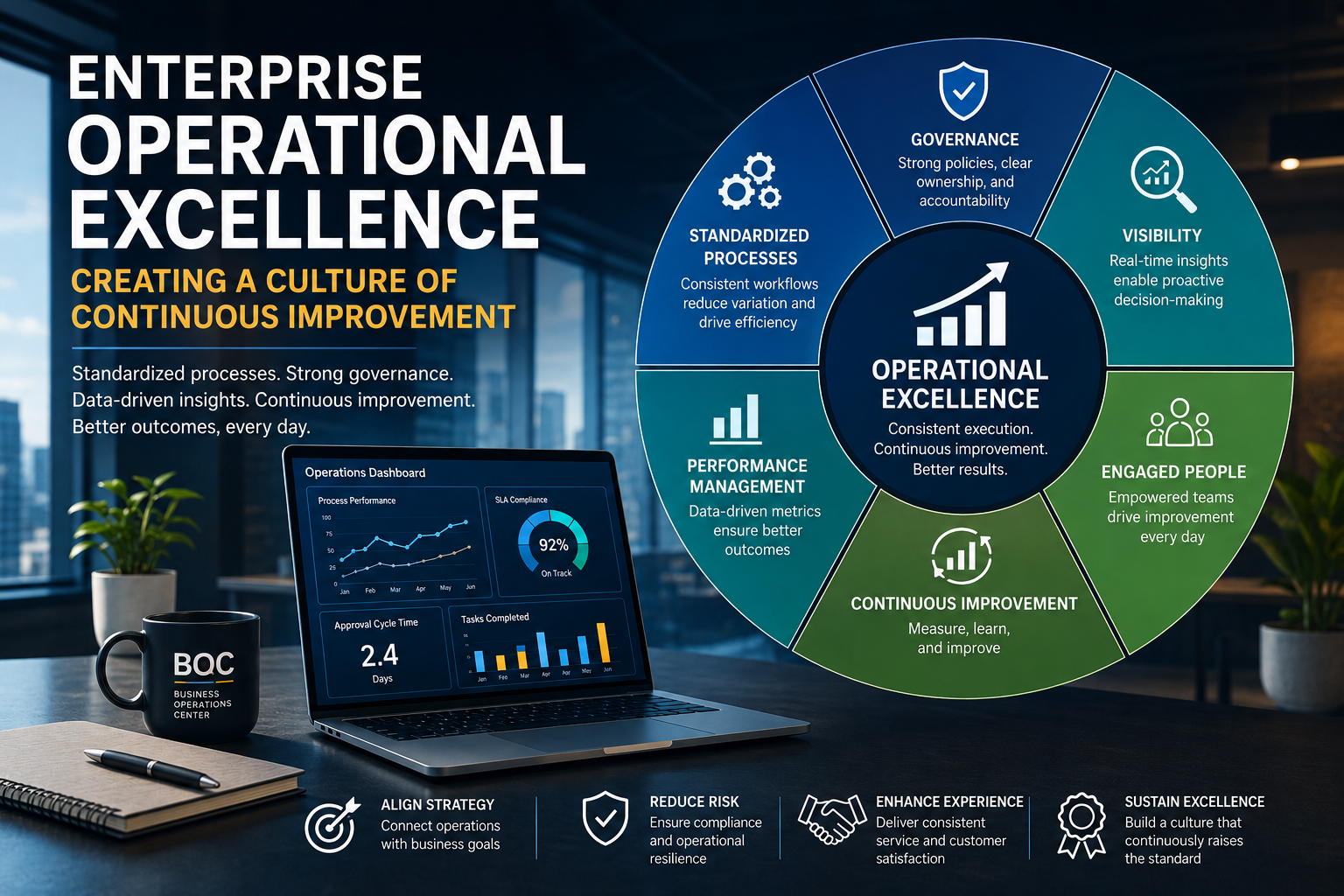
Operational excellence extends beyond process optimization. It is the ability to consistently execute enterprise operations while maintaining governance, accountability, compliance, adaptability, and continuous improvement. Organizations that achieve operational excellence standardize execution, measure enterprise performance using common metrics, clearly define ownership, and continuously refine workflows using trusted operational intelligence.
Why Operational Excellence Programs Fail
Many improvement initiatives fail because departments optimize independently. Governance remains inconsistent, operational ownership is unclear, technology implementations become isolated, and employees continue relying on manual workarounds. Sustainable improvement requires an enterprise operating model where governance supports every workflow.
Governance Before Technology
Technology accelerates existing behavior. If governance is inconsistent, automation simply increases inconsistency. Business Operations Center transforms governance policies into executable workflows so responsibilities become measurable, approvals transparent, and operational performance continuously visible.
Building Standardized Enterprise Workflows
Standardization creates consistency. Consistency enables measurement. Measurement drives continuous improvement. BOC establishes common workflow principles while allowing departments enough flexibility to address unique business requirements. Enterprise reporting becomes reliable because operational data originates from governed execution.

Creating a Culture of Continuous Improvement
Operational excellence becomes sustainable only when employees actively participate in improvement. Organizations should encourage identification of bottlenecks, documentation of best practices, governance reviews, and workflow optimization based on operational evidence. Transparency encourages accountability while standardized workflows simplify organization-wide adoption of improvements.
Leadership’s Role
Executive leadership defines strategic priorities and governance expectations. Operational leaders translate strategy into governed execution while managers monitor performance, remove bottlenecks, and coach employees. BOC provides executives with a unified operational view built upon standardized enterprise execution instead of disconnected departmental reports.
Measuring Continuous Improvement
Organizations should monitor workflow completion rates, approval cycle times, SLA compliance, bottleneck frequency, policy exceptions, audit readiness, employee productivity, customer fulfillment performance, and operational improvement initiatives. These measurements should support organizational learning and evidence-based decision making.
Artificial Intelligence and Operational Excellence
Artificial intelligence requires trusted operational data. Standardized workflows governed by BOC provide the structured data necessary for predictive analytics, intelligent routing, anomaly detection, workload forecasting, and decision support. Governance ensures AI recommendations remain reliable and aligned with enterprise policy.
Enterprise Example
A multinational organization operating independent regional processes implements Business Operations Center to standardize workflow governance across HR, finance, procurement, and operations. Approval hierarchies become consistent, operational reporting becomes standardized, compliance improves, customer experiences become more consistent, and enterprise leadership gains trusted operational intelligence.
Common Mistakes
Organizations often focus solely on technology, automate inefficient workflows, maintain inconsistent metrics, or treat operational excellence as a temporary project. BOC embeds continuous improvement directly into operational execution through governance-first workflow management.
Future of Operational Excellence
As enterprises increasingly adopt AI, predictive analytics, and intelligent automation, governance will become even more important. Organizations with standardized workflows and measurable execution will adopt future innovations faster because their operational foundation already supports consistency and transparency.
Conclusion
Enterprise operational excellence is achieved through governance, standardized workflows, operational visibility, measurable performance, and continuous improvement. Business Operations Center enables organizations to transform fragmented operations into resilient, continuously improving enterprise execution systems that support sustainable long-term growth.