


Introduction
Every enterprise eventually encounters disruption. Growth, regulatory change, cyber threats, supplier issues, mergers, and changing customer expectations all place pressure on operational execution. Operational resilience is no longer limited to disaster recovery. It is the ability to anticipate disruption, absorb change, adapt quickly, and continue delivering business value without compromising enterprise governance, compliance, or customer experience. Business Operations Center (BOC) provides a governance-first operational framework that embeds resilience into everyday execution rather than treating it as an emergency capability.
Why Operational Resilience Matters
Modern enterprises rely on interconnected people, processes, partners, and technologies. When operations depend on manual coordination, undocumented procedures, or individual knowledge, even minor disruptions can create significant business impact. Resilient organizations build standardized workflows that continue operating despite personnel changes, technology upgrades, policy revisions, or market disruption.
Beyond Business Continuity
Business continuity focuses on recovering from major incidents. Operational resilience focuses on preventing routine operational failures while ensuring business processes remain dependable every day. Governance, workflow, enterprise process orchestration, approval management, operational visibility, and continuous improvement become permanent organizational capabilities rather than temporary crisis responses.
Common Sources of Operational Fragility
Many organizations struggle with approval bottlenecks, disconnected systems, inconsistent policies, manual reporting, duplicated work, isolated departmental metrics, and limited executive visibility. These weaknesses increase operational risk and reduce organizational agility. Standardized enterprise workflows eliminate many of these hidden dependencies.
Governance as the Foundation
Governance defines ownership, accountability, approval authority, escalation rules, compliance requirements, and operational standards. Technology alone cannot create resilience. BOC transforms governance policies into executable workflows so every business activity follows enterprise-approved operating principles while remaining fully measurable and auditable.
Operational Resilience Across the Enterprise

HR benefits from standardized onboarding and offboarding. Finance gains approvals and audit readiness. Procurement improves supplier governance-driven operating and purchasing consistency. IT aligns change management with business priorities. Customer operations receive end-to-end visibility across service delivery. Every department contributes to a coordinated enterprise operating model.
The Role of Business Operations Center
Business Operations Center becomes the operational coordination layer connecting ERP, CRM, HR, procurement, finance, collaboration platforms, and enterprise workflow automation. Managers gain real-time operational visibility. Executives receive trusted operational intelligence. Compliance teams access complete audit histories. Operational teams identify bottlenecks before they affect business outcomes.
Measuring Operational Resilience
Organizations should monitor workflow completion rates, SLA compliance, approval cycle times, operational bottlenecks, policy exceptions, audit readiness, customer fulfillment performance, resource utilization, and continuous improvement initiatives. These metrics allow leaders to evaluate resilience using consistent enterprise-wide operational data.
Preparing for Continuous Change
Organizations continuously adopt new technologies, regulations, products, and operating models. A governance-driven operational framework allows change without disrupting execution. Instead of redesigning processes repeatedly, enterprises adjust governance policies while preserving standardized workflows and operational consistency.
Conclusion
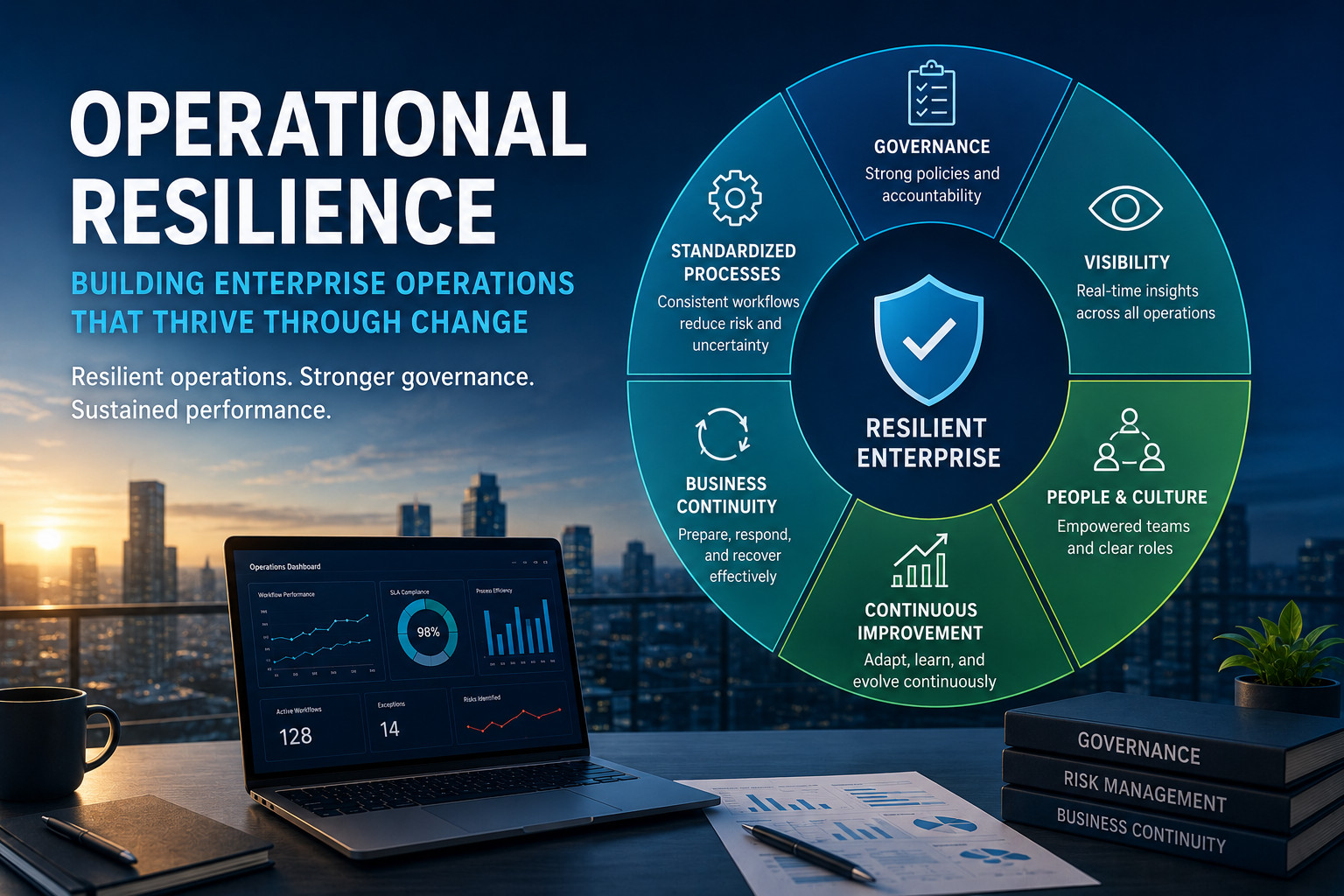
Operational resilience is achieved through disciplined governance, standardized workflows, operational intelligence, enterprise visibility, and continuous improvement. Business Operations Center enables organizations to build resilient enterprise operations capable of adapting confidently while maintaining governance, accountability, and sustainable long-term performance.