
Introduction
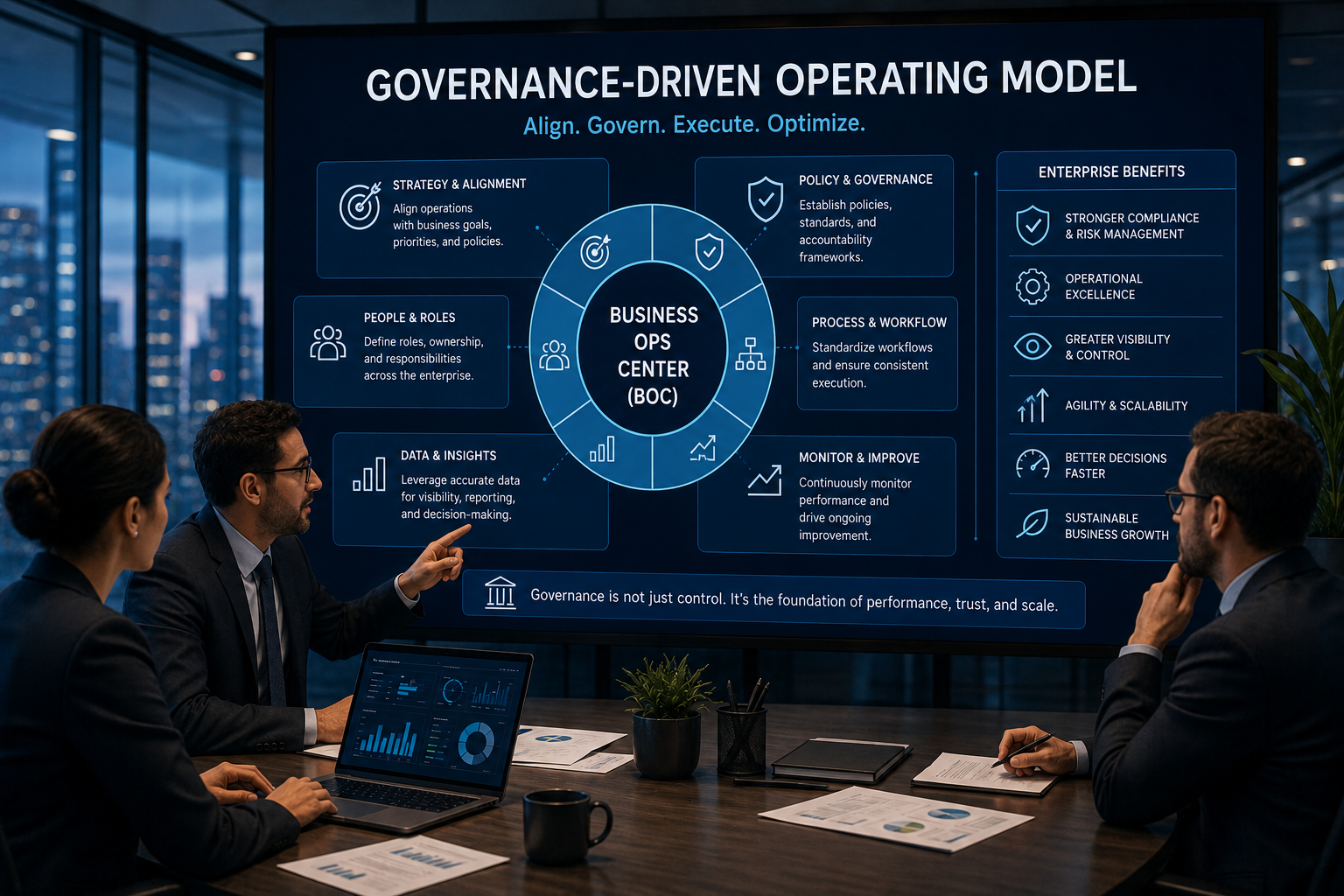
Every successful enterprise depends on a consistent operating model that aligns people, technology, policies, and decision-making. As organizations grow, operational complexity increases across departments, business units, vendors, and geographic regions. Without governance, teams develop independent workflows, creating operational silos, inconsistent reporting, delayed approvals, and compliance risks. Business Operations Center (BOC) addresses these challenges by establishing a governance-first operational framework that standardizes execution while preserving business agility.
A governance-driven operating model ensures work follows enterprise-approved processes rather than departmental preferences. Every approval, task, escalation, and business decision becomes traceable, measurable, and continuously improvable.
Why Governance Matters

Governance provides clarity regarding:
- Ownership
- Responsibilities
- Approval authority
- Service expectations
- Compliance obligations
- Operational accountability
Organizations that lack governance often rely on manual coordination, email approvals, undocumented procedures, and individual knowledge. As business complexity grows, these informal practices become operational risks. Standardized governance reduces uncertainty and enables predictable execution.
Challenges with Traditional Models
Traditional operating models frequently evolve through acquisitions, rapid growth, and isolated technology implementations. Departments optimize locally while enterprise coordination weakens.
Common challenges include:
- Employees spend valuable time following up on approvals.
- Reconciling conflicting information.
- Manually transferring data between systems.
- Leadership struggles to obtain trusted operational metrics because each team measures performance differently.
The BOC Approach
Business Operations Center functions as the operational coordination layer that connects enterprise workflows, approvals, policies, and reporting.
Existing enterprise applications continue performing their specialized functions while BOC governs how operational work flows between them. This approach improves visibility without requiring organizations to replace core business systems.
Core Components
A governance-driven operating model includes:
- Standardized workflows
- Role-based ownership
- Policy-driven approvals
- Workflow orchestration
- SLA monitoring
- Audit trails
- Exception management
- Enterprise reporting
- Operational analytics
- Continuous improvement
These capabilities transform fragmented execution into coordinated enterprise operations.
Benefits
Organizations adopting governance-driven operating models experience:
- Improved compliance
- Stronger accountability
- Faster approvals
- Reduced operational risk
- Greater transparency
- Higher employee productivity
- Improved customer experience
- More reliable executive decision-making
Because workflows become standardized, future automation initiatives become easier to implement and scale.
Implementation Strategy
Implementation should begin with cross-functional business processes such as:
- Onboarding
- Procurement
- Contract approvals
- Vendor governance
- Operational change management
- Compliance reviews
Organizations should:
- Document current execution.
- Define ownership.
- Standardize governance policies.
- Establish KPIs.
- Integrate enterprise systems.
- Continuously optimize using operational analytics generated by BOC.
Conclusion
Operational excellence begins with governance rather than technology alone. Business Operations Center enables enterprises to build a governance-driven operating model that connects people, systems, workflows, and decisions into a unified operational ecosystem capable of supporting long-term growth and digital transformation.