


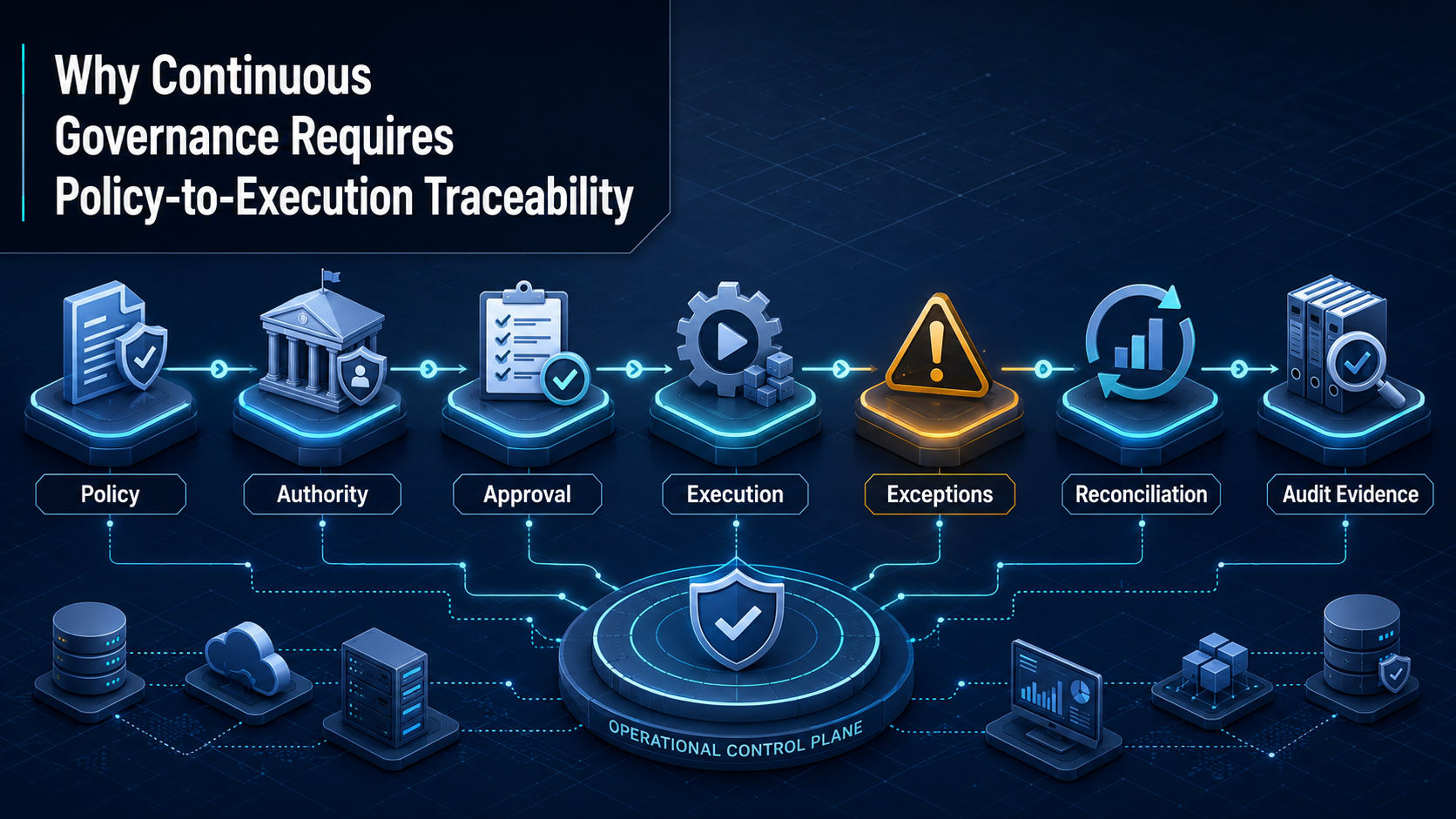
Governance Is Only Defensible When Execution Can Be Traced
Enterprise policies often appear complete at the point of approval. They define who may request an action, who may authorize it, which thresholds apply, what evidence is required, and what outcome is acceptable. Yet policy language alone does not prove that the enterprise executed the rule. Once work moves through CRM, HRIS, identity, procurement, ERP, workflow, vendor, and fulfillment systems, the connection between the governing decision and the final operational result can disappear.
That gap is more than an audit inconvenience. It creates a control weakness. A request may carry an approval, but the approved version may not match the version released downstream. An approver may be identifiable, but the enterprise may not be able to demonstrate the authority held at the decision time. A supplier may complete an order, but the delivered outcome may differ from the specification, destination, or identity attributes that were authorized.
Business Ops Center closes this gap by establishing policy-to-execution traceability. BOC keeps the policy basis, authority context, approved intent, released actions, exceptions, corrections, and reconciled outcome connected as one governed business event. Continuous brand governance becomes defensible because the organization can prove not merely that controls exist, but that those controls shaped actual execution.
What Policy-to-Execution Traceability Means
Policy-to-execution traceability is the ability to follow a business obligation from the rule that governs it through every decision and operational action required to complete it. The trace answers a coherent set of questions: Which policy applied? Which version was effective? What data qualified the request? Who possessed authority? Exactly what was approved? Were actions released, and what? What changed? How were exceptions resolved? Did the final result match authorized intent?
Traceability is not the same as collecting activity logs. Logs show that technical events occurred. They rarely establish why those events were permitted or whether their combined outcome satisfied the enterprise obligation. A defensible trace requires business semantics: policy references, decision capacity, version identity, material-change rules, control checkpoints, exception dispositions, and closure evidence.
Nor does traceability mean forcing all work into a single application. Enterprise execution excellence will remain distributed. BOC operates as the control layer above those applications, carrying a persistent correlation identity and governance context across them. Each system can continue performing its specialized role while the enterprise preserves an end-to-end account of authorized intent and actual outcome.
Where the Policy-to-Execution Chain Breaks
The chain usually breaks at transitions: from policy to configuration, from request to approval, from approval to release, from internal workflow to external provider, and from execution status to business closure. Each transition can preserve technical data while losing governance meaning.
- Policy translation gaps: written rules are converted into workflow conditions without a durable reference to the approved policy version or rationale.
- Authority context gaps: systems retain an approver name but not the role, delegation, threshold, entity, geography, or conflict conditions that made the decision valid.
- Version gaps: approval applies to one set of values while a later or enriched payload is released downstream without targeted revalidation.
- Correlation gaps: CRM, HRIS, ERP, identity, ticketing, and supplier records use different identifiers, preventing reconstruction of one business event.
- Exception gaps: corrections occur in email, spreadsheets, service desks, or vendor portals and become detached from the original approval and obligation.
- Closure gaps: a local status such as completed, shipped, synchronized, or closed is treated as proof even though the final outcome was never reconciled with authorized intent.
These gaps are difficult to detect through periodic control testing because most transactions look normal inside each application. The weakness appears only when the enterprise examines the complete chain. Continuous governance therefore requires a control model that survives boundaries rather than a collection of locally compliant steps.
The Persistent Business Event as the Traceability Spine
BOC organizes the trace around a persistent business event. The event represents the obligation the enterprise is trying to fulfill—for example, onboarding an employee, changing a customer-facing identity, opening a location, approving a purchase, modifying access, or completing a governed order. It is not replaced when work moves to another system or party.
The event records the original request, subject, scope, policy version, qualifying data, risk classification, decision authority, approved values, dependencies, downstream identifiers, acknowledgements, exceptions, recovery actions, and final evidence. New records do not overwrite the historical basis. They extend the event with versioned state and explain why execution remained permitted after each material change.
This model creates a traceability spine across systems. A CRM opportunity, HRIS employee record, identity object, business card procurement requisition, ERP purchase order, supplier order, shipment, and fulfillment confirmation can remain connected to one governed intent. Operators no longer need to infer relationships from timestamps, names, or manually maintained spreadsheets.
The Seven Capabilities of Policy-to-Execution Traceability
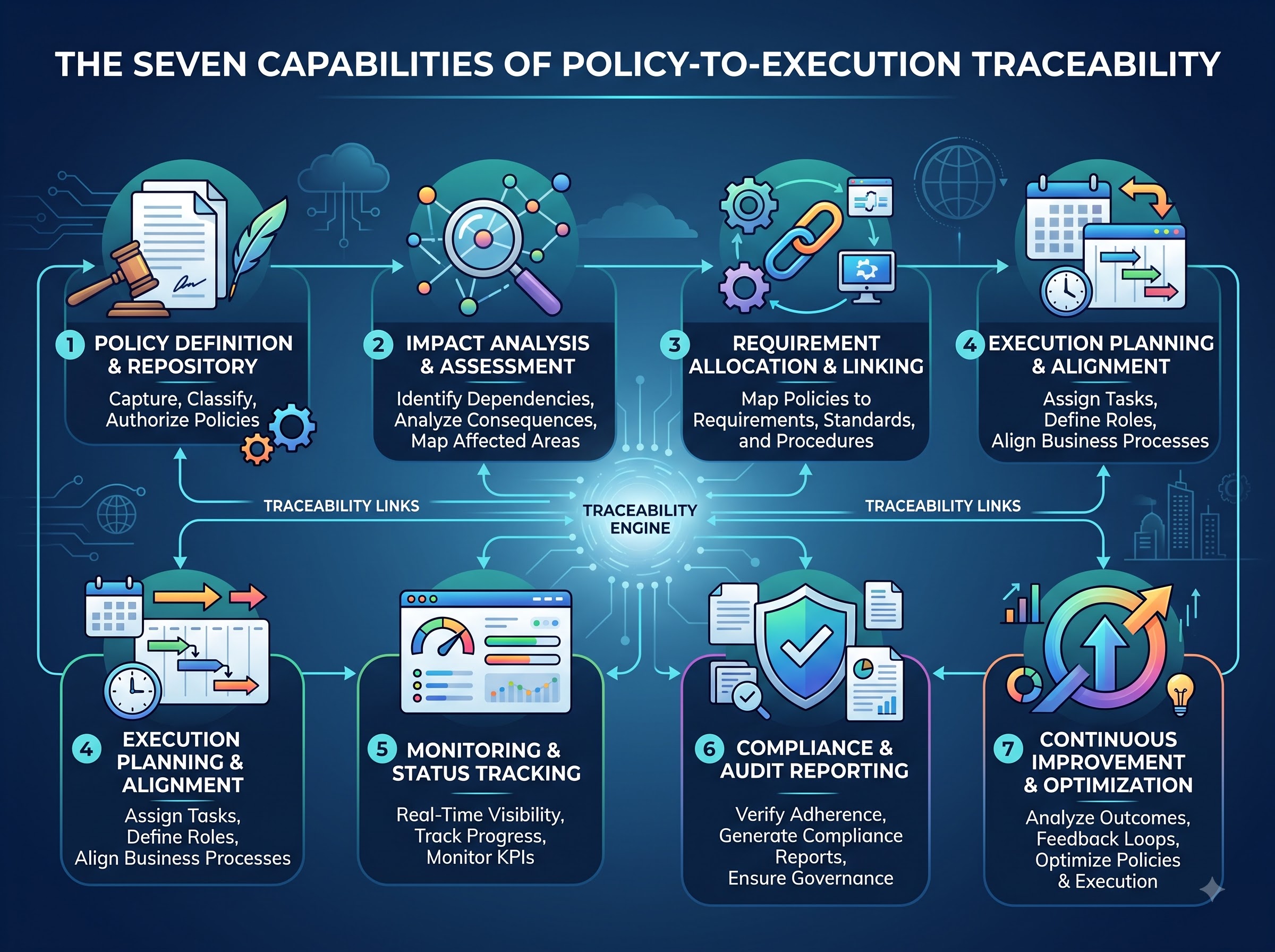
Policy identity and effective dating. Every decision references the governing rule, approved version, effective period, scope, and relevant control requirements.
Contextual authority evidence. The trace preserves not only who approved, but the capacity, delegation, threshold, entity, geography, conflict checks, and expiry conditions that validated authority.
Immutable approved-intent versions. The exact data and specification authorized for release remain distinguishable from earlier requests and later changes.
Cross-system correlation. A durable event identifier connects internal workflow records, downstream transactions, vendor acknowledgements, exceptions, and fulfillment evidence.
Material-change control. BOC compares changed values with approved intent and applies policy-defined tolerances, targeted revalidation, or full reapproval.
Governed exception lineage. Every deviation remains linked to its cause, owner, permitted resolution, approval requirement, corrective action, and recovered outcome.
Outcome reconciliation and closure. Closure requires proof that actual execution matched approved intent, fell within an accepted tolerance, or received an explicitly authorized alternate disposition.
Traceability Checkpoints Across the Operational Lifecycle
| Lifecycle point | Traceability question | Control response | Evidence retained |
| Policy selection | Which rule applies to this event and context? | Resolve scope, version, effective date, and controls | Policy ID, version, basis, qualifying facts |
| Authorization | Was this exact version approved by sufficient authority? | Validate decision capacity and freeze approved intent | Approver, authority context, version, timestamp |
| Release | Does the outbound action still match approved intent? | Compare payload, dependencies, and material changes | Released version, payload hash, destinations, IDs |
| Execution | Can every downstream action be correlated to the obligation? | Monitor acknowledgements, states, retries, and parties | Responses, system IDs, state history, custody |
| Exception | Did recovery preserve or renew authorization? | Classify, assign, correct, reapprove, and verify | Cause, owner, resolution, approvals, recovery |
| Closure | Does the actual outcome satisfy the authorized obligation? | Reconcile and validate required evidence | Comparison, tolerance, disposition, completion proof |
How Traceability Changes Enterprise Operations
For operations teams, traceability replaces reconstruction with immediate context. When work stalls or changes, operators can see the approved intent, current authority basis, released actions, dependencies, and permitted recovery paths. Resolution becomes faster because the team does not need to assemble evidence from email, tickets, portals, and application logs before deciding what may happen next.
For IT and integration teams, BOC distinguishes technical observability from business accountability. Monitoring can show whether an API call succeeded; the trace shows whether the correct version was sent, whether duplicate release was prevented, whether a retry remained authorized, and whether the downstream result fulfilled the business obligation.
For risk, compliance, and audit teams, the control population becomes testable from end-to-end evidence. Reviewers can select an event and follow the complete decision and execution chain without relying on unsupported joins or screenshots. They can also identify patterns—such as recurrent changes after enterprise approval workflow, concentrated overrides, missing supplier evidence, or weak reconciliation—that reveal structural control problems.
For business leaders, traceability strengthens change velocity. Systems, suppliers, operating models, and organizational structures can evolve without losing accountability because governance context is not trapped inside one configuration. The enterprise can change execution components while preserving the meaning and evidence of the obligation.
Metrics That Reveal Traceability Health
A traceability program should measure whether policy, authority, execution, and outcome remain connected—not simply whether records exist. Useful metrics expose where governance meaning is lost and where remediation will improve both control and throughput.
- Policy attribution rate: percentage of governed events linked to a specific effective policy version.
- Authority-context completeness: percentage of decisions with evidence of role, delegation, threshold, scope, and conflict validation.
- Approved-to-released version match: proportion of outbound actions matching the authorized data and specification without unexplained variance.
- Cross-system correlation coverage: percentage of required downstream records and acknowledgements linked to the persistent event.
- Material-change revalidation rate: consistency with which significant post-approval changes receive the required decision.
- Exception lineage completeness: percentage of deviations with cause, owner, permitted disposition, corrective action, and verified recovery.
- Reconciled closure rate: percentage of events closed with outcome evidence rather than a local administrative status alone.
Metrics should be interpreted together. High policy attribution with low version-match performance indicates that rules are identified but not reliably carried into execution. Strong correlation with weak reconciliation means the enterprise can find its records but still cannot prove the outcome. BOC retains event-level evidence so leaders can distinguish documentation gaps from genuine execution failures.
Implementation Priorities for Enterprise Leaders
Choose high-consequence obligations. Start with cross-system governance coordination events where an authorization or outcome mismatch would create material operational, financial, security, customer, or compliance impact.
Define the canonical intent record. Identify the exact values, policy references, authority conditions, specifications, and evidence that must be frozen at approval.
Create the correlation model. Connect source, workflow, application, ERP, supplier, fulfillment, exception, and reconciliation identifiers to one persistent event.
Classify material change. Define which changes may proceed within tolerance, which require targeted validation, and which invalidate prior authorization.
Govern recovery. Specify owners, time objectives, permitted corrective actions, segregation requirements, reapproval triggers, and evidence standards for every material exception class.
Make closure evidentiary. Require a verified match, accepted tolerance, or authorized alternate disposition before the obligation can close.
Use findings to improve design. Turn recurrent trace breaks into changes to policy, data ownership, workflow, integration contracts, supplier obligations, and control monitoring.
Implementation should be incremental but architecturally consistent. One high-value event can establish the identifier, versioning, authority, exception, reconciliation, and evidence patterns that later extend across other workflows. The objective is not a new reporting archive. It is a reusable control fabric that keeps policy and execution connected while work is active.
Questions Enterprise Buyers Should Ask
- Can the platform preserve the exact policy version and facts used to qualify each event?
- Does it prove the authority held at decision time rather than retaining only an approver identity?
- Can it distinguish requested, approved, released, corrected, and fulfilled versions of the same obligation?
- Does one persistent identifier correlate workflow, application, supplier, exception, and outcome records?
- Can material changes trigger precise revalidation without restarting unaffected work?
- Do exception actions remain linked to original intent and permitted resolution paths?
- Does closure require reconciliation evidence that proves the final result?
- Can operations, audit, IT, risk, and leadership examine the same coherent event record?
From Documented Policy to Provable Operational Reality
Post 61 established continuous governance as the capability that keeps policy, authority, ownership, controls, and evidence aligned as enterprise conditions change. Policy-to-execution traceability is the mechanism that makes that governance provable. It preserves a complete line of sight from the governing rule to the final operational result.
Business Ops Center turns that line of sight into an active control. Policy is identified and versioned. Authority is validated in context. Approved intent is frozen. Released actions are correlated. Material changes are evaluated. Exceptions remain owned and evidenced. Actual outcomes are reconciled before closure. The trace is therefore not a retrospective narrative; it is the operating structure through which governed work proceeds.
The result is enterprise accountability that survives complexity. Organizations do not have to choose between distributed execution and centralized control. They can keep specialized systems and providers while BOC preserves the persistent event, governance meaning, and evidence chain required to demonstrate that authorized intent became operational reality.
If your enterprise cannot follow a governed obligation from policy and authority through downstream execution and final outcome, it cannot fully prove that control intent became operational reality. Explore how Business Ops Center can create policy-to-execution traceability across CRM, HRIS, identity, procurement, ERP, workflow, supplier, and fulfillment systems.